Listen to this podcast in the app for free: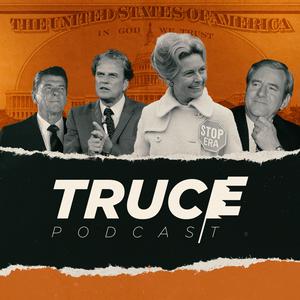 Download for free in the App Store
radio.net
Sleep timer
Save favourites
207 episodes
Republicans and Evangelicals: Bill Bright, Campus Crusade, and Cru
16/12/2025 | 53 mins.
Give to help Chris continue to make Truce William R. “Bill” Bright was born in 1921 in Coweta, Oklahoma. Though raised in a religious environment, he initially pursued business success and personal ambition. While attending the University of Southern California, Bright experienced a dramatic spiritual transformation through the influence of Christian leaders like Henrietta Mears. This encounter led him to surrender his life to Jesus Christ and ultimately shaped his calling toward full-time evangelism. In 1951, Bill and his wife, Vonette, founded Campus Crusade for Christ at UCLA with a vision to reach college students with the Gospel. He later developed The Four Spiritual Laws, a simple evangelistic tract that became one of the most widely distributed Christian tools in history. Under his leadership, Campus Crusade grew into a global movement with ministries focused on students, athletes, families, the military, and professionals. Bright also launched the Jesus Film Project in 1979, which became one of the most-translated and widely viewed films in the world. What's missing from most short bios of Bright is the depth of his involvement in the Religious Right. He organized or was present at some of their key gatherings, founded a publishing house to print their words, and raised funds among them. Bill Bright remained dedicated to fulfilling the Great Commission, often engaging in long periods of fasting and prayer for spiritual guidance. He received the prestigious Templeton Prize in 1996 for his contributions to religion and reinvested the award into Christian ministry. When he died in 2003, Campus Crusade for Christ had expanded into nearly every nation, with thousands of staff and volunteers sharing the Gospel worldwide. Bright’s life stands as a testament to the global impact one person can have through faith, vision, and relentless obedience to God’s call. My guest for this episode is historian John G. Turner, author of Bill Bright and Campus Crusade for Christ: The Renewal of Evangelicalism in Postwar America. Sources: Bill Bright and Campus Crusade for Christ: The Renewal of Evangelicalism in Postwar America by John G. Turner The Evangelicals by Frances Fitzgerald Reaganland by Rick Perlstein God as Capitalist: Seminar Promotes Religion and Riches by Russell Chandler. Los Angeles Times (1923-1995); Jun 1, 1981; starts on page B3. Accessed via ProQuest (thanks to the Teton County Library for access!) Tract: The Four Spiritual Laws The Politics of Rage by Dan T. Carter The Invisible Bridge by Rick Perlstein Before the Storm by Rick Perlstein God's Own Party by Daniel K. Williams One Nation Under God by Rus Walton (page numbers mentioned in the episode correspond to the 1993 paperback edition). I also used the 1987 version from archive.org Birchers by Matthew Dallek In the Spirit of '76, published by Third Century Publishers Inc. Jimmy Carter, the Politics of Family, and the Rise of the Religious Right by J. Brooks Flippen The 700 Club's coverage of the "Washington for Jesus Rally" Also, my guest, Dave Hopping, used to be in the comedy duo "Dave and Brian". They were pretty big! Here is one of their videos. Discussion Questions: Have you read The Four Spiritual Laws? How has Campus Crusade/ Cru impacted your life? The life of your loved ones? What threats did Bright perceive to American Christians? Where was he right? Where was he wrong? What did you think of Rus Walton's book One Nation Under God? Was Bright part of the Religious Right? To what degree? Learn more about your ad choices. Visit podcastchoices.com/adchoices
Republicans and Evangelicals I Jerry Falwell (part 2)
02/12/2025 | 36 mins.
Give to help Chris make more Truce The New Right had a plan--to bring evangelical Christians together as a voting bloc. But how to do that? They chose a few targets, people with big followings, and courted them. Jerry Falwell was an obvious choice. He was a fundamentalist preacher, televangelist, and the founder of Liberty University. He also had a propensity for the dramatic, seeing the end of days around every corner. The New Right did not like President Jimmy Carter and did their best to turn evangelicals against him. A big job considering that Carter was an evangelical and often talked about his faith. Still, they wanted Ronald Reagan (a divorced actor with a reputation with the ladies) to be their man. In this episode, Chris is joined by author and historian Rick Perlstein. Sources Reaganland by Rick Perlstein article about Reinhold Niebuhr God's Own Party by Daniel K. Williams The Evangelicals by Frances Fitzgerald Listen, America! by Jerry Falwell Discussion Questions What was the role of the New Right in recruiting religious people? Why was Falwell an ideal candidate for the New Right? A higher percentage of evangelicals voted for Nixon than for Reagan. So why do we talk so much about Reagan as a turning point? What was the Moral Majority? How do we see groups like them operating today? Learn more about your ad choices. Visit podcastchoices.com/adchoices
Republicans and Evangelicals I Jerry Falwell (part 1)
18/11/2025 | 40 mins.
Give to help Chris make Truce Jerry Falwell was a prominent American pastor, televangelist, and conservative political activist whose life and ministry had a significant impact on American evangelicalism and politics. Born on August 11, 1933, in Lynchburg, Virginia, Falwell grew up in a family that was not particularly religious. However, after becoming a Christian during his college years, he dedicated his life to ministry. He attended Baptist Bible College in Missouri, where he developed the theological convictions that would shape his future work. In 1956, at the age of 22, he returned to his hometown to found the Thomas Road Baptist Church, beginning his long journey as a spiritual and cultural leader. Falwell’s ministry expanded rapidly through the use of media. He launched the “Old-Time Gospel Hour” television program, which gained national attention and allowed him to reach millions of viewers. His style combined traditional evangelical preaching with a strong emphasis on conservative values. The success of his broadcast ministry helped him establish a broad base of support and financial backing, enabling the growth of both his church and other initiatives. By the 1970s, Falwell had become one of the most recognizable faces of American evangelicalism. In 1971, Falwell founded Liberty University in Lynchburg. Perhaps Falwell’s most politically influential move came in 1979 with the founding of the Moral Majority, an organization that mobilized conservative Christians to become involved in American politics. Through the Moral Majority, Falwell encouraged evangelicals to support Republican candidates who aligned with their views on issues like abortion, school prayer, and family values. The group played a crucial role in the election of Ronald Reagan in 1980, signaling a new era of religious involvement in American political life. Falwell's efforts helped to solidify the alliance between evangelical Christians and the Republican Party that persists to this day. Falwell’s outspoken views often sparked controversy. He was a staunch opponent of abortion, LGBTQ rights, and the feminist movement, and he frequently spoke out against what he saw as the moral decline of American society. Critics accused him of promoting intolerance and mixing religion with politics in divisive ways. Nevertheless, his supporters praised him for standing up for biblical principles and being unafraid to speak his mind in a secularizing culture. Falwell saw himself as a defender of traditional American and Christian values, even as the country grew increasingly polarized. Jerry Falwell died on May 15, 2007. My guest for this episode is Daniel K Williams, author of God's Own Party. Sources: God's Own Party by Daniel K Williams American Sermons: The Pilgrims to Martin Luther King Jr. (for the Danforth sermon) I first heard the Danforth sermon mentioned on the Now and Then podcast The Evangelicals by Frances Fitzgerald Falwell: An Autobiography by Jerry Falwell Falwell's "Ministers and Marchers" sermon Discussion Questions What do you think of Danforth's sermon? Why is it important to understand that preachers have been concerned about the US since before it became a country? Why is it valuable to understand Falwell's early opposition to integration? We know that much of the season is related to education. Why is it significant that Falwell was an educator? How should we as a society adapt when a leader repents of their racism? What role did Frances Schaeffer play in shaping Falwell? Learn more about your ad choices. Visit podcastchoices.com/adchoices
Republicans and Evangelicals: Abortion
04/11/2025 | 47 mins.
Give to help Chris continue to make Truce A lot of evangelicals are now single-issue voters, and that issue is abortion. But that was not always the case. In fact, for a great deal of American history, abortion was largely seen as a Catholic issue. There are, of course, exceptions. But most evangelicals and Protestants were divided on the subject, even favoring abortion when it came to preserving the health of the mother, or in cases of rape and incest. On this episode, Chris interviews historian and author Daniel K. Williams about the history of the abortion debate in the United States. A major turning point was the availability of elective or "on-demand" abortions in places like New York. As evangelicals grew more upset with the moral decline of the country, they lumped abortion together with gay and lesbian rights fights, the proliferation of pornography, and decided that it needed to stop. Plus, big money through New Right PACs entered the field, and politicians were soon chosen on their allegiance to pro-life legislation. Sources: Defenders of the Unborn: The Pro-Life Movement before Roe v. Wade by Daniel K Williams Reaganland by Rick Perlstein The Evangelicals by Frances Fitzgerald Romper Room on YouTube CBS Sunday Morning excellent story on Sherri Chessen Article on thalidomide Oyez.org for the Supreme Court cases Church History in Plain Language by Bruce Shelley American Experience article on Comstock Laws New York Times video on the Population Bomb (good stuff!) The US Constitution Frances Shaeffer and the Shaping of Evangelical America by Barry Hankins Discussion Questions: Why was abortion considered a Catholic issue in the mid-1900s? How did the Griswold case impact the Roe case? How did changing sexual mores contribute to the pro-life movement? How did the 1970 opening of New York to elective abortions impact public opinion? What is "abortion on demand"? How did Reagan's endorsement of the HLA shift Republican politics? Was Reagan successful in helping the pro-life movement, or was he merely throwing them a bone to get votes? Learn more about your ad choices. Visit podcastchoices.com/adchoices
Republicans and Evangelicals: The Death Penalty
21/10/2025 | 45 mins.
Give to help Chris continue making Truce In the late 1960s and early 1970s, the United States went years without using the death penalty. Not a single person was killed by injection, firing squad, hanging, or electric chair. But by the late 90s, we were killing around 100 convicted criminals per year. What happened? In 1972, the Supreme Court handed down its decision Furman v. Georgia, which negated state capital punishment laws across the country. This meant that some of the worst criminals in the country were suddenly given new sentences. And Americans... lost their minds. Within just a few years, new laws were written, and the Court decided to approve many of them. The death penalty long had a prejudiced bent, disproportionately killing people of color. The NAACP worked hard to end the practice, but those efforts were soon undone as American opinions toward the death penalty abruptly changed. My special guest for this episode is Maurice Chammah, author of Let the Lord Sort Them: The Rise and Fall of the Death Penalty Sources: Let the Lord Sort Them: The Rise and Fall of the Death Penalty by Maurice Chammah The Death Penalty: An American History by Stuart Banner (an excellent source!) Reaganland by Rick Perlstein The Hijacking of American Flight 119: How D.B. Cooper Inspired a Hijacking Craze and the FBI's Battle to Stop It. by John Wigger Listen, America! by Jerry Falwell Romans 13 (and 1 for a fact check) The US Constitution September 26, 1973 (page 94 of 98). (1973, Sep 26). The Ottawa Citizen (1954-1973) Retrieved from https://wsl.idm.oclc.org/login?url=https://www.proquest.com/newspapers/september-26-1973-page-94-98/docview/2338669544/se-2 Oyez.org coverage of Furman v. Georgia Oyez.org coverage of Gregg v. Georgia https://www.youtube.com/watch?v=U4G_O_Z55fQ Pew Research data on crime Discussion Questions: What are your thoughts on the death penalty? Why was the Furman case so important? What did it decide? Should juries have guidelines when considering a death penalty case? Why is the death penalty so popular among evangelicals? Learn more about your ad choices. Visit podcastchoices.com/adchoices
More History podcasts
 British ScandalHistory, Society & Culture, Documentary
 The Rest Is HistoryHistory
 You're Dead to MeComedy, History
 EmpireHistory
 Short History Of...History
 The AncientsHistory
 ABC RewindHistory, Society & Culture, Documentary
 No One Saw It ComingHistory
 The Rest Is ClassifiedHistory
 Real DictatorsFiction, History, Drama
Trending History podcasts
 پادکست رخFiction, History
 SNAFU with Ed HelmsHistory, True Crime
 Calm History - Bedtime Sleep Stories for Education & RelaxationHealth & Wellness, History, Alternative Health, Mental Health
 Slow BurnHistory, News, Society & Culture, Documentary, Politics
 In Our Time: HistoryHistory
 WarfareHistory
 In Our Time: ScienceHistory
 The Curious History of Your HomeHistory, Society & Culture, Documentary
 Infamous AmericaHistory, Society & Culture, True Crime, Documentary
 Past LivesHistory
 Irish History PodcastHistory
 SpyCastEducation, History, News
 Dark HistoriesHistory
 Tides of HistoryHistory, Society & Culture, Documentary
 Trashy DivorcesComedy, History
 Decoding The UnknownHistory
 Hoax!History, News, Society & Culture
 SPYCRAFT 101Education, Government, History
 Most Notorious! A True Crime History PodcastEducation, History, True Crime
 Aaron Mahnke's Cabinet of CuriositiesHistory, Society & Culture
About Truce - History of the Christian Church
Truce explores the history of the evangelical church in America, from fundamentalism to pyramid schemes to political campaigns. Host Chris Staron uses journalistic tools to investigate how the church got here and how it can do better.
The current season follows the rise of the Religious Right, examining the link between evangelicals and the Republican Party. Featuring special guests like Rick Perlstein, Frances Fitzgerald, Jesse Eisinger, Daniel K. Williams, and more.
Podcast websiteListen to Truce - History of the Christian Church, British Scandal and many other podcasts from around the world with the radio.net app
Get the free radio.net app
- Stations and podcasts to bookmark
- Stream via Wi-Fi or Bluetooth
- Supports Carplay & Android Auto
- Many other app features
Get the free radio.net app
- Stations and podcasts to bookmark
- Stream via Wi-Fi or Bluetooth
- Supports Carplay & Android Auto
- Many other app features

Truce - History of the Christian Church
Scan code,
download the app,
start listening.
download the app,
start listening.
 Australia