
Listen to this podcast in the app for free: Download for free in the App Store
radio.net
Sleep timer
Save favourites
170 episodes
Tessellation Proliferation
30/10/2026 | 28 mins.We may think of tessellation as being about how to tile a flat plane but this week we reveal how repeating patterns actually occur all over the place, and can even help us solve some of nature's most complex problems.
The presenters start with the simple principal that for shapes to fill a space without leaving any gaps or overlapping, the angles in the corners have to add up to exactly 360° - which means squares, triangles and hexagons are all strong contenders. Then they try their hand at creating their own tiles, based on a technique referred to as the 'Escher' method.
If you have an everyday mystery for the team to investigate, contact them on curiouscases@bbc.co.uk.
Contributors:
Dr Katie Steckles
Prof Mark Miodownik
Dr Vince Gallo
Producer: Lucy Taylor
Executive Producer: Sasha Feachem
A BBC Studios ProductionYawn Chorus
23/10/2026 | 28 mins.We often associate yawning with being tired or bored - but this week's episode explores whether it could be a clever way to cool down our brains?
Hannah and Dara discover humans aren't the only species that yawn. From cats to chimpanzees and even fish, plenty of other vertebrates engage in this ancient behaviour which scientists believe evolved hundreds of millions of years ago. And it doesn't always happen as a spontaneous reflex to feeling tired but can also be triggered by watching other people do it.
If you have an everyday mystery for the team to investigate, contact them on curiouscases@bbc.co.uk
Contributors:
Stephen Jackson - Professor of Cognitive Neuroscience, University of Nottingham
Laura Kelley - Associate Professor in Behavioural Ecology at University of Exeter
Dr Andrew Gallup - Professor of Behavioral Biology at Johns Hopkins University
Producer: Lucy Taylor
Executive Producer: Sasha Feachem
A BBC Studios ProductionMaking Waves
16/10/2026 | 28 mins.What happens when you give water a really good shake? You might expect splashing, spilling and general aquatic chaos - but under exactly the right conditions, something much stranger can happen...
In this episode, Hannah Fry and Dara Ó Briain dive into the world of 'Faraday waves': amazing geometric patterns that, in certain circumstances, will appear on the surface of a vibrating liquid. They discover how the renowned physicist Michael Faraday accidentally discovered this remarkable phenomenon in the 19th Century; debate whether they could ever occur in a swimming pool; and find out what on earth alligators have to do with it.
Along the way, the pair encounter eerie ‘square’ seas and learn about new ways satellites are helping us to understand the ocean’s wildest waves!
If you have an everyday mystery for the team to investigate, contact them on curiouscases@bbc.co.uk.
Contributors:
Cédric Beaume - Associate Professor in Applied Mathematics at the University of Leeds
Lucy Bricheno - Group Head of Coastal Ocean at Liverpool’s National Oceanography Centre
Glynn Holt - Former Professor of Mechanical Engineering at Boston University
Producer: Lucy Taylor
Executive Producer: Sasha Feachem
A BBC Studios ProductionIdentical(ish)
09/10/2026 | 28 mins.Ever wondered how close nature can get to making a human clone? And what happens if identical twin brothers marry identical twin sisters and have babies - how similar are they? Our listener Chris has been pondering this very issue, and his question takes Hannah and Dara down another scientific rabbit hole.
Our intrepid duo consider how one fertilised egg can somehow become two babies, why those babies aren’t quite genetic photocopies, and why even identical twins gradually become more different as they grow up. They also find out how studying twins is helping scientists learn lessons about how all of us age - and explore the classic, movie-perpetuated mystery of “twin telepathy”… could there maybe, possibly, be something to it?!
There’s also just time to address the tricky issue of cloning. From Dolly the sheep to regenerative medicine, cloning science has paved the way for some serious breakthroughs; but could we ever clone a human? And more to the point, should we?
Expect sheep, sci-fi, identical cousins, and a dash of disproven twin mythology, as Curious Cases makes its return!
If you have an everyday mystery for the team to investigate, contact them on curiouscases@bbc.co.uk.
Contributors:
Xand van Tulleken - Doctor, broadcaster and Honorary Associate Professor of Infection and Population Health at University College London
Kevin Sinclair - Professor of Developmental Biology and Head of Animal Sciences at the University of Nottingham
Claire Steves - Principal Investigator at TwinsUK and Professor of Ageing and Health at King’s College London
Chris van Tulleken - Doctor, broadcaster and Professor of Infection and Global Health at University College London
Producer: Lucy Taylor
Executive Producer: Sasha Feachem
A BBC Studios ProductionTrailer
29/09/2026 | 0 mins.Hannah Fry and Dara Ó Briain return for a new series, and a whole lot of new problems to solve!
More Science podcasts
Trending Science podcasts



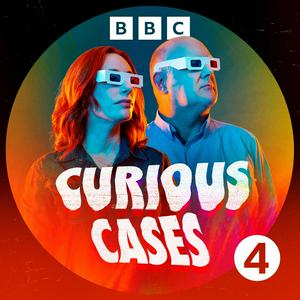
About Curious Cases
Hannah Fry and Dara Ó Briain tackle listeners' conundrums with the power of science!
Podcast websiteListen to Curious Cases, Science Vs and many other podcasts from around the world with the radio.net app
Get the free radio.net app
- Stations and podcasts to bookmark
- Stream via Wi-Fi or Bluetooth
- Supports Carplay & Android Auto
- Many other app features
Get the free radio.net app
- Stations and podcasts to bookmark
- Stream via Wi-Fi or Bluetooth
- Supports Carplay & Android Auto
- Many other app features
Curious Cases
Scan code,
download the app,
start listening.
download the app,
start listening.
Curious Cases: Podcasts in Family
 Australia

