

Listen to this podcast in the app for free: Download for free in the App Store
radio.net
Sleep timer
Save favourites
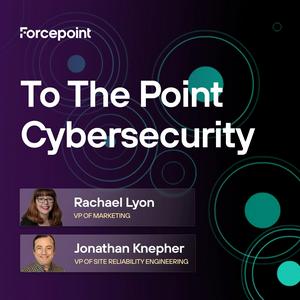
To The Point - Cybersecurity
Forcepoint | Global Cybersecurity Leader | Security. Simplified.
Latest episode
355 episodes
Governance Isn't Security When AI Agents Can't Use Judgment with Jake Williams
06/10/2026 | 48 mins.Enterprises have spent decades writing governance policies that quietly assumed a human would exercise judgment at the final step. Jake Williams, VP of R&D at Hunter Strategy and a faculty analyst at IANS Research, argues that assumption collapses the moment autonomous agents enter the picture. Agents do not use discretion and cannot be held accountable the way an employee can, which turns the implied trust at the bottom of every access control list into a liability. The result is a widening gap between what organizations govern on paper and what they can actually enforce at machine speed.
Williams makes the case that the legacy problems security teams tolerated for years, coarse data classification and unresolved entitlements debt chief among them, are now being exposed by the speed and scope of AI-driven activity. He walks through why volumetric detection matters more than signatures against agent-scale behavior, why every deployed agent needs a named business owner who is accountable for its actions, and how his open framework CUSTODY gives teams a shared taxonomy to classify and contain agents before they ship. The conversation closes on the economics most organizations are avoiding, from the true cost of tokens to the 15-30% security premium of screening for prompt injection.
For links and resources discussed in this episode, please visit our show notes at: https://www.forcepoint.com/resources/podcast/ai-governance-enforcement-gap
For readers who want to go deeper, Williams references 1Password research on why AI-generated vulnerability patches still require expert human review and a Microsoft Entra analysis of why OAuth must evolve to support AI agents.Autonomous Agents Need a Verified Identity with Rosalyn Curato
25/08/2026 | 47 mins.The identity and access model built for human users starts to break the moment an autonomous agent acts on someone's behalf, because an agent cannot be authenticated the way a person is. Rosalyn Curato, Chief Innovation Officer and General Manager of Agentic Security at Vouched, makes the case that an autonomous agent should never be an anonymous one, and that trust starts with verifying the agent and tying it to a known human. Her framing reduces to three questions every organization should be able to answer about an agent: who it is, which human it belongs to and what it has been given permission to do.
From there the conversation turns to what breaks without that binding. Curato covers rogue agents, the risk of handing an agent too much access and the fraud and liability costs that organizations are already forecasting. She and hosts Rachael Lyon and Jonathan Knepher work through the controls that answer it, including delegated permissions, immutable audit trails, kill switches and the KYA-OS open standard that Vouched donated to the Decentralized Identity Foundation.
For links and resources discussed in this episode, please visit our show notes at https://www.forcepoint.com/resources/podcast/verified-identity-for-ai-agentsUnleash AI or Block It? The Answer Is Both with Steven Walchek
18/08/2026 | 52 mins.Every CIO and CISO adopting AI faces the same trap. Loosen the guardrails and let employees use the tools they want, and put your sensitive data at risk. Block it and lock everything down, and watch shadow AI use grow.
Steven Walchek, co-founder and CEO of Liminal and a former innovation leader at AWS and FIS, joins Rachael Lyon and Jonathan Knepher to argue the answer is not one or the other but both. The conversation covers the real regulatory exposure facing mid-market companies, why the public versus private LLM question echoes the old cloud versus on-prem debate, and the security tradeoffs of running open-source models on your own infrastructure. It closes on a candid look at how AI is reshaping developer work and the careers Steven is steering his own kids toward.
For links and resources discussed in this episode, please visit our show notes at https://www.forcepoint.com/resources/podcast/enterprise-ai-security-steven-walchekAgentic AI Needs Humans on the Loop with Michael Chavira
14/07/2026 | 43 mins.As AI systems start acting on their own, the hardest security problem is no longer approving what a model outputs but governing the conditions under which it is allowed to act at all. Michael Chavira, co-founder of Axiologic Solutions, argues that most organizations confuse governance with security, writing policies and standing up AI councils that describe intent while leaving the enforcement layer, where a model actually touches data, underbuilt. His answer is to move humans out of the approve-every-action role and onto the loop, where they define the boundaries an agentic system runs inside and watch for it to step out. That control is only as good as the data underneath it, and for most enterprises, the data is a weak point. Chavira makes the case that AI security is ultimately data security, since a model is only as trustworthy as the data feeding it, and he walks through why shadow AI, unlabeled data and untracked workarounds quietly undermine even well-governed systems. For tools that answer the same question differently each time, he recommends harness engineering and continuous data operations as the way to secure the system rather than chase every output.
For links and resources discussed in this episode, please visit our show notes at https://www.forcepoint.com/resources/podcast/agentic-ai-humans-on-the-loopAI Agents Aren't People. Don't Give Them the Keys with Ido Shlomo
07/07/2026 | 40 mins.Ido Shlomo, co-founder and CTO of Token Security, makes a blunt case: an AI agent is not a person. It is a workload that impersonates one, chasing whatever goal it is handed without judgment, memory, or common sense. Treat it like an employee and hand it the keys, and enterprise security quietly starts to break down.
Shlomo explains why agents inherit the same credentials and keys that service accounts have always used, why over-permissioning backfires on the business itself, and how identity teams can align an agent's access to its real intent. He also argues, against his own instincts, for more regulation of how agents connect to business systems and makes the case that reducing the blast radius matters more than trusting any single model.
For links and resources discussed in this episode, please visit our show notes at https://www.forcepoint.com/resources/podcast/securing-ai-agents-non-human-identity
More Government podcasts







Trending Government podcasts













About To The Point - Cybersecurity
Stay ahead in the dynamic world of cybersecurity with "To the Point Cybersecurity." This podcast offers in-depth discussions on the latest cyber threats, trends, and technologies impacting businesses, governments, and communities globally.
Listeners will gain insights into how emerging technologies, such as AI and frameworks like data governance and expanded global cyber regulations, are shaping modern security practices. The podcast also provides practical strategies for navigating the ever-evolving threat landscape, including innovative approaches to data protection and insider threat mitigation.
Each episode features thought leaders and influencers who share their expertise and experiences, providing valuable perspectives on how to tackle cybersecurity challenges effectively. Whether you are a business leader, a government official, or simply interested in cybersecurity, "To the Point Cybersecurity" delivers the knowledge you need to stay informed and protected.
Rachael Lyon hosts the podcast, bringing over 20 years of experience in technology and work with global industry leaders and innovative start-ups. Co-host Jonathan Knepher serves as the Vice President of Site Reliability Engineering at Forcepoint. With nearly two decades of experience in cybersecurity and strategic leadership, Jonathan is focused on enhancing system reliability and performance.
Tune in on Apple Podcasts, Spotify, and other major platforms to keep up with the latest in cybersecurity.
Podcast websiteListen to To The Point - Cybersecurity, The National Security Podcast and many other podcasts from around the world with the radio.net app
Get the free radio.net app
- Stations and podcasts to bookmark
- Stream via Wi-Fi or Bluetooth
- Supports Carplay & Android Auto
- Many other app features
Get the free radio.net app
- Stations and podcasts to bookmark
- Stream via Wi-Fi or Bluetooth
- Supports Carplay & Android Auto
- Many other app features
To The Point - Cybersecurity
Scan code,
download the app,
start listening.
download the app,
start listening.
 Australia