
Listen to this podcast in the app for free: Download for free in the App Store
radio.net
Sleep timer
Save favourites
27 episodes
2.8 Why God Must Be Fantastical | Bhagavata Podcast with Advaita Das
22/09/2026 | 52 mins.Philosophy decided two thousand years ago that God cannot have a body. Every body is material, limited, reducible. If you want God to be eternal and unlimited, he cannot be bodied. The Bhagavatam's answer to that is a baby stealing butter and peeing in the house of a cowherd woman.
Canto 2, Chapter 8 is the hinge on which the entire Purana turns. Pariksit has seven days left and has already received his practical instructions: fix the mind on Vishnu, chant the name of Narayana. Now he asks the large questions: creation, the gunas, karma, embodiment. These are the questions, Dr. Edwin Bryant (Advaita Das) argues, that the Bhagavatam spends its first nine cantos answering. The God you will meet crawling in the dust of Vrindavan, stealing butter and peeing in the houses of the gopis, is the same God of the Vedas and the Upanishads and the Nyaya and the Sankhya. But that claim requires nine books to establish before it can land.
Dr. Edwin Bryant is Professor of Hindu Religion and Philosophy at Rutgers University and translator of the 10th Canto for Penguin Classics. His forthcoming book, In Defense of a God with Form, traces the idea that a bodied God is a philosophical impossibility back to Plato and Aristotle, who were working from empiricism alone: every observed body is material, limited, and reducible. That premise was absorbed into Christianity and traveled to India with the missionaries. It is also, Bryant notes, why Hindus should stop calling their own tradition "Hindu mythology," since a myth by definition is something not factually true. The Bhagavatam, he argues, is the counter-instance the Greek premise had never encountered, the black swan that overturns the inference. Krishna's body is made of a completely different category of stuff. A form that can morph into every cowherd boy in Vrindavan is not a limitation.
The conversation closes on a personal note. Dr. Edwin Bryant spent forty years in academe, translated thousands of pages, taught the Krishna Leela in universities and yoga studios, and recently gave away his collection of seven thousand books. What he plans to read in retirement: the Bhagavatam, daily, from the beginning. He also recalls the moment he stopped being hesitant about teaching the strange stories to students and simply let them encounter the text. What he found was that the stories needed no editing. They have, as he puts it, their own Shakti.
Send us Fan Mail
The Bhagavata Podcast is produced by the Gaudiya Studies Research Programme at the Oxford Centre for Hindu Studies. Each episode brings together scholar-practitioners, trained in both Indology and lived Vaishnava devotion, to read this text closely and seriously.2.7 One Verse Each. Except Krishna. | Bhagavata Podcast with Sundar Gopal Das
17/08/2026 | 51 mins.The Bhagavatam's longest avatar list gives each divine figure one verse. Sometimes two. When it reaches Krishna, it gives him ten.
Canto 2, Chapter 7 surveys 23 lila avatars, the longest such list in the entire Purana. Sundar Gopal Das (Dr. Simon Haas), a Gaudiya Vaishnava scholar and author, reads it as a narrative table of contents: each avatar gets just enough detail to generate appetite for the full account in the cantos ahead. These stories are told, as the preceding verse puts it, so that listeners may "drink up the dryness of the ears."
The chapter raises questions commentators have been working through for centuries. Narada himself is absent from the list; Bhrigupada wonders whether Brahma left him out deliberately, not wanting to give his student that particular kind of pride. The details about individual avatars differ from their fuller accounts elsewhere: Varaha kills the demon differently than in the third canto; Kurma scratches an itch while the Mandara mountain spins on his back; the Buddha in verse 37 is not the Bhudda we know, but a figure connected to the Tripura story, the demons in flying cities who had to be decoyed away from Vedic ritual before Shiva could destroy them.
The episode closes on Brahma's instruction to Narada: pass the text on, and expand it. A tradition that only repeats itself, Sundar Gopal Das notes, becomes a photocopy of a photocopy of a photocopy, until you can no longer read the page.
Send us Fan Mail
The Bhagavata Podcast is produced by the Gaudiya Studies Research Programme at the Oxford Centre for Hindu Studies. Each episode brings together scholar-practitioners, trained in both Indology and lived Vaishnava devotion, to read this text closely and seriously.2.6 You Cannot Know God. So Sing Anyway. | Bhagavata Podcast with Gopinathacharya Das
29/07/2026 | 1h 10 mins.Brahma describes the entire process of creation and then admits he cannot know the Lord. His response to that admission is not silence. It is song.
Canto 2, Chapter 6 continues the Virat Rupa meditation from the previous chapter, but shifts the emphasis. Where chapter 5 asked what the cosmic form is, this chapter asks what it generates: the faculties of the human body, each mapped to a presiding deity, each tied to the wider cosmos through what the Vedic tradition calls bandhus, hidden correspondences between person and universe. The eye and the sun. Speech and fire. Gopinathacharya Das (Dr. Rembert Lutjeharms), research lecturer in Hindu Studies at the Faculty of Theology and Religion at Oxford University and Fellow at the Oxford Centre for Hindu Studies, is one of the most careful Sanskrit scholars working within the Gaudiya Vaishnava tradition. He reads the Bhagavatam weekly with his local community, and the combination of textual precision and practiced familiarity with the text shows throughout this conversation. He explains why these connections are not decorative. They are ontological: none of the body's faculties function without the universe they are woven into.
Around verse 13, the Purusha Sukta of the Rig Veda enters the chapter without being named. The language tracks the original so closely that entire verses are nearly identical. What the Bhagavatam adds is a theme the Sukta does not carry: devotion. The primordial sacrifice becomes an act of worship. Creation is not just a cosmic event. It is an offering.
By text 34, Brahma steps outside his role as teacher. His speech never fails, his mind is never diverted, because he has seized the lotus feet of the Lord with great zeal. One verse later, he says he cannot understand the Lord. The Bhagavatam does not read this as contradiction. It reads it as conclusion: because I cannot know him, I will sing. The conversation closes with Sanatana Goswami's Brihad Bhagavatamrita, a verse Gopinathacharya Das recites nearly every day: the Lord inspires the devotee to worship him, provides all the means, and receives that worship as if the devotee has done him the greatest favor.
Send us Fan Mail
The Bhagavata Podcast is produced by the Gaudiya Studies Research Programme at the Oxford Centre for Hindu Studies. Each episode brings together scholar-practitioners, trained in both Indology and lived Vaishnava devotion, to read this text closely and seriously.2.5 Who Created the Creator? | The Bhagavata Podcast with Sri Prahlada Dasa
30/06/2026 | 59 mins.There are dozens of gods in the Vedic scriptures, and the texts seem to glorify some of them just as highly as Vishnu. For anyone raised in a tradition that insists Narayana is supreme, that is not an abstract problem. Sri Prahlada Dasa carried that question from his teenage years until a single line from the Bhagavad Gita answered it.
Canto 2, Chapter 5 is built around exactly this kind of correction. Narada approaches Brahma as the independent creator, using the image of a spider spinning its web from within itself. Brahma's response is precise: he creates within a certain range, but there is a power behind him, and before he says another word, he offers obeisances. Sri Prahlada Dasa, visiting professor of management at Manhattan University and a kirtan musician known across the Vaishnava world, reads that gesture as the chapter's thesis stated before the argument begins: everything proceeds from Narayana.
The chapter then runs through two accounts of creation. The first draws on Sankhya, time, action, and innate nature disturbing the equilibrium of unmanifest matter until the elements and sense organs unfold in sequence. Sri Prahlada Dasa notes that yogis in the later cantos reverse this process exactly, dissolving the layers back until the self is extracted from matter. What the Bhagavatam adds to Sankhya is a name for who initiates the disturbance. The second account tracks the Purusha Sukta of the Rig Veda almost verbatim, with one addition the Vedic hymn does not have: Bhagavan. The cosmic man becomes a personal God. Brahma then offers several meditations on this form, the 14 planetary systems mapped onto the Lord's body, and the Gayatri's bhur bhuvah svah as a condensed version of the same vision.
🔔 Subscribe to join listeners around the world exploring the Bhagavatam together:
https://www.youtube.com/channel/UCxspSZeIYq_ZZaW89hhnptA?sub_confirmation=1
Starting from the beginning? Episode 1.1 is here: https://youtu.be/2LcGX8iK5tM
#Bhagavatam #BhaktiYoga #HinduPhilosophy #PurushaSukta #VedicCosmology
Send us Fan Mail
The Bhagavata Podcast is produced by the Gaudiya Studies Research Programme at the Oxford Centre for Hindu Studies. Each episode brings together scholar-practitioners, trained in both Indology and lived Vaishnava devotion, to read this text closely and seriously.2.4 I've Never Been Completely Satisfied with Anything I've Done | Bhagavata Podcast with Anuradha Devi Dasi
03/06/2026 | 55 mins.Standing at Govardhan, Bhrigupada felt something deeply spiritual. A few minutes later it was gone. The Srimad Bhagavatam does not treat this as failure. It treats it as the starting point.
Canto 2, Chapter 4 carries a misleading title: "The Process of Creation." The question about creation is asked in verse 9. The answer begins in the next chapter. What Shukadeva Goswami does instead, for more than half this chapter, is pray. Anuradha Dooney, who leads the Youth Education Programme at the Oxford Centre for Hindu Studies, explains why the Bhagavatam's method is not to deliver answers but to demonstrate the orientation from which answers become possible. Shukadeva models what Parikshit is being taught before teaching it.
The conversation covers the chapter's placement in the Srimad Bhagavatam, the verse in which Parikshit addresses Shukadeva as "as good as God" (2.4.14) and what that claim means for how knowledge moves through the text, and verse 18, which extends the promise of purification to peoples entirely outside the Vedic tradition. Prabhupada returned to this verse repeatedly as a rationale for bringing the Bhagavatam to the West. The episode also traces what Anuradha calls the Bhagavatam's "echo chamber" structure: not boxes within boxes but persons responding to persons, each bringing a different relationship to Krishna into the conversation. The episode closes on a practical question: what do you do if you have no devotee community near you? Anuradha's answer draws on decades of practice in settings that were, at various points, exactly that isolated.
🔔 Subscribe to join listeners around the world exploring the Bhagavatam together: https://www.youtube.com/channel/UCxspSZeIYq_ZZaW89hhnptA?sub_confirmation=1 Starting from the beginning? Episode 1.1 is here: https://youtu.be/2LcGX8iK5tM
#Bhagavatam #BhaktiYoga #HinduPhilosophy #DevoteeCommunity #Govardhan
Send us Fan Mail
The Bhagavata Podcast is produced by the Gaudiya Studies Research Programme at the Oxford Centre for Hindu Studies. Each episode brings together scholar-practitioners, trained in both Indology and lived Vaishnava devotion, to read this text closely and seriously.
More Hinduism podcasts
Trending Hinduism podcasts
About The Bhagavata Podcast
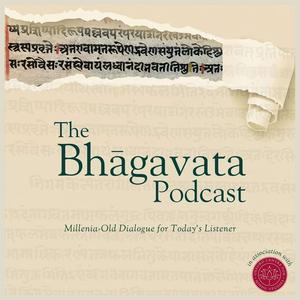
The Bhagavata Podcast invites listeners on an engaging journey through the Bhagavata Purana, more commonly known as the Srimad Bhagavatam. Each episode features conversations between scholars, many of whom are also practitioners, as they reflect on and analyze a chapter of this text together. The podcast offers a unique blend of academic rigor and personal insight, providing fresh perspectives that illuminate the beauty and uniqueness of the Bhagavatam.In each episode, host Dr. Måns Broo, an esteemed scholar and Gaudiya Vaishnava practitioner, invites expert guests to reflect on a chapter of the Bhagavata Purana. Following a linear progression through the text, the discussions explore the philosophical, theological, and literary dimensions of the Bhagavatam, offering both traditional insights and modern academic interpretations. This thoughtful approach enables listeners to journey through the Bhagavata Purana chapter by chapter, uncovering the intricate teachings of this work.The Bhagavata Podcast is an initiative supported by the Gaudiya Studies Research Programme of the Oxford Centre for Hindu Studies, furthering the mission of connecting living traditions with academic exploration.
Podcast websiteListen to The Bhagavata Podcast, Mahabharat - The Complete Saga and many other podcasts from around the world with the radio.net app
Get the free radio.net app
- Stations and podcasts to bookmark
- Stream via Wi-Fi or Bluetooth
- Supports Carplay & Android Auto
- Many other app features
Get the free radio.net app
- Stations and podcasts to bookmark
- Stream via Wi-Fi or Bluetooth
- Supports Carplay & Android Auto
- Many other app features
The Bhagavata Podcast
Scan code,
download the app,
start listening.
download the app,
start listening.
 Australia