

Listen to this podcast in the app for free: Download for free in the App Store
radio.net
Sleep timer
Save favourites
115 episodes
#114 – Why a Year Late on Brownfield CBTC Is a Good Result, with Mike Palmer
23/09/2026 | 1h 11 mins.A brownfield CBTC project that lands a year late is a good result. Not a consolation prize. That is what the record actually looks like once you take the press releases out of it.
Mike Palmer spent 29 years at London Underground, finishing as the user acceptance manager on the Jubilee and Northern line upgrades, where every operational decision on scope and functionality went through him and nobody else. He then crossed to the supplier side, and in 2014 Andy Byford brought him to the Toronto Transit Commission as Deputy Chief Operating Officer and later COO. He now works at Parsons. This conversation was recorded in 2024, and Mike speaks throughout in a personal capacity rather than for any employer or agency.
In this episode: why eight contracts across three suppliers left Toronto Line 1 with no endgame, and what consolidating them to two actually fixed. Why he does not want a fully compliant bid, and what he asks for instead. What a reference site is worth, and why he flew his team to Mexico City and Panama to touch the system before committing. Why backup signalling so often buys risk instead of resilience. Why dwell times, turnbacks and traction power queue up behind signalling and take away the capacity you just paid for. And his top three golden rules for brownfield CBTC, with the same one at number one every time.
If you get something out of it, tell a colleague. That is the only ask.
If this conversation has got you wanting to go deeper, visit my training platform at www.docfranktraining.com. There you find the most comprehensive suite of online courses in advanced railway signalling anywhere. CBTC, ETCS, high capacity signalling, and more. All in one place, all vendor neutral. Check out my latest course addition, ETCS for Australia.#113 – Why ETCS Is a Change Program, Not a Tech Project, with Cara Cohen
09/09/2026 | 1h 1 mins.Fit the locomotives, commission the trackside, write the rules, and ETCS can still stumble on the day a driver decides the old way was better. The technology is the measurable part of an ETCS introduction. The people are the program.
My guest Cara Cohen is an organisational psychologist who worked on business change for the introduction of ETCS at UK freight operator Freightliner, inside the East Coast Digital Programme. This conversation was recorded during her time there; she has since moved to the Rail Delivery Group as People, Change and Projects Specialist for ETCS, so the people side of this rollout continues to be her day job.
We get into what a business change manager actually does, why drivers hesitate to trust the screen and what wins them over, how Level NTC works and why most freight drivers meet it before they ever meet Level 2, why a fitted locomotive is treated as new traction, and the quiet disciplines that keep a change program alive: bite-sized learnings, myth busting, and unions involved from the first human factors session. The conversation closes with Freightliner's decision to take its first-in-class fitment in-house, in partnership with Siemens.
If you find this useful, share it with a colleague.
For the best way to truly understand ETCS, CBTC and high capacity signalling, all vendor neutral, visit www.docfranktraining.com. New course addition: ETCS for Australia.#112 – Why More Review Comments Make Railways Less Safe, with Andy Petrie
26/08/2026 | 1h 8 mins.Twenty people comment on a document. Nineteen of them have no expertise in it. Every comment has to be answered, and the two that mattered get lost in the noise. Andy Petrie has spent thirty years watching this happen and has stopped being polite about it.
Andy is Director of Systems and Safety Assurance at ARCH in Sydney, with thirty years across rail, nuclear, oil and gas, and major civils. He has been Lead Independent Safety Assessor on Melbourne's Metro Tunnel, Director of Safety and Engineering Systems at Transport for NSW, and Head of Safety and Assurance for Network Rail Consulting in Australia. His stated mission is to cut the BS.
In this conversation he sets out four stages of assurance. Value for money, where risk-based assessment confirms the work is good enough and you stop. Chasing perfect, where you push for more than you paid for. Admin overload, where twenty people comment on a document and nineteen have no expertise in it. And crossing the line, where the client starts instructing the designer and quietly takes back the liability they paid someone else to carry.
We also get into why assessing a document is not the same as reviewing it, why "no comments" is the hardest review to write, and what happens to signalling design responsibility when the technology becomes a black box. The conversation closes on Australian interoperability and whether a single national standard is the answer, or whether the answer sits on the train.
If you find this useful, share it with a colleague.
For the best way to truly understand ETCS, CBTC and high capacity signalling, all vendor neutral, visit www.docfranktraining.com. New course addition from 1 September 2026: ETCS for Australia.#111 — Fitting ETCS to a Freight Railway, with Craig Evans
12/08/2026 | 54 mins.Freight is where the ETCS business case really gets tested. Many freight locomotives were built long before anyone drew a European Train Control System (ETCS) fitment design, and there is no factory fit to fall back on. So the fair question is whether you can retrofit an entire freight fleet without it turning into a nightmare.
Recorded during his time leading ERTMS operations at Freightliner, this conversation has Craig Evans explain how one of Britain's largest freight operators is fitting ETCS across more than 185 locomotives and getting 700 drivers ready for it.
Craig's answer is that it is hard work but far from unmanageable. Four locomotive types, not forty. One consistent onboard equipment set across every UK freight operator. A learning curve where the tenth fitment is quick even if the first one has you scratching your head. He walks through the East Coast Digital Programme, Britain's largest ETCS deployment, and the collaboration behind it, with freight operators, passenger operators, the infrastructure manager and even the unions pulling the same way. We get into the first full-cab ETCS freight simulators in the UK, and the human side of the change, right down to the veteran driver who did not want ETCS until he saw what it does.
If you find it useful, share it with a colleague wrestling with the same questions.
For the best way to truly understand ETCS, CBTC and high capacity signalling, all vendor neutral, visit www.docfranktraining.com.#110 — Why Digital Signalling Never Got Cheaper, with Andy Harrison
29/07/2026 | 35 mins.Twenty years ago the promise was simple. Digital train control would get cheaper, and ETCS and CBTC would become the default for every new scheme. Neither happened. Costs keep rising, and the system knowledge keeps migrating into the supply base.
My guest is Andy Harrison, a long-time friend and consultant to top railway clients across Great Britain, with four decades in the industry. We get into why the tipping point never came, what changes when the railway no longer holds competence in its own systems, why "change management" is far more than a new job description, and why zero disruption should be the default for bringing new signalling into service, not the exception.
Subscribe to the channel "Railway Conversations with Doc Frank" on your podcast platform of choice (YouTube, Apple, Spotify) to get notified first.
If are interested in deeper understanding of modern train control, visit my training portal at www.docfranktraining.com. There you find the most comprehensive suite of online courses in advanced railway signalling anywhere. CBTC, ETCS, high capacity signalling, and more. All in one place, all vendor neutral.
More Technology podcasts
 Download This ShowNews, Technology
 All-In with Chamath, Jason, Sacks & FriedbergBusiness, Entrepreneurship, Health & Wellness, Investing, Technology
 Darknet DiariesTechnology
 AcquiredBusiness, Investing, Technology
 Search EngineBusiness, Society & Culture, Technology
 Hard ForkTechnology
 Machine GodsNews, News Commentary, Tech News, Technology
 Waveform: The MKBHD PodcastHobbies, Leisure, News, Tech News, Technology
 Better OfflineTechnology
 The AI Daily Brief: Artificial Intelligence News and AnalysisTechnology
Trending Technology podcasts
 Life and Technology with Charlie BrownTechnology
 Blood in the MachineSociety & Culture, Technology
 Weird TechLeisure, News, Physics, Science, Society & Culture, Tech News, Technology, Video Games
 TFTC: A Bitcoin PodcastTechnology
 The Electric VikingTechnology
 No need for Prince CharmingTechnology
 The Peterman PodEducation, Technology
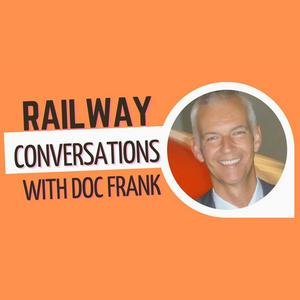
About Railway Conversations with Doc Frank
Authentic discussions with interesting people about railway subjects that matter.
Podcast websiteListen to Railway Conversations with Doc Frank, Download This Show and many other podcasts from around the world with the radio.net app
Get the free radio.net app
- Stations and podcasts to bookmark
- Stream via Wi-Fi or Bluetooth
- Supports Carplay & Android Auto
- Many other app features
Get the free radio.net app
- Stations and podcasts to bookmark
- Stream via Wi-Fi or Bluetooth
- Supports Carplay & Android Auto
- Many other app features

Railway Conversations with Doc Frank
Scan code,
download the app,
start listening.
download the app,
start listening.
 Australia