PodcastsFictionBarbary Lane Dispatches Podcast

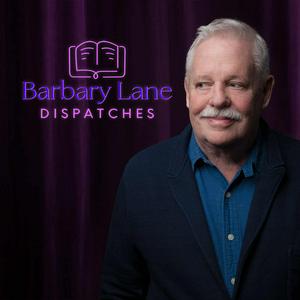
Barbary Lane Dispatches Podcast

Armistead Maupin
Barbary Lane Dispatches Podcast
Latest episode

40 episodes

  • Barbary Lane Dispatches Podcast

    The Teachers Who Made Me a Writer

    16/03/2026 | 10 mins.
    Here’s a transcript of the video: When I was a little boy, I had a terrible recurring nightmare. It wasn’t about a specific thing—it was just a kind of feeling, a sort of thrumming in my head that scared the hell out of me. And inevitably I would end up going into my parents’ bedroom and crawling in between them to feel safe from that nightmare.
    Then I developed the technique of telling myself a story at bedtime to get to sleep. It’s really where my serial fiction began in that form. I would tell a story and then make it continue the next night. I’d usually have a couple of stories going at the same time.
    I remember one was set in Florida, in Tarpon Springs—or at least that’s where the movie was set. I saw something called Beneath the 12 Mile Reef that really affected me in terms of making me fascinated by the undersea world. It was about these Greek-American fishermen who were going underwater with those big steel diving helmets, and it just made me think about the whole world of the undersea.
    The other one was something I called The Secret Crossroads, which was inspired by the Hardy Boys, really. A lot in those days was inspired by the Hardy Boys.
    I still tell myself stories sometimes at night. It’s an old habit, and I haven’t broken it easily. But that’s where most of my stories came from—from that habit of putting myself to sleep, a sort of self-hypnosis when I was a little boy.
    So storytelling really came first. Writing kind of crept up on me.
    I kept a diary when I was nine years old in which I recorded all sorts of useless information—but I still have that diary somewhere. I would write about movies I had seen and what I’d had for lunch. It was all over the place, really.
    I would write about my friend Bobby Ballance who, on the bus with me, would make up stories about mysterious murder cases and how we were going to solve them. Bobby was the only person I knew who had a tape recorder—a reel-to-reel recorder—and we would go over to his house and record the clues on the tape recorder.
    About the same time, I took shirt cardboards from my father’s shirts and used them as things I could write on, and I created a comic book called Little Tallulah, which was a merger of the two things I loved most: Little Lulu, the comic, and Tallulah Bankhead.
    As a child I would hear Tallulah Bankhead on the radio doing her “Big Show”, and I loved her. She had a voice that was as deep as a man’s, and a very warm way about her that was appealing to me as a little boy.
    At Ravenscroft School—which is where I went to grade school—I had a teacher named Mrs. Robertson. She brilliantly gave us an assignment called Word Pictures, where she would give us a postcard and ask us to describe what we saw in the postcard.
    She gave one to me which evoked a whole story about the Old West—a saloon at night with lights coming out of the window—and I built a story around it. I wrote about a piano tinkling at night, footsteps on the path, and a mysterious stranger coming into town. It started to build my imagination.
    I count her as one of my first really serious influences when it comes to telling stories—to writing. She read my story aloud to the class, which thrilled me and made me very proud.
    I wrote a story in the seventh grade about a boy that’s fixating on a girl—a beautiful girl in his class—and he thinks of her as a goddess, really, until he discovers that she has a vaccination mark, you know, a sign of her human nature. I was obviously trying to talk myself out of having a romance with anybody… I must have been dealing with that.
    But the person who really made a difference to me was Mrs. Phyllis Peacock, who was my senior English teacher.
    We’ve all had one of those teachers—or if we were lucky, you’ve had one of those teachers—that you remember all your life, and who changed the way you think and work and create.
    A lot of people thought she was kind of a loony because she was melodramatic. She would jump on a chair to make a point. But I thought she was charming—and the fact that she liked me had something to do with it, I suppose.
    She had two other students, Anne Tyler and Reynolds Price, both of whom became famous writers, and she was always telling me that she thought of me in the same way—that I could do that.
    She singled me out, in other words, and paid special attention to me. And while it must have annoyed the hell out of some of the other students, it charmed me and made a difference.
    I think she sensed that I was a bit of a wallflower—maybe even a prude—and so she gave me an assignment to explain the origins of the maypole.
    I had no idea what that meant, but I went home and asked my parents and saw great embarrassment in their faces… they couldn’t talk about it. So my mother left an Encyclopaedia Britannica on my bed with it open to “Maypole,” where it explained that it was a phallic symbol.
    So I went in to talk to Mrs. Peacock the next day, and she sat there, eyes twinkling, while I explained about penises and whatever symbolism was involved. She knew exactly what she was doing. She wanted to get that out of me—I look at it as an act of benevolence now.
    So the big finale for the year was a stage performance that we would do in the theater of the high school. I was comfortable with this because I had already been in the production of The Desperate Hours at the Raleigh Little Theatre—a grown-up play where I was the little boy on stage. The hardest part about being in that play was coming in with a football and throwing it around as if I knew what to do with it.
    So Sarah Pierce and I, a classmate, were assigned to do this performance that I called Sleep in Literature. We dressed all in white. We made columns out of Pine State Creamery ice-cream cartons—made Corinthian columns—and we read “The Lotus Eaters” by Tennyson.
    At the end of the reading, I looked out into the audience to see what kind of response I was getting, and Mrs. Peacock was feigning sleep. Her head was over to one side… and then she very melodramatically woke up.
    It was her way of telling me that it was doing exactly what I thought it would do—that she had fallen asleep in the course of listening to my poem.
    She was one of those rare teachers who really inspired me to do better—to create, to write, really.
    She died when she was in her nineties in 1998, I believe. And I certainly didn’t keep up with her at that point, but she lives in my memory so vividly. And a lot of other writers as well—not just writers, but people who loved her—remember what she was like, how inspirational she was, and how much she cared about what she did. It was an amazing thing to be a part of.
    The last time I saw her was when I went back to Raleigh for a book signing. I was signing a book for a couple of leather queens in full regalia when I looked up and there was Mrs. Peacock behind them, sort of twiddling her fingers at me and letting me know that she was there.
    It’s a perfect last memory of her, really.
    I was so blessed to have her—as well as my English grandmother—to be a kind of fairy godmothers to me in my youth. I don’t know what I would have done without them. They made a difference.
    So the person I turned out to be, for better or worse, was greatly due to those women, and I shall always be grateful that I had them in my life.
    Thank you all for coming along, and I’ll see you next time.
    A bit more about Phyllis Peacock (1904-1998):
    Reynolds Price who won the National Book Critics Circle Award for Fiction wrote of Mrs. Peacock- “She was a formidable guardian at the gates of good old censorious, rule-ridden, clear English and a magical teacher who worked a sort of inexplicable voodoo on her students.”
    Anne Tyler who won the Pulitzer Prize for her novel Breathing Lessons, dedicated her first novel - “To Mrs. Peacock, For everything you've done. Anne.”


    This is a public episode. If you'd like to discuss this with other subscribers or get access to bonus episodes, visit armisteadmaupin.substack.com/subscribe

  • Barbary Lane Dispatches Podcast

    Demigods and Crimes Against Nature

    10/03/2026 | 13 mins.
    Here’s a transcript of the video: When I was a teenager, my best friend was a guy named Eddie Russell.
    My parents didn’t approve of him, and I always assumed that was because he was a Yankee. He’d come from elsewhere and had lived in Miami, so he was very suspect.
    But I didn’t fully understand until my mother pulled me aside one day and said,“I think you should hang out less with your friend Eddie… because he’s a little bit sissy, so people might get the wrong idea.”
    This is a theme in the South. People are always worried that somebody’s going to get the wrong idea about something. In Eddie’s case, I didn’t see the sissy part. I saw him as simply another boy who liked movies the way I did and loved to talk about them.
    Because of this Southern mentality, my mother never stopped worrying about how I appeared to the world. I had bad skin at the time, so she was always on a hunt for blackheads. She would creep up on me sometimes and say, “Let me get this one right here,” which was hideously embarrassing to me.
    And she knew that I walked funny—like a duck with my feet turned out. It’s the way I still walk, by the way. So she would constantly say, “Straight—turn your feet straight.” I remember going up to the mountains of Virginia once with her, and she had a chance to be with me all the time then. She would practically follow me as I walked and give me that instruction:“Straight. Go straight.”
    I read a Dear Abby article when I was sixteen where Abby said that a parent should be concerned if their sixteen-year-old child has not kissed a member of the opposite sex. So I made that my project. One evening I took a girl I knew just slightly—a sixteen-year-old girl—out to Roy’s Drive-In, and we kissed a bit.
    When I’d done it, I felt that I had completed a merit badge. It was an assignment that had been given to me by Abby, and I had come through with flying colors, because I could no longer be suspected of being gay.
    I was certain at the time that I was mentally ill, because I had read somewhere that homosexuality was a mental illness. I knew I needed to tell my parents if I was to be cured of this terrible thing. But I couldn’t bring myself to do it.
    Then I decided that the way to save myself from shame would be to become paralyzed from the waist down, so I couldn’t act on those desires. It’s hard to say this, really. I can’t believe that I ever thought that, but I did. I don’t know whether I even considered ways that I could become paralyzed that weren’t too bad—in a minor car accident, for instance. Also, if I became paralyzed, there wouldn’t be any expectations from my future wife that I was bound to have. I would have an excuse for not performing.
    The afternoon I realized that I was beyond saving, I took my grandmother—Mimi—to her beauty parlor to get her hair done. It was in the Old Carolina Hotel, which had a newsstand in the lobby.
    When I walked in there, I saw this magazine that leapt out at me. It had a man on the cover who was clearly there for me and me alone. I felt like he wanted me. It wasn’t like your standard bodybuilding magazine or anything else. This was a man who was—well, I thought—very desirable. He was sitting behind satin sheets in bed and giving me a look.
    Well, I didn’t have the nerve to pick up the magazine, which is ironic since the guy who ran the newsstand was a blind man. But I even worried that his other senses might be heightened because of his blindness. He might be able to hear where I had walked. I was completely paranoid about the whole thing, so I left it alone.
    The magazine was called Demigods, and that name was emblazoned in my head so much that it lasted for years. I would remember the name of that magazine.
    When I went back out to my car in the hot summer afternoon—a little red Volkswagen, my first car—a song came on the radio called “Walk on the Wild Side.” It wasn’t the Lou Reed version. It was another one used in connection with the movie of that name. It starred Jane Fonda, and she played a hooker.
    It was a very smoky, sultry song.“You know the odds are against going to heaven six to one.”
    And I felt that I had finally reached my complete downfall, that I had been condemned to this life of sordid whatever.
    At the time in North Carolina, homosexuality was referred to officially as “the unspeakable crime against nature.” I had this illustrated for me when I was a high school student at Broughton High School in Raleigh. I had this really vile trigonometry teacher, a guy who was quite sadistic in his need to torture his students. I remember he told us very early on that many of us weren’t going to get this thing, and if we didn’t, watch out—because we were going to be out of there.
    Then one day we got word from the front office that the teacher was not going to show up for work that day. We were all delighted, because we figured he’d been fired for being cruel or something. But it turned out that he had been arrested for “crimes against nature” in the woods at William B. Umstead State Park.
    He was the first person who made it clear to me how terrible it would be to follow my desires. That was the lesson I brought out of that. I was glad to see him go because I didn’t have to take that class anymore, but he had been caught for unspeakable crimes against nature.
    And that was it for me. That was the only example I needed to shut down my life. I did not want to become a ho-mo-sex-ual… that war chant that so thrummed in my head at the time. So I didn’t. I made up my mind not to.
    Of course, I did come out. San Francisco helped, as I’ve said before, in a big way. It gave me a place to feel safe and to be myself.
    But it wasn’t until years later that my friend Nick Hongola heard this story from me. I told him the magazine was called Demi-Gods.
    And he said, “Oh my God, I think I’ve got one of those.”
    He had known some old gay man who had left him, in a sense, all his early porn. And the porn was very mild stuff, but one of them was called Demi-Gods.
    He showed up at my house the next day and said, “Is this the magazine?”
    And I said, “Nick, that’s not just one—that is the one.”
    So I had this chance many years later—thirty years later, maybe forty—to look at the magazine that I didn’t have the nerve to pick up on the stands.
    The guy on the cover that I was so in love with was named Larry Kunz. I hope that’s not the way it’s pronounced, but it looks like that: K-U-N-Z. He was wrapped in a shower curtain—a rather cheesy-looking shower curtain—and he was sitting on the edge of a bathtub, not in bed at all.
    But I paged through the magazine, and it was this time capsule of ’60s gay life. Everybody was in posing straps. It was really kind of wondrous, after all those years, to sit there and look at it and feel no guilt, no shame, no embarrassment—just to observe it for what it was.
    What struck me most about this fading artifact was how profoundly innocent it seemed. The guilt that it had once provoked in me wasn’t there at all. It was kind of silly in many ways. I flipped through it and found people whose names were Troy Saxon—which is about the most ’50s made-up name you can think of—and another one called Mr. Mike Nificent.
    There were ads in the back like the ones I remembered from my childhood—the ones where you’d buy sea monkeys and other such things. But these were for gay-themed things that the reader might enjoy. A pith helmet… what else? Anyway, you get the point. It was very silly. And I felt very silly for having ever feared this thing.
    I wish that I could go back and tell that terrified sixteen-year-old that this thing I had feared the most would be the source of great inspiration to me, and would inspire my life’s work—which is exactly what happened. Being a gay man has been my greatest joy. Letting go of that shame was the most important thing I ever did.
    And I hope that nobody out there—well, I know some of you are still living with that kind of shame—but don’t. Just don’t. You don’t have to. You can let it go. You can be yourself and not be punished for it.
    So thank you for coming along, and I’ll see you next time.


    This is a public episode. If you'd like to discuss this with other subscribers or get access to bonus episodes, visit armisteadmaupin.substack.com/subscribe
  • Barbary Lane Dispatches Podcast

    I Found Myself in 1970s San Francisco

    02/03/2026 | 16 mins.
    Here’s a transcript of the video:
    I moved to San Francisco in 1971. I got a job with the Associated Press. They first offered me Buffalo, and I had several people tell me that Buffalo was one place you don’t want to shuffle off to. So I turned them down. I was very disappointed, but I didn’t think I could handle Buffalo.
    A few days later they came back and said, “We’ve just had an opening in San Francisco. Would you like to go there?” So I leapt at that one, of course.
    I drove across the country in my little Opel GT — a ridiculous car, very tiny. You practically had to lie down to drive it. Along the way I stopped in Clinton, Iowa, to visit my friend Tom Nielsen, who had been in what we called “the commune” in Vietnam. While we were having dinner with his parents, a call came in from the White House saying they wanted Tom to come there for an event, a meeting with the president. And by the way, did they know where Armistead Maupin was? So they got two birds with one stone. It was very exciting that I was going to be invited to the White House.
    I guess I was just full of myself. I went to Washington to meet with Richard Nixon and bragged about it when I got back to San Francisco to anybody who would listen — which was not many people. They were mostly horrified. It would be like saying today that you’d met with President Trump. It was just that bad.
    I was a young conservative. I’d grown up that way. I didn’t realize how different it was in San Francisco, how people didn’t feel that way there, for the most part. I had never been around a liberal community, and I didn’t realize how much I was about to change because of living there, because of knowing the people who lived there.
    I found a place off Lafayette Park in a little Victorian. A pretty little place. I had a parrot at the time — I’d forgotten about that parrot — a real pain in the ass. He could say about two things: “How are you?” And I think that was about it. He drove me crazy, constantly taking my temperature.
    I discovered that Lafayette Park was a place where gay men hung out at night, and I had a few adventures there because it felt so random and anonymous. Eventually I found a more permanent place to live over on Russian Hill. I had the top-floor flat — I called it the “pentshack”, because it was a little house on the roof. Very small, but it had this breathtaking view.
    There in the pentshack I came to the realization that I had landed in a beautiful place, a magical place, where the people were really nice and I felt quite free all of a sudden. I hung a picture of me shaking hands with Nixon on the wall, and it was amazing how many people came in and looked horrified. What was I doing with that? How did I have this nefarious connection?
    I had people who helped me adjust to the new city in a very nice, understanding way. Peggy Knickerbocker was one — still my friend after all these years. She showed me places, we did things together, and she was so funny and sweet. Another was Jan Fox, this flaming redhead who, in a way, inspired Mona Ramsey. I was picking little pieces out of the air as I was there, trying to find my story.
    I remember making a vow to myself that I would not go into a gay bar. That didn’t last very long. I discovered the town was full of queers, and I wanted to meet some of them. At first the bars were on Polk Street. I didn’t get over to the Castro for a number of years.
    In Charleston I had had sex a couple of times — well, maybe more than a couple — with people I picked up on the Battery. But I’d never really marched into a gay bar and had a good time. It was always about how do you meet people and how do you keep it quiet. San Francisco was a revelation. There were bars everywhere on Polk Street, and it was easy to meet people. I quickly began to realize it wasn’t something I needed to keep quiet.
    When I stammered and was hesitant about the secret I had to tell Jan Fox, I said, “I’m gay.” And she said, “Big f*****g deal. Half of our friends are gay.” That was the biggest eye-opener of all. I needed to relax into myself. And that’s what I began to do.
    Talk about born again — I was born again in the sense that I was really feeling like a human being for the first time. Truth would set me free. Pretty soon I was confessing to everybody. Cab drivers would hear my story because I wanted to be honest, wanted to be truthful.
    Very early on I made up my mind that I wanted to have a lover, some permanent person in my life. I didn’t let go of that for the longest time, and it took the form of making some bad choices. They tended to be kind of stuffy and conservative — not the kind of person I’d want to be with anymore. It didn’t matter in the long run that I was unsuccessful at falling in love. I could find sex, and that was a brand-new substitute for everything.
    It was as if I had landed in a world where everything was possible. Sometimes there were rude awakenings, but most of the time it was a grand adventure because everybody was out looking — for somebody for the night or for life. We were all looking at the same time. It was exhilarating to be part of.
    There were a lot of people like me, agreeing that they could change the world by telling the truth about themselves. There was great power in that — and power in the numbers we had. It was less a scary proposition than coming out in the Midwest, for instance. It was gay heaven, and it inspired most of us to do something about it.
    There was a freshness then to a gay pride march. It wasn’t about commercial enterprises showing up. It was fresh and new and inspirational. We felt we were inventing our freedom. I don’t want to exaggerate it, but it was pretty great. I think it’s inspired marches ever since.
    I think back on the people I knew — Gilbert Baker was one. I used to buy pot at his house. He invented the gay pride flag, which we see everywhere now. And of course there was Harvey Milk, who really put a brave face on being a queer. He wore suits and ties and knew he had to be an example from the very beginning. Harvey and I used to do events together — anything that required a queer to be present, we’d both be there. We had him for such a short time. Such a short time.
    Among my lesbian friends were Del Martin and Phyllis Lyon, pioneers of the movement. But it has to be said that for a long time gays and lesbians weren’t in the same boat together. We simply weren’t. I knew that wasn’t a good thing. I was building a story in the Chronicle in which lesbians figured prominently. It took AIDS, really, for the communities to come together.
    Many lesbians were heroic about stepping into the breach and supporting dying brothers. It was amazing to see, and I think it inspired many of us to get rid of any reservations we had. I didn’t have any at all. I think I understood what lesbians were and I wanted to celebrate them in my work. But it took that crisis to bring us all together and to get over ourselves.
    We tend to break into little camps and see a narrow version of the world as opposed to the inclusive one we claim to believe in. I think lesbians stepping forward in support of dying gay men touched many people and helped them see what was important.
    That was a special time. We had a lot to learn about ourselves, but you could feel the movement growing. Even though it was taken away from us with AIDS, it wasn’t really. Many people felt they were being punished because of the good times we had. That breaks my heart to think that anybody ever took that route.
    I’m grateful to have had that time and that place and that experience because it helped shape me. I learned what I could be and what I had to do to keep on being that. Those few euphoric years before AIDS showed me how beautiful life could be. And I still believe it, in spite of everything that fucked us in the end. I still believe in our goodness, in the rightness of what we’re fighting for.
    And I know that the work we did then has paved the way for everything today. These gay-straight alliances in high schools, for heaven’s sakes. The way the culture has changed, in terms of understanding who we are. It all started with people wanting to tell the truth back then, and who kept on telling it in spite of the fact that a terrible epidemic came along. The exhilaration we felt has infected everything in modern life. We are better because of those early days of ultimate freedom.
    I’m so grateful I moved to San Francisco when I did, that I hit that moment in history to be a gay man. If it hadn’t happened, I would be quite a different man today. I probably would have found my way out one way or another — maybe not in North Carolina. San Francisco taught me who I could become, and I’ve lived in that joy and freedom all these years.
    I was a lucky b*****d to have found San Francisco when I did. It changed who I became completely. It affected my work. It affected so many things in my life. I was very, very blessed to have come along when I did.
    So thank you for coming along on this visit. I appreciate it very much. I’ll see you soon.


    This is a public episode. If you'd like to discuss this with other subscribers or get access to bonus episodes, visit armisteadmaupin.substack.com/subscribe
  • Barbary Lane Dispatches Podcast

    The Secret I Didn't Know I Had

    19/02/2026 | 8 mins.
    Here’s a transcript of the video:
    “I lived with a secret, but didn’t know it was a secret. I didn’t even know I was living with it for many, many years.
    My grandfather died about ten years before I was born, and the circumstances of his death were so not discussed that I simply assumed he had died of cancer or something. It wasn’t until I was a teenager that my friend Clark Crampton told me what I needed to know — that my grandfather had killed himself, had taken a shotgun and offed himself in the family home.
    This was shocking to me because I couldn’t imagine why no one had ever told me. But now that I look back on it, it’s really clear to me what it was. It was just part of that ailment that Southerners have of needing to keep things secret. Always.
    The interesting part of this is that everybody knew that this had happened. I found some letters in my grandmother’s bedroom one time — very kind but too-gushy letters about what a fine man my grandfather was. They were clearly meant to reassure my grandmother in some way. And I knew something was off, but I couldn’t tell what it was.
    Years later, mostly in reference to the closet and my being out and all of that, I made the statement: ‘the world changes in direct proportion to the number of people willing to be honest about their lives’. Chris has always told me that this quote was his favorite of mine over the years. And I thought recently about how it applies to everything — not just being in the closet, but about telling the truth about yourself whenever it’s possible.
    And it’s always possible.
    “The world changes in direct proportion to the number of people willing to be honest about their lives.”

    Don’t have any secrets. Secrets are what get you in trouble. And that was what happened with the treatment of my grandfather’s suicide. My family didn’t talk about it, but everybody gossiped about it. And it was a source of great pain, I’m sure, for my grandmother. And it’s just not necessary.
    I think that coming out of the closet taught me that. That was one of the great gifts of being an openly gay man and being free to talk about it — and unintimidated by the silences that were mandated at the time. So I think that that aspect of my coming out helped in every aspect of my life.
    I don’t understand people who have secrets about themselves. I just don’t understand it. I feel like this Southern obsession with keeping up appearances and keeping quiet and being discreet comes directly from England, from the UK. I feel that more and more as I live here in London — that there are people who just keep their discreet silences, and it always gets them in trouble.
    It’s an Anglo-Saxon disease, I suppose — this business of ‘stiff upper lip’ and shut your mouth. It’s very English, and it translates very nicely to the South, as I experienced at the time.
    In modern times, though, it’s gotten better. We’re not afraid to talk about mental health. We’re not afraid to talk about what’s beyond the norm. We’ve begun to celebrate people who do.
    I have realized that the current anti-woke movement is just a new version of that old-timey shut up and get on with it attitude. And that’s another reason why I’m so impatient with it. It’s just the modern way of saying, ‘be quiet. That’s none of your business. You shouldn’t talk about that.’ It’s a way of silencing people — to make something bad about being woke, about evolving as a human being, to make that something that should be mocked.
    That movement is a way of shaming people who have the courage to speak out and say who they are when it violates the laws of white Anglo-Saxon behavior.
    Some of the most courageous people I know — trans people, queer people speaking their truths — are heroes to me. Their job is much harder than mine, this old garden-variety queer just saying what he thinks. They are the brave folks.
    And by extension, these anti-woke people are cowards who don’t have the courage to be themselves and want to punish anybody else who does.
    You know, I wish my father had been able to tell us about his father’s suicide. I wish he’d been able to discuss it. I think I could have put his mind at ease. He told me years later that that wasn’t such a big deal to him, but I didn’t believe it at all. It obviously was a big deal. He lived with it all his life and tried to keep the secret, and punished my grandmother — and, well, the entire family, really — by not being honest.
    It takes courage to be yourself, whatever that might happen to be. And I wish that people in these repressed conservative areas would see that, and would realize what an improvement it could make on their own lives if they confront their own truth.
    It was Chris who encouraged me to pursue this line of thought. I was a little hesitant because I thought maybe I’d already delivered the message. It’s one I believe in, and there’s never too much truth.
    Sadly, truth is a scarce commodity these days.
    So I want to celebrate it — in every one of you who has the courage to speak your own truth.
    Thank you for coming along, and I’ll see you soon.”


    This is a public episode. If you'd like to discuss this with other subscribers or get access to bonus episodes, visit armisteadmaupin.substack.com/subscribe
  • Barbary Lane Dispatches Podcast

    I'm Back

    18/02/2026 | 3 mins.
    Here’s a transcript of the video:“Well, I’m back.
    As some of you may already know, I fell down those stairs over there on Christmas Eve — fifteen stairs — and it’s taken me a while to recuperate. I had three weeks in the hospital — the lovely hospital, NHS care — and then another nine days in the Cotswolds. Chris was scheduled for a ski trip out of town, and I didn’t want him to miss out on that. So I went up there, which is not a bad place to be. It’s really beautiful. My sister’s there, so we would go out and have lovely meals in pubs three or four times that week.
    Then I came back here, and I’m gradually on the mend. I’m told that the bones — the ribs that were broken — are getting better. So yes, I don’t want to bore you with that anymore. But I’m glad to be back, and I’m glad to be telling you a few more stories.
    It’s nice seeing signs of spring here in London. The bluebells and the daffodils are poking their heads up, and that’s an encouraging sight. I really have looked forward to this time of year living here, because it’s different. You can really feel the departure of winter. Not completely yet — it’s still cold as hell, especially in this house, which isn’t very well insulated — but anyway, it’s nice to be back and have your company again.
    I really appreciate everybody who contacted me with concern after my accident. That was really appreciated. I’m glad you’re here, and I’m glad I’m here.
    I’m grateful, too, to the friends who came just to hang out with me here at the house. Among them were Lord Cashman — Michael Cashman — and Richard Lloyd Morgan, our friend the vicar, who was very sweet and easy to be with.
    And of course, my husband, Christopher, who was just a marvel during all of this, anticipating my needs. He still is, as a matter of fact, because some of the aches haven’t gone yet. But it’s wonderful having someone who’s so tuned in to how I’m feeling. It’s one of the great joys of having a husband, I suppose.
    So thank you so much for being here and keeping me company in your own way, allowing me to do these talks. You’ll be hearing a lot more from me — and from Chris. We’re so happy to be back.
    I’m happy to be back.
    And thanks for tuning in.”


    This is a public episode. If you'd like to discuss this with other subscribers or get access to bonus episodes, visit armisteadmaupin.substack.com/subscribe


More Fiction podcasts

About Barbary Lane Dispatches Podcast

Pull up a chair on the porch of 28 Barbary Lane—tales, truth, and tea from Armistead Maupin. armisteadmaupin.substack.com
Podcast website

Listen to Barbary Lane Dispatches Podcast, Home Town Boys and many other podcasts from around the world with the radio.net app

Get the free radio.net app

  • Stations and podcasts to bookmark
  • Stream via Wi-Fi or Bluetooth
  • Supports Carplay & Android Auto
  • Many other app features