
Listen to this podcast in the app for free: Download for free in the App Store
radio.net
Sleep timer
Save favourites
12 episodes
NA012 - The Oblong Table
19/10/2026 | 1h 22 mins.Steinn and Urs pull up chairs at the oblong table with John Howard, Brian Jeggesen and Bart Dorlandt for an unstructured conversation about why network automation adoption is still stuck, what AI actually changes for infrastructure teams, and what conferences and communities owe the people who show up.
Brian looks back on running the first CPH^Automate in Copenhagen, John pushes back on the idea that network engineers can't think in systems, and the panel works through the Trail of Bits model of AI assisted, augmented and native organizations, and why you could swap the word "AI" for "automation" and lose nothing. Along the way: CVE packing from vendors, port knocking with MFA, tiered AI policies and guardrails, why conference talks should show the how and not just the result, and John's verdict that the goalposts haven't moved, the ball has.
What we cover:
Running CPH^Automate and keeping the organic community feel
Why most engineers still think automation means generating configs faster
Systems thinking vs organizational silos and mean time to innocence
AI, investor expectations and what is happening to dev vs ops salaries
Why security adopted AI first, coding second and infrastructure last
Vendors packing 100+ CVEs into one advisory
Knocknoc and closing everything on your border
AI assisted, augmented and native, and the maturity matrix behind it
AI summaries in incident response and tiered AI policies with PII detection
Why clear green/yellow/red guidelines speed up adoption
What conference talks should give the audience to take home
"The goalposts haven't moved, the ball has"
A pragmatic "Mr. Manager" agent that pumps the brakes
Linus Torvalds, AI patches and reading the whole thread
Spotting Claude-generated slides from across the room
At the table: John Howard, Brian Jeggesen (CPH^Automate), Bart Dorlandt (NLNAM, dreamnetworking.nl)
Links: How we made Trail of Bits AI-native (talk) | Transforming Network Automation with Temporal | Knocknoc | Network Automation Forum
Hosted by Steinn "Steinzi" Bjarnarson and Urs Baumann.
YouTube: @networkautomagic
#networkautomation #networkautomagic #AI #autocon #networkengineering #communityNA011 - Netlab, ACLs and AI-Generated Configs with Ivan Pepelnjak
07/08/2026 | 1h 38 mins.Ivan Pepelnjak joins Steinn and Urs to talk about netlab, why multi-vendor ACLs are a hellscape, and what AI can and cannot do with network configuration.
Ivan is a CCIE Emeritus, the author of more Cisco Press books than most of us have read, the voice behind ipSpace.net, and the creator of netlab — an open source tool that builds and configures virtual labs across roughly twenty platforms. He describes it himself as an "intent based digital twin lifecycle management system", then immediately admits that's a bullshit bingo winner if you have the right card.
The conversation digs into why LLMs write decent Python and bad router configs (vendor CLIs are almost identical but not quite, which is the worst possible training data), the ChatGPT doom loop Ivan hit trying to configure EVPN on Nokia SR OS, and the endless device quirks behind multi-vendor abstraction — Juniper loopbacks, Nokia prefix lengths, and one vendor with roughly 400 keywords you are not allowed to use as a VLAN name.
Plus: why every layer 3 switch is really a bridge in disguise, why ACLs are containable and QoS never will be, what a real CCIE engagement looks like when you have twenty years of customer mistakes and exactly one command to fix them, and Ivan's controversial opinion on conferences.
What we cover
What netlab actually is, and the five years behind it
Whether netlab is a crutch for beginners
Splitting a lab across multiple servers with automatic VXLAN tunnels
Netlab vs containerlab and Kubernetes-based labs
Why AI generates good Python and bad router configs
The ChatGPT doom loop on Nokia SR OS EVPN
Cloning production into a lab: control plane works, data plane is a lottery
ACL support in netlab, Cartesian products and resequencing
AI code review vs AI code — technically correct and five times too long
Vibe coders, 1982 edition, on a ZX Spectrum
Leaky abstractions and worst common denominators
Device quirks: Juniper, Nokia, Cisco, and 400 forbidden VLAN names on EXOS
Why every layer 3 switch is a bridge with a router attached
ACLs are containable. QoS is not.
BGP labs designed like gym machines
Why CCIE lab scenarios are so insane — and why they're accurate
The power of saying no, and the customer who said thank you
Controversial opinion: the hallway track is the only track
Links from the episode
netlab: netlab.tools
netlab on GitHub: github.com/ipspace/netlab
netlab examples: github.com/ipspace/netlab-examples
Ivan's blog: blog.ipspace.net
Free BGP labs: bgplabs.net
Free IS-IS labs: isis.bgplabs.net
Free VXLAN/EVPN labs: evpn.bgplabs.net
Batfish: github.com/batfish/batfish
Aerleon: github.com/aerleon/aerleon
Guest
Ivan Pepelnjak — ipspace.net | netlab.tools
Hosted by Steinn "Steinzi" Bjarnarson and Urs Baumann.
Subscribe and follow
Watch on YouTube: youtu.be/odcwCByRj6g
Channel: youtube.com/@networkautomagic
Web: networkautomagic.net
#networkautomation #networkautomagic #netlab #ipspace #AI #networkengineeringNA010 - The future of Platform Engineering with Stuart Clark
26/04/2026 | 1h 20 mins.NA010 - The Future of Platform Engineering with Stuart Clark
Hairdresser to CCIE Automation. Cisco DevNet to AWS to Spotify. Stuart Clark joins Steinn and Urs for a wide-ranging conversation on internal developer portals, AI in production, and what 8 years across DevRel actually taught him about driving revenue instead of vanity metrics.
The conversation digs into Spotify's Backstage and the new Portal SaaS offering, why IDPs become a "voice to chaos" the moment AI agents start checking in code, what really happened to Cisco DevNet after the leadership changes, and Stuart's signature Ford RS Turbo metaphor for organizations bolting on horsepower without ever upgrading their brakes.
Plus: Claude Code knocking 221 broken links to zero in an hour, the AI mania trap and why Stuart signs out of work apps after 6pm, the conference-room reality that 99% of devs use AI but only 2% run it in production, and Stuart's closing hot take on not letting your job define you.
What we cover:
• Stuart's hairdresser-to-CCIE-Automation career arc
• What happened to Cisco DevNet after Susie Wee and Mandy Whaley left
• Working faster, not harder, with AI assistants
• Setting boundaries in the always-on AI era
• DevRel as revenue pipeline, not vanity metrics
• Spotify's Backstage and the Portal SaaS offering
• Why IDPs are a "voice to chaos" once AI agents are committing code
• Skills files, golden paths, and CI/CD
• The 99/2 gap between AI use and AI in production
• The Ford RS Turbo brakes metaphor for platform engineering
• Why a strong fundamentals CCIE still beats chasing every shiny thing
• Why AI companies still ask candidates to write Python by hand
Guest:
Stuart Clark, Senior Developer Advocate at Spotify — linkedin.com/in/stuarteclark
Hosted by Steinn "Steinzi" Bjarnarson and Urs Baumann.
Subscribe and follow:
YouTube: youtube.com/@networkautomagic
Spotify: Network AutoMagic
Apple Podcasts: Network AutoMagic
#networkautomation #networkautomagic #platformengineering #backstage #spotify #devnet #ai #devrel #podcastNA009 - The Square Table — AI, Hype, and the Future of Network Engineering
03/04/2026 | 1h 31 mins.Seven network automation engineers. One table. Zero filter. In our first-ever roundtable episode, Steinn and Urs are joined by Marco Martinez (Swisscom), Bart Dorlandt (Dream Networking), John Howard (ProtonMail), Joseph Nicholson (NTT DATA), Mark Prosser (Nokia), William Collins(Itential), and Ryan Shaw for an unfiltered conversation about AI's real impact on network engineering. The panel digs into what AI has actually changed day-to-day, whether the "force multiplier" framing holds up, the danger of vibe coding without validation, AI mandates from management who read one LinkedIn post, knowledge atrophy vs getting dumber, why critical thinking is the meta-skill of the AI era, and whether code quality is a moral virtue or just a pricing tier. Expect sharp disagreements on OSPF vs IS-IS, a 1910 engineering quote that predicted all of this, and Marco's call to action: if AI makes you 30% faster, invest that time in quality — not just more output. What we cover:• AI as a force multiplier — the xkcd ROI chart has been rewritten• The cognitive shift from code generation to code verification• AI mandates and the unhealthy pressure of inflated expectations• Are we getting dumber or just shifting context?• Vibe coding, neural fatigue, and the ownership problem• Code quality as a pricing tier — script vs service• Critical thinking in the age of information overload• The next generation of engineers and how they learn differently Guest LinkedIn profiles:Marco Martinez — linkedin.com/in/marcom4rtinezBart Dorlandt — linkedin.com/in/bartdorlandtJohn Howard — linkedin.com/in/jonnyhowardJoseph Nicholson — linkedin.com/in/joseph-nicholson-b8413533aMark Prosser — linkedin.com/in/mark-prosserWilliam Collins — linkedin.com/in/william-collinsRyan Shaw — linkedin.com/in/ryan-shaw-3a474169 Hosted by Steinn "Steinzi" Bjarnarson and Urs Baumann. Subscribe and follow:YouTube: youtube.com/@networkautomagicSpotify: Network AutoMagicApple Podcasts: Network AutoMagic #networkautomation #networkautomagic #ai #networkengineering #automation #podcastNA008 - AI and Automation MCP vs CLI with Calvin Remsburg
27/03/2026 | 1h 1 mins.Steinn and Urs are joined by Calvin Remsburg — network engineer turned AI security specialist at Palo Alto Networks, formerly at Juniper — to break down the MCP vs CLI debate for AI agents, why deterministic tooling is beating probabilistic tool invocation, and what network engineers should be doing right now to stay ahead.
More Technology podcasts



Trending Technology podcasts





About Network Automagic
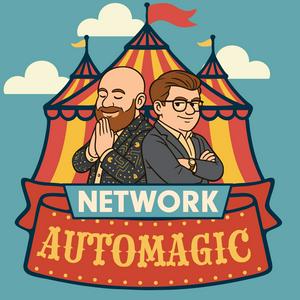
Learn and discover network automation tooling with Steinn & Urs
Podcast websiteListen to Network Automagic, All-In with Chamath, Jason, Sacks & Friedberg and many other podcasts from around the world with the radio.net app
Get the free radio.net app
- Stations and podcasts to bookmark
- Stream via Wi-Fi or Bluetooth
- Supports Carplay & Android Auto
- Many other app features
Get the free radio.net app
- Stations and podcasts to bookmark
- Stream via Wi-Fi or Bluetooth
- Supports Carplay & Android Auto
- Many other app features
Network Automagic
Scan code,
download the app,
start listening.
download the app,
start listening.
 Australia