PodcastsArtsThe Classical Music Minute

The Classical Music Minute

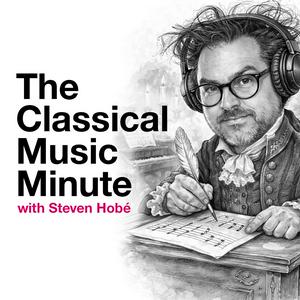
Steven Hobé, Composer & Host
The Classical Music Minute
Latest episode

280 episodes

  • The Classical Music Minute

    Why Do Symphony Orchestras Have So Many Violins? | The Classical Music Minute

    22/06/2026 | 1 mins.
    Send us Fan Mail
    Why are there so many violins in a symphony orchestra?
    In this episode of The Classical Music Minute, we explore the role of the violin section and why it often contains more players than any other group in the orchestra.
    Because a single violin produces a relatively delicate sound, many players are needed to create the rich, powerful sonority associated with orchestral strings. Violins also perform much of the orchestra’s melodic and harmonic material, making them central to the overall musical texture.
    Large orchestras often include twenty to thirty violins split between first and second violin sections, helping balance the sound of the brass, woodwinds, and percussion.
    In just sixty seconds, discover why the violin became the largest section of the modern orchestra.
    Fun Fact
    In some of the largest late-Romantic works, composers such as Gustav Mahler and Richard Strauss called for string sections so large that more than forty violins could be on stage at the same time.
    About The Classical Music Minute
    The Classical Music Minute is a short podcast exploring fascinating stories, quirky history, and surprising facts from the world of classical music—all in about sixty seconds.
    Each episode offers a quick and entertaining glimpse into composers, masterpieces, musical traditions, and the curious moments that shaped music history.
    You can also read the written versions of these episodes on Substack, where they’re published as short articles delivered directly to subscribers.
    About Steven, Host
    Steven Hobé is a Canadian composer and actor based in Toronto and a member of the Canadian League of Composers. He is the creator and host of The Classical Music Minute, a series devoted to making classical music history engaging, surprising, and accessible.

    Join me on Substack
  • The Classical Music Minute

    How Do Opera Singers Sing So Loud Without Microphones? | The Classical Music Minute

    15/06/2026 | 1 mins.
    Send us Fan Mail
    How can opera singers be heard over an entire orchestra without any electronic amplification?
    In this episode of The Classical Music Minute, we explore the fascinating science behind operatic singing. Contrary to popular belief, opera singers do not simply sing louder than everyone else. Instead, they train for years to develop breath control, resonance, and efficient vocal production.
    One key advantage is the “singer’s formant,” a special concentration of sound frequencies that allows the voice to stand out above the orchestra. Combined with the acoustics of traditional opera houses, this enables singers to project their voices to thousands of listeners without microphones.
    It’s a remarkable blend of artistry, technique, and acoustical science.
    In just sixty seconds, discover how opera singers fill large theatres with the power of the human voice alone.
    Fun Fact
    Before microphones became common in theatres, opera singers were among the loudest unamplified performers in the world. Some voices could be heard clearly in venues holding more than 2,000 people.
    About The Classical Music Minute
    The Classical Music Minute is a short podcast exploring fascinating stories, quirky history, and surprising facts from the world of classical music—all in about sixty seconds.
    Each episode offers a quick and entertaining glimpse into composers, masterpieces, musical traditions, and the curious moments that shaped music history.
    You can also read the written versions of these episodes on Substack, where they’re published as short articles delivered directly to subscribers.
    About Steven, Host
    Steven Hobé is a Canadian composer and actor based in Toronto and a member of the Canadian League of Composers. He is the creator and host of The Classical Music Minute, a series devoted to making classical music history engaging, surprising, and accessible.
    Topics Covered
    opera singers, how do opera singers sing so loud, singer's formant, opera voice training, classical singing, operatic technique, opera acoustics, vocal resonance, opera without microphones, classical music explained, opera facts, human voice projection

    Join me on Substack
  • The Classical Music Minute

    Why Is Beethoven’s Ninth Symphony So Important? | The Classical Music Minute

    08/06/2026 | 1 mins.
    Send us Fan Mail
    Why is Beethoven’s Ninth Symphony considered one of the most important works in classical music?
    In this episode of The Classical Music Minute, we explore the revolutionary ideas behind Beethoven’s final completed symphony. Premiered in 1824, the work broke new ground by introducing a choir and vocal soloists into the final movement—something virtually unheard of in a symphony at the time.
    The famous Ode to Joy theme, based on Friedrich Schiller’s poem, celebrates unity, friendship, and the common bonds that connect humanity. Combined with the symphony’s unprecedented scale and emotional depth, it helped redefine what orchestral music could achieve.
    The work’s influence can still be heard today, and its message continues to resonate across cultures and generations.
    In just sixty seconds, discover why Beethoven’s Ninth Symphony changed music history forever.
    Fun Fact
    The Ode to Joy melody from Beethoven’s Ninth Symphony was adopted as the anthem of the Council of Europe in 1972 and later became the official anthem of the European Union, making it one of the most widely recognized pieces of classical music in the world.
    About The Classical Music Minute
    The Classical Music Minute is a short podcast exploring fascinating stories, quirky history, and surprising facts from the world of classical music—all in about sixty seconds.
    Each episode offers a quick and entertaining glimpse into composers, masterpieces, musical traditions, and the curious moments that shaped music history.
    You can also read the written versions of these episodes on Substack, where they’re published as short articles delivered directly to subscribers.
    About Steven, Host
    Steven Hobé is a Canadian composer and actor based in Toronto and a member of the Canadian League of Composers. He is the creator and host of The Classical Music Minute, a series devoted to making classical music history engaging, surprising, and accessible.
    Topics Covered
    Beethoven Ninth Symphony, why is Beethoven's Ninth important, Ode to Joy, Beethoven symphonies, choral symphony, Ludwig van Beethoven, classical music history, famous symphonies, Beethoven deafness, Ode to Joy meaning, music history explained, European anthem

    Join me on Substack
  • The Classical Music Minute

    What Is the Difference Between Opera and Operetta? | The Classical Music Minute

    02/06/2026 | 1 mins.
    Send us Fan Mail
    What is the difference between opera and operetta?
    In this episode of The Classical Music Minute, we explore two closely related forms of musical theatre. Opera is usually larger in scale and often more serious in tone, with music driving the drama from beginning to end. Many operas deal with intense themes such as love, tragedy, power, fate, and betrayal.
    Operetta, whose name means “little opera,” is generally lighter and more comic. It often includes spoken dialogue, catchy melodies, romantic plots, mistaken identities, and a playful theatrical style.
    Popularized by composers such as Johann Strauss II and Franz Lehár, operetta became especially fashionable in nineteenth-century Vienna and later influenced the development of musical theatre.
    In just sixty seconds, discover how opera and operetta are connected, and why one tends to bring the drama while the other brings the sparkle.
    Fun Fact
    Operetta helped shape the modern musical. Its combination of spoken dialogue, memorable songs, romance, and comedy influenced later stage works on Broadway and in London’s West End.
    About The Classical Music Minute
    The Classical Music Minute is a short podcast exploring fascinating stories, quirky history, and surprising facts from the world of classical music—all in about sixty seconds.
    Each episode offers a quick and entertaining glimpse into composers, masterpieces, musical traditions, and the curious moments that shaped music history.
    You can also read the written versions of these episodes on Substack, where they’re published as short articles delivered directly to subscribers.
    About Steven, Host
    Steven Hobé is a Canadian composer and actor based in Toronto and a member of the Canadian League of Composers. He is the creator and host of The Classical Music Minute, a series devoted to making classical music history engaging, surprising, and accessible.
    Topics Covered
    opera vs operetta, difference between opera and operetta, what is operetta, opera explained, operetta explained, classical music terms, musical theatre history, Johann Strauss II, Franz Lehár, Die Fledermaus, The Merry Widow, classical music for beginners

    Join me on Substack
  • The Classical Music Minute

    Why Did Beethoven Go Deaf? | The Classical Music Minute

    26/05/2026 | 1 mins.
    Send us Fan Mail
    Why did Beethoven lose his hearing?
    In this episode of The Classical Music Minute, we explore one of the most famous mysteries in music history. Ludwig van Beethoven began experiencing hearing problems in his late twenties, including ringing in the ears and difficulty hearing high sounds and distant voices.
    By 1802, he knew the condition was serious and progressive. During a stay in Heiligenstadt, he wrote the deeply personal Heiligenstadt Testament, describing the distress caused by his hearing loss.
    Although many possible causes have been suggested, including illness, infection, autoimmune disease, and lead exposure, the exact reason for Beethoven’s deafness remains uncertain.
    What makes his story extraordinary is that he continued to compose some of his most powerful music even as his hearing declined.
    In just sixty seconds, discover how Beethoven’s deafness became part of one of the most remarkable creative stories in classical music.
    Fun Fact
    Beethoven’s Ninth Symphony premiered in 1824, when he was profoundly deaf. According to one famous account, he could not hear the audience applauding and had to be turned around to see their reaction.
    About The Classical Music Minute
    The Classical Music Minute is a short podcast exploring fascinating stories, quirky history, and surprising facts from the world of classical music—all in about sixty seconds.
    Each episode offers a quick and entertaining glimpse into composers, masterpieces, musical traditions, and the curious moments that shaped music history.
    You can also read the written versions of these episodes on Substack, where they’re published as short articles delivered directly to subscribers.
    About Steven, Host
    Steven Hobé is a Canadian composer and actor based in Toronto and a member of the Canadian League of Composers. He is the creator and host of The Classical Music Minute, a series devoted to making classical music history engaging, surprising, and accessible.
    Topics Covered
    Beethoven deafness, why did Beethoven go deaf, Beethoven hearing loss, Ludwig van Beethoven, Heiligenstadt Testament, Beethoven Ninth Symphony, Beethoven biography, classical music history, composers with hearing loss, Beethoven facts

    Join me on Substack

More Arts podcasts
About The Classical Music Minute
The Classical Music Minute is a short, engaging classical music podcast that explores the stories, composers, and curious traditions behind the world’s greatest music.Ever wondered who the Florentine Camerata were? Where the conductor’s baton came from? Or what the difference is between opera buffa and opera seria?Hosted by Canadian composer and storyteller Steven Hobé, each episode offers a quick and entertaining journey through classical music history, uncovering fascinating facts about composers, famous works, opera, orchestras, and musical traditions.Whether you’re a lifelong music lover or simply curious about classical music, hop around music history with Steven—one musical minute at a time.
Podcast website

Listen to The Classical Music Minute, Vain-ish and many other podcasts from around the world with the radio.net app

Get the free radio.net app

  • Stations and podcasts to bookmark
  • Stream via Wi-Fi or Bluetooth
  • Supports Carplay & Android Auto
  • Many other app features