

Listen to this podcast in the app for free: Download for free in the App Store
radio.net
Sleep timer
Save favourites
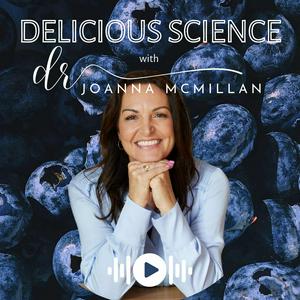
Delicious Science with Dr Joanna McMillan
With Dr Joanna McMillan
Latest episode
14 episodes
HOLY SH!T: The Case for Fibre
28/09/2026 | 18 mins.“Fibre isn’t sexy. But the science of fibre truly is.”
Fibre has an image problem. Say the word out loud and most people think poo, farts, bloating — maybe your grandmother’s cereal box. Hardly the stuff of food joy.
Delicious Science with Dr Joanna McMillan is a reader-supported publication. To receive new posts and support my work, consider becoming a free or paid subscriber.
But fibre isn’t just about your bowels. It’s touching your gut microbiome, your heart, chronic inflammation, your weight, your blood sugar, your brain and your body’s own detox systems — often all at once, from the same humble, chewy part of real food that’s quietly disappeared from most of our plates.
In this special episode, I take you inside my book, The Fibre Factor (Penguin, out now), chapter by chapter — the science, the surprises, and a taste of what’s waiting for you in each one.
In This Episode
· Why fibre vanished from our plates over the last century — and just how big the global “fibre famine” really is
· Why “fibre” isn’t one thing: meeting the very different characters in the fibre line-up, from psyllium to resistant starch to beta-glucan
· MACs and short-chain fatty acids: how your gut microbes turn fibre into butyrate, propionate and acetate — and why that matters for nearly every system in your body
· What actually happens when fibre doesn’t agree with you, and how to work with your gut instead of against it
· The real mechanism behind fibre and cholesterol — and how much you actually need
· The gut–inflammation connection, and why it underpins so many chronic diseases
· How fibre triggers your own GLP-1 and PYY release
· What a genuinely normal blood sugar curve looks like — and where continuous glucose monitors can mislead healthy people
· The gut–brain axis, the vagus nerve, and the 2025 Nurses’ Health Study finding on healthy ageing
· Why “detox” doesn’t need a juice cleanse — and what fibre’s real job is in your body’s clean-up crew
· How to actually get there: 30 grams of fibre a day, 30-plus plant foods a week, no gram-counting required
About the Book
The Fibre Factor by Dr Joanna McMillan
Penguin | Trade paperback, ebook & audiobook | RRP $36.99 | Out now
Also in Spanish - La Clave Esta En La Fibra
Chapters:
1. The Fibre Fallout — how fibre fell off the plate, and why we need to bring it back
2. Fibre 101 — meet fibre in all its forms, from gritty to gummy, simple to sophisticated
3. The Prebiotic Powerhouses — microbiome fuel 101: MAC attack
4. Fibre and Your Gut — from first chew to final flush
5. Fibre and Your Heart — cholesterol, blood pressure and cardiovascular health
6. Fibre and Inflammation — why fibre helps calm the fire
7. Fibre and Your Waistline — satiety, GLP-1, and metabolism
8. Fibre and Blood Sugar — flatten the curve
9. Fibre and Your Brain — the gut–brain highway
10. Fibre and Detox Done Right — your microbiome’s own detox toolkit
11. Your Fibre Dream Team — meet the Grain Gang, Pod Squad, Veggie League, Fruit Force, Lovable Nutbags and Seedy Characters
12. Fibre in Play — your fibre-fuelled kitchen, where the science hits your plate
Available now wherever you get your books.
Related Episode
GLP-1 Drugs: The Skinny on Weight Loss, Nutrition, and Health
For the full mechanism behind the natural GLP-1 story referenced in this episode — plus nutritional risks to watch for on GLP-1 medications and how to support your own appetite hormones through diet — go back to this earlier episode.
Connect with Jo
· Website: drjoanna.com
· Instagram / TikTok / Facebook / Threads / LinkedIn: @drjoannamcmillan
· YouTube: @drjomcmillan
· Substack: Delicious Science with Dr Joanna McMillan
Enjoyed This Episode?
If this gave you a taste for the full story, share it with someone whose gut could use the good news. Subscribe, leave a review, and grab a copy of The Fibre Factor — it genuinely helps others find both the show and the book.
Dr Joanna McMillan is a PhD-qualified nutrition scientist and Accredited Practising Dietitian. This podcast is for educational purposes and does not constitute personal medical or dietary advice. If you have a diagnosed gut condition such as IBS or IBD, speak with your dietitian or GP before making significant changes to your fibre intake.
Delicious Science with Dr Joanna McMillan is a reader-supported publication. To receive new posts and support my work, consider becoming a free or paid subscriber.
Get full access to Delicious Science with Dr Joanna McMillan at drjoannamcmillan.substack.com/subscribeStrength, Independence and the Science of Staying Strong
25/08/2026 | 22 mins.Delicious Science with Dr Joanna McMillan is a reader-supported publication. To receive new posts and support my work, consider becoming a free or paid subscriber.
Get full access to Delicious Science with Dr Joanna McMillan at drjoannamcmillan.substack.com/subscribeGLP-1 Drugs & Diet Culture
03/08/2026 | 21 mins.Delicious Science with Dr Joanna McMillan is a reader-supported publication. To receive new posts and support my work, consider becoming a free or paid subscriber.
Get full access to Delicious Science with Dr Joanna McMillan at drjoannamcmillan.substack.com/subscribeAnimals vs. Plants
26/06/2026 | 31 mins.In this episode of Delicious Science, I’m diving into one of nutrition’s most heated debates: plants versus animals. Should we all be eating more plants? Are animal foods unfairly maligned? And can a diet include meat, fish, eggs and dairy while still supporting health and sustainability?
My answer is a resounding yes — but with nuance.
I explore why humans evolved as omnivores, why whole plant foods are essential for fibre, phytonutrients, gut health and long-term disease prevention, and why animal foods bring important nutrients that are harder to replace, including high-quality protein, haem iron, vitamin B12, zinc, iodine, omega-3s and lesser-known “zoonutrients” such as creatine, choline, taurine and carnosine.
We also tackle sustainability, where the story is far more complex than “plants good, animals bad”. How food is produced, how much we waste, and how much ultra-processed food we eat all matter enormously.
This episode introduces my Plant-Rich Omnivore approach — or PRO diet — a way of eating built on diversity, balance and joy: plenty of vegetables, legumes, whole grains, nuts, seeds, herbs, spices and olive oil, with quality animal foods included thoughtfully.
Because nutrition should not make us more anxious. It should help us eat better, feel better, and enjoy food more.
Listen in if you’re tired of the diet wars and ready for a more delicious, science-backed middle ground.
Delicious Science with Dr Joanna McMillan is a reader-supported publication. To receive new posts and support my work, consider becoming a free or paid subscriber.
Get full access to Delicious Science with Dr Joanna McMillan at drjoannamcmillan.substack.com/subscribeFive Stars for What? The Health Star Rating's Blind Spot
11/06/2026 | 30 mins.Dr. Joanna McMillan critically examines the limitations of the Health Star Rating system, especially its application to cooking oils like extra virgin olive oil, and advocates for a more nuanced approach to food labeling that reflects food complexity and dietary patterns.
keywords
Health Star rating, food labeling, extra virgin olive oil, nutrition science, food complexity, dietary patterns, public health, food policy
00:00 The Health Star Rating: An Overview
02:52 Understanding the Algorithm Behind Health Star Ratings
06:27 The Case Against Cooking Oils in Health Star Ratings
10:38 The Complexity of Food Beyond Nutrients
15:18 Dairy and the Health Star Rating: A Case Study
19:01 Nuts and Seeds: A Positive Example
21:59 The Meat Category and Health Star Ratings
26:18 Learning from Global Systems: Nutri-Score and Beyond
30:00 Recommendations for a Better Health Star Rating System
33:38 Conclusion: The Future of Food Labeling
Get full access to Delicious Science with Dr Joanna McMillan at drjoannamcmillan.substack.com/subscribe
More Health & Wellness podcasts
 Steph & LauraHealth & Wellness, Kids & Family, Mental Health, Parenting, Relationships, Society & Culture
 The ImperfectsEducation, Health & Wellness, Mental Health, Self-Improvement
 Passion Struck with John R. MilesAlternative Health, Education, Health & Wellness, Mental Health, Self-Improvement
 What's That Rash?Health & Wellness, Medicine
 Huberman LabHealth & Wellness, Life Sciences, Science
 On Purpose with Jay ShettyBusiness, Health & Wellness, Mental Health
 All In The MindHealth & Wellness, Life Sciences, Mental Health, Science
 Health ReportHealth & Wellness, Medicine
 Nothing much happens: bedtime stories to help you sleepFiction, Health & Wellness
 Maintenance PhaseEducation, Health & Wellness, History
Trending Health & Wellness podcasts
 The Good GPEducation, Health & Wellness, Medicine
 All in the MindHealth & Wellness, Science
- Delicious Science with Dr Joanna McMillanHealth & Wellness, Nutrition, Science
 The Neuro ExperienceEducation, Health & Wellness, Medicine
 Good Humans with Cooper ChapmanEducation, Health & Wellness, Mental Health, Personal Journals, Self-Improvement, Society & Culture, Sports
 姐妹悄悄話|SistersTalkTalkShowHealth & Wellness, Mental Health, Society & Culture
 The Way Forward with Alec ZeckAlternative Health, Arts, Education, Health & Wellness, Self-Improvement, Society & Culture
 Emergency Medicine CasesCourses, Education, Health & Wellness, Medicine, Science
 Sexy StoriesHealth & Wellness, Sexuality
About Delicious Science with Dr Joanna McMillan
Get straight-talking tips, science-backed insights, and everything you need to fuel your health, feed your gut, and power your brain—without the fluff. drjoannamcmillan.substack.com
Podcast websiteListen to Delicious Science with Dr Joanna McMillan, Steph & Laura and many other podcasts from around the world with the radio.net app
Get the free radio.net app
- Stations and podcasts to bookmark
- Stream via Wi-Fi or Bluetooth
- Supports Carplay & Android Auto
- Many other app features
Get the free radio.net app
- Stations and podcasts to bookmark
- Stream via Wi-Fi or Bluetooth
- Supports Carplay & Android Auto
- Many other app features
Delicious Science with Dr Joanna McMillan
Scan code,
download the app,
start listening.
download the app,
start listening.
 Australia