
Listen to this podcast in the app for free: Download for free in the App Store
radio.net
Sleep timer
Save favourites
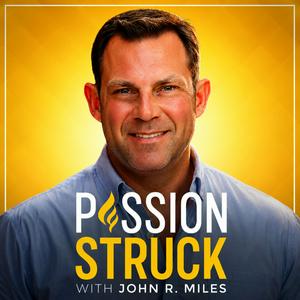
Passion Struck with John R. Miles
Passion Struck with John R. Miles
Latest episode
839 episodes
Harvard Psychologist: College Students Have Always Struggled. So What Has Changed? | Alexis Redding – EP 838
27/10/2026 | 59 mins.What if today's young people aren't as different from previous generations as we think?
When Alexis Redding and her colleagues uncovered interviews with college students from the 1970s, they found familiar stories of loneliness, academic pressure, family expectations, and uncertainty about the future.
In this episode of Passion Struck, the Harvard developmental psychologist and editor of Mental Health in College: What Research Tells Us About Supporting Students explores what has changed across generations, why belonging matters to student well-being and success, and how parents, educators, and institutions can create environments where young adults feel seen, heard, valued, and encouraged.
Together, Miles and Redding examine the pressure to achieve, the myth of effortless perfection, the importance of student voices, and why learning to pivot may be one of the most valuable skills young adults can develop.
In This Episode, You'll Discover
What archival recordings reveal about the similarities between college students across generations.
Why blaming “kids these days” gets in the way of meaningful solutions.
How belonging influences academic performance, help-seeking, persistence, and graduation.
Why colleges need a campus-wide culture of care—not just a crisis-response model.
How parents and educators can share their own failures and uncertainties to help young people feel less alone.
Why perfectionism and achievement pressure make it harder for students to take risks and explore.
How small changes in language can encourage curiosity rather than prescribe a single path.
Why career pivots and reinvention are normal parts of adulthood, not signs of failure.
The Bigger Idea
Young people don't need adults to pretend that life follows a predictable path. They need environments where they can struggle, ask for help, take risks, and learn to find their way. When students feel that they belong, they have more freedom to grow.
Alexis Redding's work reminds us that the question isn't simply what's wrong with young people. It's what we can change about the environments surrounding them.
LinkedIn: https://www.linkedin.com/in/alexisredding/
Get the full show notes here.
Pre-Order The Mattering Effect: https://matteringeffect.com/. Take the 90-second diagnostic to see if you're disappearing.
Explore the Show: https://passionstruck.com/starter-packs/. New to Passion Struck? Start with the best episodes curated for you.
Connect with John
Website: https://johnrmiles.com
Book John to Speak: https://johnrmiles.com/speaking/
Substack: https://www.theignitedlife.net/
Children’s Book — You Matter, Luma: https://youmatterluma.com/
Support the Movement: https://startmattering.com/. Every human deserves to feel seen, valued, and like they matter. Wear it. Live it. Show it.
Passion Struck — #1 Alternative Health Podcast. 85M+ downloads.
Disclaimer
The Passion Struck podcast is for educational and entertainment purposes only. The views and opinions expressed do not necessarily reflect those of Passion Struck or its affiliates. This podcast is not a substitute for professional medical or psychological advice.
Hosted by Simplecast, an AdsWizz company. See pcm.adswizz.com for information about our collection and use of personal data for advertising.3 Questions to Stop Letting Other People Define Your Worth | John R. Miles - EP 837
23/10/2026 | 24 mins.What happens when the next achievement matters more than the one you just reached?
Even after The Mattering Effect landed on the USA Today bestseller list, John caught himself immediately checking where it might rank on the NYT bestseller list. That instinct revealed how deeply conditioned even the most intentional leaders are to let external scorecards dictate internal worth.
In this solo series finale, John connects the dots across three essential conversations:
Dr. Nir Halevy (Stanford): How tournament theory and stacked rankings pull teams apart and breed learned helplessness.
Dr. Kristin Neff (UT Austin): How the environment's scorecard moves inside your head as a ruthless inner critic—and why self-compassion provides the safe soil for true agency.
Heather Monahan: What it looks like to recognize you built your own cage, stop shrinking yourself, stand tall, and know when to change your room versus change your mindset.
Drawing on a timeless parable from Antoine de Saint-Exupéry’s The Little Prince, John examines our cultural obsession with "the figures" and delivers The Blueprint Check: a concrete, three-question diagnostic framework to run on your workplace, your social feeds, and your daily life.
Key Takeaways
The Scorecard Trap: Why rankings, quotas, and follower counts tell us where we stand relative to others—but not who we are.
Tournament Theory at Work: How outsized rewards for top performers can fuel destructive competition, while others disengage or begin to experience what Martin Seligman called learned helplessness.
Self-Esteem vs. Self-Compassion: Why constantly evaluating yourself keeps you on the achievement treadmill, while self-compassion helps you respond to setbacks with greater clarity and agency.
The Worcester Academy Realization: How Heather Monahan discovered that the room hadn't changed—her perception of herself had—and why it's equally important to recognize when a genuinely toxic environment needs to change.
The Three-Part Move: How to reclaim agency by changing your response, working to change the environment, or leaving a system that refuses to change.
Your worth was never meant to be a number on someone else's scorecard. The goal isn't to stop measuring your progress. It's to stop confusing your performance with your value as a person.
Click here for the full show notes.
Pre-Order The Mattering Effect: https://matteringeffect.com/. Take the 90-second diagnostic to see if you're disappearing.
Explore the Show: https://passionstruck.com/starter-packs/. New to Passion Struck? Start with the best episodes curated for you.
Connect with John
Website: https://johnrmiles.com
Book John to Speak: https://johnrmiles.com/speaking/
Substack: https://www.theignitedlife.net/
Children’s Book — You Matter, Luma: https://youmatterluma.com/
Support the Movement: https://startmattering.com/. Every human deserves to feel seen, valued, and like they matter. Wear it. Live it. Show it.
Passion Struck — #1 Alternative Health Podcast. 85M+ downloads.
Disclaimer
The Passion Struck podcast is for educational and entertainment purposes only. The views and opinions expressed do not necessarily reflect those of Passion Struck or its affiliates. This podcast is not a substitute for professional medical or psychological advice.
Hosted by Simplecast, an AdsWizz company. See pcm.adswizz.com for information about our collection and use of personal data for advertising.Why You Keep Doubting Yourself and How to Rebuild Your Confidence | Heather Monahan - EP 836
22/10/2026 | 59 mins.What happens when you spend years proving yourself, only to find that the people around you make you question your worth?
Heather Monahan knows firsthand how that experience can change you. After rising to the C-suite as a chief revenue officer, she was unexpectedly fired from the company where she had built her career. Rather than retreating from the setback, she shared her story publicly, asked for help, and turned a painful ending into the beginning of an entirely new chapter.
A 2X bestselling author, TEDx speaker, host of the Creating Confidence podcast, and board member, Heather was also named one of Real Leaders’ Top 50 Keynote Speakers in 2022. Through her work, she helps people build confidence, overcome obstacles, and recognize their own potential.
In this conversation, Heather shares why confidence isn’t something you’re simply born with. It’s built through the actions you take, the risks you’re willing to face, and the choices you make when life doesn’t go according to plan. Together, we explore how to recognize toxic environments, stand up for yourself without losing your integrity, and stop allowing other people’s opinions to define who you are
In this episode, you’ll discover:
Why self-doubt can persist even when you’re successful.
How your environment can either strengthen your confidence or slowly erode it.
Why Heather believes you should never take a no from someone who can’t give you a yes.
What toxic workplace dynamics can cost you, and when it’s time to walk away.
How Heather turned being fired into a career-changing opportunity.
Why confidence is built through small actions, not one defining moment.
How to use fear as a signal to move forward instead of retreat.
How journaling can help you identify the beliefs and relationships holding you back.
Why setting boundaries is essential to protecting your growth.
You don’t have to wait until you feel confident to make a change. You build confidence by taking the next step, especially when it scares you. And sometimes, the environment you’re afraid to leave is the very thing keeping you from becoming who you could be.
Grab the full show notes here.
Download the Companion Workbook.
Pre-Order The Mattering Effect: https://matteringeffect.com/. Take the 90-second diagnostic to see if you're disappearing.
Explore the Show: https://passionstruck.com/starter-packs/. New to Passion Struck? Start with the best episodes curated for you.
Connect with John
Website: https://johnrmiles.com
Book John to Speak: https://johnrmiles.com/speaking/
Substack: https://www.theignitedlife.net/
Children’s Book — You Matter, Luma: https://youmatterluma.com/
Support the Movement: https://startmattering.com/. Every human deserves to feel seen, valued, and like they matter. Wear it. Live it. Show it.
Passion Struck — #1 Alternative Health Podcast. 85M+ downloads.
Disclaimer
The Passion Struck podcast is for educational and entertainment purposes only. The views and opinions expressed do not necessarily reflect those of Passion Struck or its affiliates. This podcast is not a substitute for professional medical or psychological advice.
Hosted by Simplecast, an AdsWizz company. See pcm.adswizz.com for information about our collection and use of personal data for advertising.Why Your Workplace Turns Colleagues Into Competitors | Dr. Nir Halevy – EP 835
20/10/2026 | 59 mins.Why do some teams bring out the best in people while others turn colleagues into competitors? The answer may lie in the way we structure power, status, and success.
On this episode of Passion Struck, I sit down with Dr. Nir Halevy, a Stanford professor who studies social influence, power, and human behavior, to explore his book, Level Up: Why Hierarchies Are Broken and How to Fix Them.
Drawing on decades of research and real-world examples from elite sports, healthcare, academia, and corporate America, Nir explains why hierarchy itself isn't necessarily the problem. The real issue is whether the systems we create encourage people to work together or push them to succeed at one another's expense.
We discuss:
Why hierarchies persist: Why eliminating hierarchy is rarely practical, and how to distinguish structures that help teams function from those that create harm.
The danger of forced rankings: How pitting employees against one another can encourage information hoarding, rivalry, and even sabotage.
The psychology of social comparison: Why another person's success can change how we experience our own, even when nothing about our performance has changed.
Dominance versus prestige: The difference between leading through intimidation and leading through competence, contribution, and respect.
The three warning signs of a broken hierarchy: Excessive competition, injustice, and instability—and how they undermine trust and retention.
Why fairness matters: How unfair outcomes, opaque procedures, and disrespectful treatment combine to make people feel powerless.
What leaders can learn from improv: How active listening, psychological safety, empathy, and making your teammates look good can strengthen relationships.
How to build healthier teams: Why leaders should create multiple ways for people to contribute and demonstrate their value, rather than tying worth to a single ranking.
Nir leaves us with one question every leader should consider: Does your hierarchy bring people closer together or pull them apart? Because the goal isn't to eliminate structure. It's to build systems in which people can succeed without making others feel like they have to lose.
See the Full Shownotes.
Pre-Order The Mattering Effect: https://matteringeffect.com/. Take the 90-second diagnostic to see if you're disappearing.
Explore the Show: https://passionstruck.com/starter-packs/. New to Passion Struck? Start with the best episodes curated for you.
Connect with John
Website: https://johnrmiles.com
Book John to Speak: https://johnrmiles.com/speaking/
Substack: https://www.theignitedlife.net/
Children’s Book — You Matter, Luma: https://youmatterluma.com/
Support the Movement: https://startmattering.com/. Every human deserves to feel seen, valued, and like they matter. Wear it. Live it. Show it.
Passion Struck — #1 Alternative Health Podcast. 85M+ downloads.
Disclaimer
The Passion Struck podcast is for educational and entertainment purposes only. The views and opinions expressed do not necessarily reflect those of Passion Struck or its affiliates. This podcast is not a substitute for professional medical or psychological advice.
Hosted by Simplecast, an AdsWizz company. See pcm.adswizz.com for information about our collection and use of personal data for advertising.Why Success Can Leave You Feeling Like You Don't Matter | John R. Miles & Linda Hurtado – EP 834
16/10/2026 | 1h 6 mins.What happens when you achieve the life you thought you wanted, only to realize you no longer feel connected to it?
For John R. Miles, that question became impossible to ignore. After years of executive success, demanding workweeks, and responsibilities that kept growing, a simple question from his young son stopped him in his tracks: “Dad, why don't you ever laugh anymore?”
In this special live conversation from the launch of The Mattering Effect at the St. Petersburg Museum of History, John sits down with Emmy Award-winning Fox 13 anchor Linda Hurtado to explore the experiences that led him to investigate a question millions of people quietly carry: Do I matter?
John explains why success and mattering are not the same, how the environments around us can reward what we produce while overlooking who we are, and how this gradual loss of connection can lead to what he calls the Great Erasure.
In this conversation, you'll discover:
Why achievement doesn't always lead to meaning or fulfillment.
How the Great Erasure happens when systems extract our value without reflecting our worth.
Why loneliness, burnout, and disengagement may share a deeper underlying cause.
How the M.A.T.T.E.R. framework identifies six conditions that help people feel significant: Meaning, Autonomy, Trust, Time, Energy, and Reciprocity.
What John learned from transforming a struggling employee engagement team at Lowe's.
Why the Slow Fade can leave you feeling increasingly disconnected before you recognize what's happening.
How to begin rebuilding mattering through personal choices, stronger relationships, and environments that support your well-being.
What leaders and parents can do to help people feel seen, including the power of undivided attention and asking what support someone needs.
How Linda's decision to leave a workplace where she no longer felt valued illustrates the importance of recognizing your own worth.
The conversation also explores John's personal turning points, the experiences that prompted him to reconsider his priorities, and why rebuilding a sense of mattering starts with how we treat ourselves and the people closest to us.
The central takeaway: You can climb the mountain you always wanted to climb and still discover it was the wrong mountain. Sometimes the next step isn't working harder. It's asking what kind of life you're actually building, and whether it allows you and the people around you to feel that you matter.
This is a special episode about the ideas, experiences, and human stories behind The Mattering Effect: Creating a Life of Meaning and Worth.
Pre-Order The Mattering Effect: https://matteringeffect.com/. Take the 90-second diagnostic to see if you're disappearing.
Explore the Show: https://passionstruck.com/starter-packs/. New to Passion Struck? Start with the best episodes curated for you.
Connect with John
Website: https://johnrmiles.com
Book John to Speak: https://johnrmiles.com/speaking/
Substack: https://www.theignitedlife.net/
Children’s Book — You Matter, Luma: https://youmatterluma.com/
Support the Movement: https://startmattering.com/. Every human deserves to feel seen, valued, and like they matter. Wear it. Live it. Show it.
Passion Struck — #1 Alternative Health Podcast. 85M+ downloads.
Disclaimer
The Passion Struck podcast is for educational and entertainment purposes only. The views and opinions expressed do not necessarily reflect those of Passion Struck or its affiliates. This podcast is not a substitute for professional medical or psychological advice.
Hosted by Simplecast, an AdsWizz company. See pcm.adswizz.com for information about our collection and use of personal data for advertising.
More Alternative Health podcasts


Trending Alternative Health podcasts

About Passion Struck with John R. Miles
You built the life you were supposed to want. So why doesn't it feel like enough? Passion Struck is the #1 Health and Fitness podcast — and it exists to answer exactly that question. I'm John R. Miles — Navy veteran, former Fortune 50 executive, bestselling author — and I built this show because I lived the "successful but empty" version of life myself, and I wanted to find a better way. Each week, I sit down with the world's top voices in neuroscience, psychology, medicine, and elite performance — including Angela Duckworth, Susan Cain, Robert Waldinger, Daniel Amen, and Ryan Holiday — to unpack what the research tells us about purpose, connection, and resilience, and how to apply it to your own life. Fridays, I share what I'm learning directly, in solo episodes built around the same ideas. New interviews every Tuesday and Thursday. Solo episodes every Friday.
Podcast websiteListen to Passion Struck with John R. Miles, BETTER! with Dr. Stephanie Estima | Strength, Body Composition & Perimenopause and many other podcasts from around the world with the radio.net app
Get the free radio.net app
- Stations and podcasts to bookmark
- Stream via Wi-Fi or Bluetooth
- Supports Carplay & Android Auto
- Many other app features
Get the free radio.net app
- Stations and podcasts to bookmark
- Stream via Wi-Fi or Bluetooth
- Supports Carplay & Android Auto
- Many other app features
Passion Struck with John R. Miles
Scan code,
download the app,
start listening.
download the app,
start listening.
 Australia