
Listen to this podcast in the app for free: Download for free in the App Store
radio.net
Sleep timer
Save favourites
1023 episodes
Which bands pass the three-year test? – plus the great live albums & rock stars’ alter egos
26/10/2026 | 1h 3 mins.Stirring the spice-filled gumbo of news and turning the heat up. This week’s nutritious ingredients include ….
… is everything better shorter?
… the greatest opening line in a book ever written
… did Tom Waits, Warren Zevon, Joe Cocker, the Bee Gees, Cheap Trick, Sam Cooke, Talking Heads or Bill Evans make the greatest live album of all time?
… the worst beers Buster Poindexter ever had
… rock stars’ alter egos – Lady Gaga as Jo Calderone, Andy Partridge as Sir John Johns, George Clinton as Mr Wiggles, Justin Hawkins as Sir Voltage Blackthorn!
… Blur, Radiohead, Stones, Doors, Steely Dan, Bowie, Leonard Cohen … they all had a three-year golden streak
… “I’m writing a short letter as I don’t have time to write a long one”
… why the Matrix was a watershed moment
… the three stages of success – getting known, the magnum opus, basking in the glow
… and why we love August N'gutu Leibowitz-Clementine.
Plus Ezra Pound, T.S. Eliot, Buckshot La Funke, birthday guest Phil Hopwood and how everyone at the BBC is a gossip.
Help us to keep The Longest Continuous Conversation In Rock'n'Roll going: https://www.patreon.com/wordinyourear
Hosted on Acast. See acast.com/privacy for more information.Dexys, their hits and flops and how I survived them by Helen O’Hara
21/10/2026 | 46 mins.Helen’s violin at the start of Come On Eileen has filled a million wedding dancefloors. She was a member of Dexys Midnight Runners, later their musical director, at the boom time of Too Rye Ay (and its wobbly sequel) and captures the thrill of it all in her just-updated memoir, What’s She Like: A Violinist’s Tale. You’ll love this conversation - warm, candid, forgiving and touching on all the following …
… the day the dungarees arrived
… the tribal nature of bands
… the social skills required in a group as tangled as Dexys who’d “go to the caff and just … not talk!"
… what she learnt from the memorabilia found in her shed
… the myth that she met Kevin Rowland at a bus-stop and her reinvention as “the belle from Ballymena”
… working with Nicky Hopkins (“my hero”), Tom Dowd, Woody Woodmansey and Tanita Tikaram
… Dexys studio method: “focus, discipline, tightness” and trying to record a 12-minute track in one take
… hearing hits by Rod Stewart and Slade that featured violins
… and her swansong: recording Because Of You for the TV sitcom Brush Strokes.
Order copies of ‘What’s She Like’ here: https://www.route-online.com/all-books/whats-she-like
Help us to keep The Longest Continuous Conversation In Rock'n'Roll going: https://www.patreon.com/wordinyourear
Hosted on Acast. See acast.com/privacy for more information.Nigel Dick shot videos for Band Aid, Guns N’Roses, Britney and Oasis by ‘failing upwards’
20/10/2026 | 49 mins.We first met Nigel Dick in the late ‘70s when he was the motorbike messenger for Stiff Records and watched him rocket to success in the video boom, directing career-launching clips for Guns N’Roses, Tears for Fears and Britney Spears and working with Cher, Joni Mitchell and McCartney, all recorded in his memoir ‘Music Video Mischief’. He looks back here on that big-budget golden age and the rise of the amateurs from his home in Colorado and stops off at …
… ‘You have to work out where the power lies’
… the story of the million dollar video
… how he finally found the Axl Rose charisma
… New Boots And Panties, ‘the most radical album to have that level of success’
… Stiff’s ‘frightening, lovable, devious’ Dave Robinson, characteristics every label boss requires
… ‘I’ll make sure you never work in this town again!’
… why the 16 year-old (ex-Mickey Mouse Club) Britney Spears was born for video
… working with his teenage heroes Yes: ‘the beautiful castles I’d built in my mind just collapsed to sand’
… the rise of AI – ‘best to check people haven’t got six fingers and a changing haircut’
… and working with McCartney, Cher, Band Aid, Oasis and Claude Van Damme.
Order copies of ‘Music Video Mischief’ in the UK from: https://uk.bookshop.org/p/books/music-video-mischief-ozzy-to-britney-oasis-to-gn-r-mccartney-to-cher-a-lifetime-of-rock-and-chaos-nigel-dick/619386081ce90352?ean=9798999048783
And in the U.S. from: https://www.trouserpressbooks.com
Help us to keep The Longest Continuous Conversation In Rock'n'Roll going: https://www.patreon.com/wordinyourear
Hosted on Acast. See acast.com/privacy for more information.Tall stories about towering and tiny rock stars, ‘50s jazz and Mick Jagger’s gym shoes
19/10/2026 | 49 mins.Two fearless men journey to the Edge Of News so that you don’t have to. Some highlights of this week’s report …
… when a gig’s all about the performer not the audience
… the power of singing other people’s songs
… can you ever trust a film critic?
… what connects Richard Thompson, Neil Tennant, Loudon Wainwright and Randy Newman?
… “bands can’t look like gangs if they’re not all the same height”
… can you picture ‘50s jazz without cigarette smoke?
… who – dear god – is “achingly cool” according to critics? Miles Davis? The Portico Quartet? Annie Lennox?!
… should we call time on the ailing Mike Love?
… biopics that can’t afford the music
… why Robert Evans hated the American Graffiti soundtrack
… people who perform sitting down
… plus BB King, Jack Bruce, Philip Roth, Woody Guthrie, Woody Allen, James McMurtry and the 15-year old “Michael” Jagger’s gym shoes.
Help us to keep The Longest Continuous Conversation In Rock'n'Roll going: https://www.patreon.com/wordinyourear
Hosted on Acast. See acast.com/privacy for more information.Another Word with … Richard Thompson: includes Fairport, Lennon, Schwarzenegger and a cast of thousands!
15/10/2026 | 35 mins.Richard Thompson has a new album, ‘Hippies, Thugs and Heroes’, and he’s touring again in 2027, the perfect excuse to get another of our favourite guests back in the chair again. He joins us here for a brilliant, free-wheeling conversation with a cast list including …
Arnold Schwarzenegger (and his son Wolfie)
William Shakespeare
Mandy Miller
Shostakovich
Fairport Convention
William Walton
Fellini
John Lennon
Louis Armstrong
Post-War Brighton gangsters
Nellie the Elephant
Les Paul
Harold Pinter
Booker T & the M.G.’s
Bix Beiderbecke
Stephane Grappelli
Ennio Morricone
John Coltrane
Django Reinhardt
My Fair Lady
‘50s radio show Journey Into Space
Once Upon A Time In The West
… his dad (a policeman) and his first girlfriend Deirdre.
Order copies of ‘HIPPIES, THUGS AND HEROES’ here: http://newwst.com/hippies
And tickets here: https://www.richardthompson-music.com/tour-dates/
Help us to keep The Longest Continuous Conversation In Rock'n'Roll going: https://www.patreon.com/wordinyourear
Hosted on Acast. See acast.com/privacy for more information.
More Music podcasts





Trending Music podcasts

















About Word In Your Ear
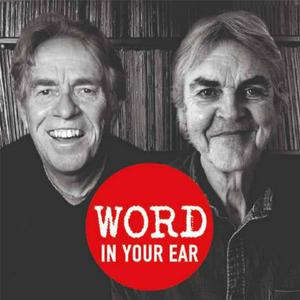
Mark Ellen and David Hepworth have been talking about and writing about music together and individually for a collective eighty years in magazines like Smash Hits, Mojo and The Word and on radio and TV programmes like "Rock On", "Whistle Test" and VH-1.Over thirteen years ago, when working on the late magazine The Word, they began producing podcasts. Some listeners have been kind enough to say these have been very special to them. When the magazine folded in 2012 they kept the spirit of those podcasts alive in regular Word In Your Ear evenings in which they spoke to musicians and authors in front of an audience. Over these years they've produced hundreds of hours of material. As of the Current Unpleasantness of 2020, they've produced yet hundreds of hours more with a little help from guests kind enough to digitally show them around their attics such as Danny Baker, Andy Partridge, Sir Tim Rice and Mark Lewisohn. For the full span of the Word In Your Ear world, visit wiyelondon.com. Hosted on Acast. See acast.com/privacy for more information.
Podcast websiteListen to Word In Your Ear, Strong Songs and many other podcasts from around the world with the radio.net app
Get the free radio.net app
- Stations and podcasts to bookmark
- Stream via Wi-Fi or Bluetooth
- Supports Carplay & Android Auto
- Many other app features
Get the free radio.net app
- Stations and podcasts to bookmark
- Stream via Wi-Fi or Bluetooth
- Supports Carplay & Android Auto
- Many other app features
Word In Your Ear
Scan code,
download the app,
start listening.
download the app,
start listening.
Word In Your Ear: Podcasts in Family
 Australia