
Listen to this podcast in the app for free: Download for free in the App Store
radio.net
Sleep timer
Save favourites
937 episodes
Audio long read: How to stay smart in the age of AI — the science of critical thinking
19/10/2026 | 16 mins.Critical thinking is a skill that is under threat from the AI revolution in large language models. But all is not lost. Specialists in education and cognition have long been studying critical thinking, and some have useful tips on how to stay cognitively sharp in the age of AI.
This is an audio version of our Feature: How to stay smart in the age of AI: the science of critical thinking
Hosted on Acast. See acast.com/privacy for more information.Briefing Chat: An invisible tattoo that appears under UV light – and then disappears
16/10/2026 | 9 mins.In this episode:
00:15 An appearing, disappearing tattoo ink
Nature: Watch this invisible tattoo appear under UV light
04:13 How the epigenome could help explain why big dogs age faster
Nature: Big dogs age faster than little ones — rogue ‘jumping genes’ might be to blame
Subscribe to Nature Briefing, an unmissable daily round-up of science news, opinion and analysis free in your inbox every weekday.
Hosted on Acast. See acast.com/privacy for more information.The world is closer to a major conservation target than scientists thought
14/10/2026 | 21 mins.Analysis suggests number of protected areas is hugely underestimated but biodiversity is still in peril — plus, a huge study looking at the health effects of brown fat.
00:45 The world may have more conservation areas than previously thought
Research Article: O’Neill et al.
08:38 Research Highlights
Nature: The Solar System could die one billion times earlier than thought
Nature: Chimp and gorilla brains resist weight loss with age — unlike human brains
11:19 Giant study expands list of brown fat’s health benefits
Research Article: Gómez-Banoy et al.
Nature: Overlooked 'brown' body fat linked to wide range of health benefits
Subscribe to Nature Briefing, an unmissable daily round-up of science news, opinion and analysis free in your inbox every weekday.
Hosted on Acast. See acast.com/privacy for more information.Briefing Chat: Top researchers are being misled by sham academic societies
09/10/2026 | 12 mins.In this episode we discuss a recent Nature exclusive investigating an international constellation of sham academies and societies that have successfully misled some of the world’s leading scientists and universities.
Nature: Exclusive: Sham scientific societies are misleading star researchers
Subscribe to Nature Briefing, an unmissable daily round-up of science news, opinion and analysis free in your inbox every weekday.
Hosted on Acast. See acast.com/privacy for more information.Nobel Prizes 2026: ‘ghost’ particles, mirror molecules and light switches in the brain
07/10/2026 | 23 mins.In this episode:
00:45 The Nobel Prizes 2026
Nature: Medicine Nobel awarded for brain ‘switch’ that controls neurons with light
Nature: ‘What took them so long?’ This year’s medicine Nobel winner is overdue
Nature: Nobel physics prize awarded for detection of cosmic neutrinos
Nature: Astronomy’s ‘adrenaline junkies’: Nobel prize captures the thrill of neutrino physics
Nature: Chemistry Nobel for solving mystery of how ‘handed’ organic molecules can emerge
11:53 Research Highlights
Nature: Youthful fans of YouTube sports videos stick to the sofa
Nature: A black hole’s jets have a halo effect
14:11 The ancient human gut microbiome
Research Article: Carter et al.
News and Views: Gut microbes that trace ancient human journeys
Subscribe to Nature Briefing, an unmissable daily round-up of science news, opinion and analysis free in your inbox every weekday.
Hosted on Acast. See acast.com/privacy for more information.
More News podcasts







Trending News podcasts












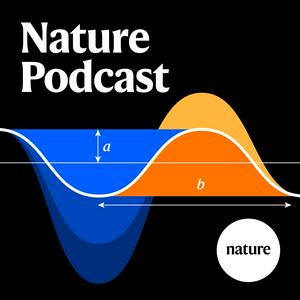
About Nature Podcast
The Nature Podcast brings you the best stories from the world of science each week. We cover everything from astronomy to zoology, highlighting the most exciting research from each issue of the Nature journal. We meet the scientists behind the results and provide in-depth analysis from Nature's award-winning journalists. Hosted on Acast. See acast.com/privacy for more information.
Podcast websiteListen to Nature Podcast, The Daily and many other podcasts from around the world with the radio.net app
Get the free radio.net app
- Stations and podcasts to bookmark
- Stream via Wi-Fi or Bluetooth
- Supports Carplay & Android Auto
- Many other app features
Get the free radio.net app
- Stations and podcasts to bookmark
- Stream via Wi-Fi or Bluetooth
- Supports Carplay & Android Auto
- Many other app features
Nature Podcast
Scan code,
download the app,
start listening.
download the app,
start listening.
 Australia