

Listen to this podcast in the app for free: Download for free in the App Store
radio.net
Sleep timer
Save favourites
72 episodes

Why Companies That Are Great at Innovation Still Fail - with Stanford Professor Charles O'Reilly
05/08/2026 | 43 mins.Most companies know how to innovate. Far fewer know how to scale innovation.
Charles introduces the explore versus exploit framework, explaining why the same systems that help organizations succeed today can make them resistant to change tomorrow. As companies mature, they become better at serving existing customers, improving existing products, and optimizing existing processes. The harder question is how to create space for experimentation without undermining the business that already exists.
Henrik, Jeremy, and Charles explore what this means in the age of AI. They discuss whether AI should be viewed as a substitute or a complement, why Microsoft's transformation under Satya Nadella succeeded, how Amazon has built exploration into its operating system, and why leaders don't create adaptable organizations through vision alone. They do it by shaping culture through incentives, systems, and the behaviors they reward.
Key Takeaways:
The biggest challenge isn't generating ideas. It's scaling them.
Many organizations are good at innovation. The difficult part is giving promising ideas the support they need to grow.
Great companies become trapped by what made them successful.
The metrics, incentives, and culture that optimize today's business can make it harder to adapt to tomorrow's.
Culture is built through systems.
Leadership principles only matter when they're reflected in hiring, incentives, performance reviews, and everyday behavior.
The goal isn't to predict the future. It's to discover it.
The most adaptable organizations build processes that help them experiment, learn, and uncover new opportunities as the world changes.
Charles' Stanford profile: stanford.edu/faculty/charles-oreilly
00:00 Intro: Why Companies Die Fast
00:36 Meet Charles O'Reilly
02:01 Explore Versus Exploit
03:50 AI Substitute Or Complement
06:51 Adaptability As Culture
09:19 Resistance To Change
12:32 Microsoft Culture Turnaround
15:25 Ambidexterity And Lifespans
18:20 Ideate Incubate Scale
20:10 Scaling Needs Separation
24:44 Amazon PRFAQ Machine
34:33 Rituals And Failure Signals
38:05 The Debrief
📜 Read the transcript for this episode: here!
For more prompts, tips, and AI tools. Check out our website: https://www.beyondtheprompt.ai/ or follow Jeremy or Henrik on Linkedin:
Henrik: https://www.linkedin.com/in/werdelin
Jeremy: https://www.linkedin.com/in/jeremyutley
Show edited by Emma Cecilie Jensen.What You Can Learn From Asking AI for Brutal Honesty About Yourself - with Bestselling Author Daniel Pink
22/07/2026 | 50 mins.The conversation begins with an experiment that caught Jeremy's attention. Dan asked ChatGPT to tell him what his friends wouldn't. From questions about his blind spots to what people might say behind his back, some responses felt completely wrong, while others landed with surprising force. Rather than accepting every answer, Dan explains why the real value comes from wrestling with AI's perspective, not simply believing it.
From there, Henrik, Jeremy, and Dan explore what it takes to use AI well. They discuss intellectual humility, prompting models to challenge rather than flatter us, and why AI works best as a sparring partner that exposes weaknesses in our thinking. The conversation also touches on taste, agency, and why, in a world where execution is becoming easier, discernment and original thinking become even more valuable.
Key Takeaways:
Use AI to make your thinking visible
The best AI conversations don't just generate answers. They help you understand your own assumptions, reactions, and ideas more clearly.
Treat AI as a sparring partner
Challenge AI's responses, ask it to critique your work, and use it to strengthen your thinking rather than replace it.
Taste is developed by creating
As AI makes execution easier, judgment and discernment become more valuable. The best way to develop both is by creating, not just consuming.
Agency depends on context
People don't become more agentic through willpower alone. The right environment, with autonomy and room to take risks, makes initiative possible.
Daniel's website: danpink.com
LinkedIn: linkedin.com/danielpink
AI Self-Reflection Prompts: danpink.com/ai-guide/
00:00 AI as a Brutally Honest Advisor
00:32 Meet Daniel Pink
00:47 AI for Self-Knowledge
01:40 A Brutally Honest AI
06:10 What Do People Say Behind Your Back?
07:45 Should You Trust AI's Advice?
13:28 The Fear of Irrelevance
17:44 Intellectual Humility
20:04 AI as a Sparring Partner
24:35 Teaching AI to Think Like You
27:38 Why Taste Matters
29:59 Agency Starts with Context
37:08 A Future That's a Little Better
41:49 Nostalgia vs. Reality
45:18 The Debrief
📜 Read the transcript for this episode: Here!
For more prompts, tips, and AI tools. Check out our website: https://www.beyondtheprompt.ai/ or follow Jeremy or Henrik on Linkedin:
Henrik: https://www.linkedin.com/in/werdelin
Jeremy: https://www.linkedin.com/in/jeremyutley
Show edited by Emma Cecilie Jensen.Are You Qualified to Challenge Your Team on AI? - with Geoff Woods, Author of The AI-Driven Leader
08/07/2026 | 53 mins.Geoff Woods returns to Beyond the Prompt to discuss the updated edition of The AI-Driven Leader and what has changed over the past 18 months. Rather than focusing on the latest AI models, Geoff argues that leaders need to use AI themselves before asking others to, using it to think more clearly, shape strategy, and make better decisions.
The conversation explores why many organizations confuse access with adoption, why strategy should come before use cases, and how AI can change the way leaders approach everything from business strategy to organizational design. Along the way, Henrik and Jeremy challenge Geoff's ideas on authorship, judgment, and whether understanding AI changes what leaders believe is possible.
Key Takeaways:
Leaders need to use AI themselves
Using AI personally is what qualifies leaders to shape strategy and lead others from practice rather than theory.
Use AI to improve your thinking
The biggest opportunity isn't automating work. It's using AI to think better, solve better problems, and imagine new possibilities.
Start with problems, not use cases
Begin with the biggest challenges facing the business, then use AI to rethink how to solve them.
AI still needs human judgment
AI can generate ideas, but people are still responsible for reviewing the output and standing behind it.
Focus AI on your highest-value work
Use AI to amplify the small set of activities where your human strengths create the greatest impact.
The AI-Driven Leader: aileadership.com
Geoff's LinkedIn: linkedin/geoff-woods
00:00 Are You Qualified to Lead on AI?
00:35 Meet Geoff Woods
00:54 The AI Slop Dilemma
05:48 Putting Your Stamp of Approval
09:19 What Changed in 18 Months
12:13 Access Isn't Adoption
15:50 Why Leaders Can't Delegate AI
20:09 Strategy Before Use Cases
22:02 BarkBox's AI Strategy
26:23 Reinventing Strategy with AI
33:11 Compressing Months into Hours
37:22 Human Skills as Superpowers
42:46 The Debrief
📜 Read the transcript for this episode: are-you-qualified-to-challenge-your-team-on-ai-with-geoff-woods-author-of-the-ai-driven-leader/transcript
For more prompts, tips, and AI tools. Check out our website: https://www.beyondtheprompt.ai/ or follow Jeremy or Henrik on Linkedin:
Henrik: https://www.linkedin.com/in/werdelin
Jeremy: https://www.linkedin.com/in/jeremyutley
Show edited by Emma Cecilie Jensen.The Unexpected Economics of AGI - with Christian Catalini, Tech Founder and Co-Creator of Libra
24/06/2026 | 53 mins.Christian believes the AI era will be defined less by generating outputs and more by evaluating them. As intelligence becomes cheaper and more accessible, the people who create the most value may be those who can distinguish good work from exceptional work and help guide increasingly capable systems.
The conversation explores verification, judgment, and why expertise still matters in a world where AI can perform many tasks at a high level. Christian explains why today's experts are both highly valuable and simultaneously training the systems that may eventually replace parts of their work.
Jeremy and Henrik also explore what this means at a personal level. They discuss building AI agents that reflect your own preferences, creating personal verification systems, and why AI may make it easier to learn new skills, switch careers, and pursue more ambitious ideas.
Key Takeaways:
Verification becomes more valuable as intelligence gets cheaper
As AI makes generating outputs easier, the ability to recognize what is actually good becomes increasingly important.
Experts are training their own replacements
The people best positioned to verify AI outputs are also helping codify the expertise that trains future systems.
Human value shifts from doing to directing
As AI handles more execution, people create value through judgment, direction, and orchestration.
Build your own verification system
The best AI users are developing agents, workflows, and tools that reflect their own preferences and standards.
Christian's LinkedIn: linkedin.com/ccatalini/
Christian's X: x.com/ccatalini
Christian's website: catalini.com
Economics of AGI: full paper
Jeremy's Persona File Template: YouTube/The8Files
00:00 Non-Measurable Frontiers
00:32 Meet Christian Catalini
01:08 The Economics of AGI
03:09 Why Verification Matters
06:37 Can Everything Be Measured?
10:32 The Rise of the Verifier
14:35 When Intelligence Gets Cheap
21:46 Building Your Verification Harness
24:08 Human + AI Augmentation
30:18 Persona Files and Privacy
33:12 Reasons for Optimism
36:00 Career Switching in the AI Era
39:31 The Debrief
📜 Read the transcript for this episode: the-unexpected-economics-of-agi-with-christian-catalini-tech-founder-and-co-creator-of-libra/transcript
For more prompts, tips, and AI tools. Check out our website: https://www.beyondtheprompt.ai/ or follow Jeremy or Henrik on Linkedin:
Henrik: https://www.linkedin.com/in/werdelin
Jeremy: https://www.linkedin.com/in/jeremyutley
Show edited by Emma Cecilie Jensen.Why Fear Kills Curiosity and What That Means for AI - with Chantel Prat, Cognitive Neuroscientist
10/06/2026 | 1h 1 mins.Chantel Prat studies how different brains make sense of the world. Her work starts from a simple idea: every experience leaves a mark. The inputs we consume shape how we think, what we notice, and ultimately who we become.
The conversation explores why people often choose familiar rewards over uncertain opportunities to learn. Chantel explains the tension between exploration and exploitation, why curiosity is essential for growth, and how fear can prevent us from engaging with new technologies like AI.
They also discuss theory of mind, cognitive offloading, and what happens when we increasingly rely on AI for thinking. The goal is not simply to do better work, but to use AI in ways that help us become better versions of ourselves.
Key Takeaways:
Curiosity requires safety
When people feel threatened, they become defensive rather than exploratory. Fear gets in the way of learning.
Better inputs create better outputs
Every experience leaves a footprint on the brain. The ideas, conversations, and information we consume shape how we think and who we become.
We naturally favor certainty over exploration
Our brains are biased toward familiar rewards, even when something new may offer greater long-term value.
Curiosity starts with admitting you might be wrong
Learning requires recognizing that you do not already have the answer. Without that openness, exploration never begins.
Use AI to become better, not just produce more
The most important question is not what AI can do for you, but what you still want to get better at yourself.
Chantel Prat: linktr.ee/chantelprat
The Neuroscience of You: The-Neuroscience-of-you/book
00:00 Curiosity Versus Threat
00:31 Meet Chantel Prat
01:02 Why Input Shapes Brains
04:08 The Output Pressure Trap
05:52 Exploration Versus Exploitation
10:05 Average Brains And Teams
15:35 Theory Of Mind Defined
22:12 Practicing With AI Feedback
24:31 Offloading Thinking To AI
29:50 Humans In The Loop
35:16 Age And Tech Reactions
42:15 Why Curiosity Requires Safety
48:15 Personal Codex And AI
50:54 Becoming More Yourself
54:34 The Debrief
📜 Read the transcript for this episode: why-fear-kills-curiosity-and-what-that-means-for-ai-with-chantel-prat-cognitive-neuroscientist/transcript
For more prompts, tips, and AI tools. Check out our website: https://www.beyondtheprompt.ai/ or follow Jeremy or Henrik on Linkedin:
Henrik: https://www.linkedin.com/in/werdelin
Jeremy: https://www.linkedin.com/in/jeremyutley
Show edited by Emma Cecilie Jensen.
More Business podcasts
 The Diary Of A CEO with Steven BartlettBusiness, Education, Society & Culture
 Straight Talk with Mark BourisBusiness, Careers, Education
 CommSec Market UpdateBusiness, Investing
 Equity Mates Investing PodcastBusiness, Education, Investing, Tutorials
 The Money Café with Alan KohlerBusiness, Investing
 money money moneyBusiness, Comedy, Investing
 She's On The MoneyBusiness, Investing
 Get Started InvestingBusiness, Education, Investing
 Prof G MarketsBusiness, Investing
 The Ramsey ShowBusiness, Education, Investing, Self-Improvement
Trending Business podcasts
 The CurveBusiness, Investing
 Motley Fool Hidden Gems InvestingBusiness, Investing
 CNBC's "Fast Money"Business, Investing, News
 Market UpdatesBusiness, Investing
 Uncensored CMOBusiness, Entrepreneurship, Marketing
 Tom Bilyeu's Impact TheoryBusiness, News, News Commentary, Philosophy, Society & Culture
 The Follio Property PodcastBusiness, Investing
 Property Investment & Wealth Creation Australia | The Michael Yardney PodcastBusiness, Investing
 半拿铁 | 商业沉浮录Business, Business News, Entrepreneurship, History, News
 The Economics of Everyday ThingsBusiness
 The Koerner Office - Business Ideas and Deep Dives with Chris KoernerBusiness, Entrepreneurship, Investing, Marketing
 Open Book with Anthony ScaramucciArts, Books, Business, Entrepreneurship
 Catch My Drift PodcastBusiness, Comedy, Daily News, Entrepreneurship, Improv, News
 Tess TalksBusiness, Health & Wellness, Personal Journals, Religion & Spirituality, Society & Culture, Spirituality
 Worklife with Molly GrahamBusiness, Careers, Entrepreneurship, Management
About Beyond The Prompt - How to use AI in your company
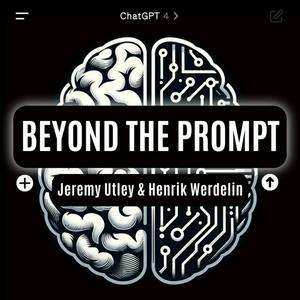
Beyond the Prompt dives deep into the world of AI and its expanding impact on business and daily work. Hosted by Jeremy Utley of Stanford's d.school, alongside Henrik Werdelin, an entrepreneur known for starting BarkBox, prehype and other startups, each episode features conversations with innovators and leaders to uncover pragmatic stories of how organizations leverage AI to accelerate success. Learn creative strategies and actionable tactics you can apply right away as AI capabilities advance exponentially.
Podcast websiteListen to Beyond The Prompt - How to use AI in your company, The Diary Of A CEO with Steven Bartlett and many other podcasts from around the world with the radio.net app
Get the free radio.net app
- Stations and podcasts to bookmark
- Stream via Wi-Fi or Bluetooth
- Supports Carplay & Android Auto
- Many other app features
Get the free radio.net app
- Stations and podcasts to bookmark
- Stream via Wi-Fi or Bluetooth
- Supports Carplay & Android Auto
- Many other app features

Beyond The Prompt - How to use AI in your company
Scan code,
download the app,
start listening.
download the app,
start listening.
 Australia