Listen to this podcast in the app for free: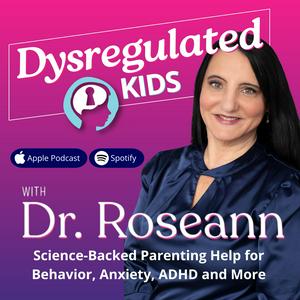 Download for free in the App Store
radio.net
Sleep timer
Save favourites
Dysregulated Kids: Science-Backed Parenting Help for Behavior, Anxiety, ADHD and More
Dr. Roseann Capanna Hodge
Latest episode
367 episodes
365: The Real Reason Your Child Is Struggling in School (and How to Fix It at Every Age)
17/12/2025 | 19 mins.
Many bright kids struggle daily in school, and it’s not because of laziness or lack of effort. The real reason your child is struggling in school is often a dysregulated nervous system. I’ll show you how Regulation First Parenting™ strategies help kids calm, focus, and thrive.Every parent knows the sinking feeling when homework, tests, or transitions turn your child’s school day into a battle. It’s tempting to think the problem is effort, attitude, or ability—but the truth is, learning, focus, and motivation depend on regulation. When a child’s nervous system is overstimulated or under stimulated, even the brightest students can struggle academically.In this episode, I break down why kids across all ages—from preschoolers to college students—face learning challenges, and how parents can partner with schools and use evidence-based strategies to unlock their child’s full potential.Why does my child melt down over schoolwork or transitions?Many children experience sensory or emotional overload, leading to meltdowns, avoidance, or shutdowns. Younger kids often face developmentally inappropriate expectations or tasks that feel too big, which triggers fight, flight, or freeze responses.Recognizing that every child has different learning styles is key, because what feels overwhelming to one child may feel manageable to another. Understanding your child’s learning process helps you tailor support and maintain progress in their child’s education, whether during the regular school year or even summer school.Tips for parents:Break tasks into manageable steps and offer sensory breaks.Validate your child’s feelings: “I see this is overwhelming, let’s take a minute.”Incorporate short nervous system resets, like deep breathing, gentle movement, or butterfly tapping.Real-Life ScenarioA preschooler refuses to start writing. Using a 3-minute reset and offering a small, achievable writing goal helps her calm and complete the activity.How can I help my middle or high schooler stay motivated?Middle and high school kids face growing demands on executive functioning—planning, organizing, and emotional regulation—all while managing increased homework, quizzes, and tests.Chronic stress can lead to procrastination, anxiety, or perfectionism, even in academically strong students.Tips for parents:Request a team meeting with teachers, guidance counselors, or case managers.Identify simple classroom supports, like sensory breaks or visual schedules.Encourage small, consistent self-regulation practices daily.🗣️ “You can’t pour knowledge into a brain that’s on fire—calm the brain first, and learning will follow.” — Dr. RoseannWhat can I do for my child’s learning in college?College is a test of independence and executive functioning.Without prior support, students may experience burnout, missed deadlines, anxiety, or withdrawal, regardless of intelligence. Nutrition, sleep, and coping strategies directly impact their academic performance and self-esteem.Tips for parents:Encourage self-advocacy and identify the school’s learning center resources.Know critical deadlines for dropping or adjusting classes to protect grades and...
364: Why Your Kid’s Brain Shuts Down When Plans Change
15/12/2025 | 17 mins.
Child meltdowns spike when plans change because your child’s brain feels unsafe and the nervous system goes into survival mode. I’ll guide you through Regulation First Parenting™ strategies to calm, support, and help your child adapt with confidence.Every parent knows the moment when plans change and your child suddenly spirals into tears, anger, or shutdown. It feels overwhelming, frustrating, and sometimes even personal—but you’re not alone.In today’s episode, we explore why these meltdowns happen and practical ways to help your child stay regulated and resilient.Why does my child shut down when plans change?It’s not defiance—it’s anxiety in disguise. Many children struggle with flexibility because their nervous system craves predictability.When plans change, the amygdala—the brain’s fear center—takes over, and the prefrontal cortex responsible for logic goes offline.Small changes feel like danger to a dysregulated brain.Stress accumulates silently throughout the day (think schoolwork, transitions, friendships), filling your child’s “stress cup.”Meltdowns are the overflow, signaling their brain is overwhelmed.Parent StoryMaria’s daughter, Molly, would explode every weekend when plans shifted. By previewing the day and co-regulating, Maria helped Molly feel safe—and those meltdowns stopped.How can I help my child cope with unexpected changes?The key is regulation first, flexibility second. You can’t force a child to adapt if their nervous system is in survival mode. Instead:Preview changes in advance—give gentle warnings or visual schedules.Co-regulate through transitions—model calm, name emotions, and breathe together.Practice flexibility in small doses—switch dinner seating or minor routines while your child is calm.Tip: Every time your child navigates a small change successfully, their brain rewires for resilience. Predictability isn’t coddling—it’s scaffolding their emotional growth.Why do some kids struggle more than others?Nervous system sensitivity plays a big role.Children with neurodivergence, trauma histories, or heightened sensory experiences often feel emotions and changes more intensely. Their brains are wired to survive, not to negotiate logic in the moment.Over- or under-stimulation can trigger emotional dysregulation.Daily stress adds up, making even minor changes feel impossible.Developmental expectations vary by age, from toddlers needing reassurance to teens pushing back verbally.A tween might say, “You ruined everything!” while a teen might retreat with, “I don’t care.” Same nervous system reaction—different expression.Get instant tools to soothe your child’s stress and prevent meltdowns—grab your Quick CALM now at https://drroseann.com/quickcalm/What mistakes do parents make during meltdowns?It’s natural to want to lecture, explain, or impose consequences—but when the brain is in red-zone survival mode, logic doesn’t land.Talk less,
363: Is Everyday Stress Quietly Rewiring Your Child’s Brain?
10/12/2025 | 12 mins.
Is everyday stress quietly rewiring your child's brain? Learn how chronic stress reshapes the nervous system, affects emotional regulation, and how small, practical lifestyle changes can protect your child’s brain health.Parenting a child whose emotions swing from calm to chaos can feel overwhelming. Everyday pressures—school demands, social tension, family stress—can quietly rewire your child’s brain, pushing it into a constant state of survival mode. But the good news? You can change these patterns.In today’s episode, we break down how chronic stress affects brain development, why your child may seem "overly reactive" or withdrawn, and practical tools you can use to build emotional resilience and calm.Why does my child overreact to small stressors?Your child's brain is highly responsive to repeated stress, especially those with trauma, neurodivergence, or sensory sensitivities. Chronic stress strengthens fear circuits in the amygdala while weakening prefrontal cortex control, making your child more prone to anxiety, meltdowns, or overreaction.Takeaways:Frequent stress rewires the brain: the more your child experiences stress, the stronger the fear pathways become.Behavior reflects the brain: meltdowns aren’t misbehavior—they’re signs of an overactive stress response.Small moments add up: transitions, noise, or school pressures can overflow your child’s stress cup.Real-Life ExampleJess noticed her son melting down every afternoon. By adding a quiet snack and a two-minute decompression before homework, she saw his meltdowns reduce within a month.How can I tell if my child’s nervous system is overstimulated or under-stimulated?Overstimulation looks like constant movement, big emotions, defiance, sleep troubles, and hyper-reactivity. Under-stimulation shows as daydreaming, zoning out, sluggishness, or excessive caffeine use in teens. Both reflect dysregulated stress response patterns.Tips for parents:Observe daily patterns in behavior and energy.Offer micro resets: 1–2 minute stretches, humming, tapping, or deep breathing.Track stressors to notice triggers and early warning signs.Quick CALM™ gives your child fast, simple tools to reset their nervous system and regain emotional control in moments of stress. With easy, science-backed techniques, it helps kids stay grounded, focused, and calm—so you can reduce meltdowns and boost everyday resilience.What can parents do to protect the brain during stressful moments?Regulate first, teach second. Your calm acts as the anchor for your child’s nervous system. Predictable routines and lifestyle changes—hydration, sleep, magnesium-rich foods—help balance stress hormones and protect brain structure.Action Steps:Incorporate short, frequent nervous system breaks.Prioritize predictable schedules and safe environments.Co-regulate for connection before correction—behavioral learning happens when your child feels safe.🗣️ “Every meltdown isn’t a tantrum—it’s your child’s nervous system overflowing. You can teach their brain to recover,...
362: Why Therapy Isn’t Working: The Hidden Power of Neurofeedback for Dysregulation
08/12/2025 | 27 mins.
If you’ve spent months—or years—in therapy and your child is still melting down, avoiding schoolwork, or unable to calm their body, you are not alone. And it’s not because the therapy is “bad” or you’re doing anything wrong. The real issue is that their brain can’t use the strategies yet.That’s where neurofeedback comes in. Today’s episode dives deep into the science of why so many kids stay stuck and why regulation must come first before any traditional therapy can work.Why isn’t therapy working for my child’s chronic meltdowns?It’s not your parenting, and it’s not that therapy “failed.”Often, traditional talk therapy assumes the prefrontal cortex—our thinking brain—is online. When your child is stuck in fight, flight, or freeze, that part of the brain shuts down, affecting how your brain functions, cognitive function, and overall brain health.Key takeaways:Dysregulation is biological, not behavioral. Kids know what to do but can’t act when their nervous system is stressed, affecting mental health disorders, anxiety symptoms, and overall brain function.Frontal lobe offline = skills don’t stick. Strategies learned in therapy may not transfer at home because brain waves aren’t balanced.Red flags: prolonged emotional resets, sleep or eating issues, constant overwhelm, and hypervigilance—common in mental health conditions and sometimes linked to chronic pain.Real-Life ExampleEthan struggled for two years in therapy. He could talk about his feelings but couldn’t apply any strategies at home, showing that knowledge alone doesn’t fix brain dysregulation or improve cognitive function.Once neurofeedback training targeted his brain’s communication centers through QEEG brain mapping, he began to pause, self-regulate, and thrive.This shows how brain science and precise interventions can create better mental health, strengthen overall brain function, and help children manage mental health disorders more effectively.How does neurofeedback therapy actually help the brain self-regulate?Neurofeedback uses real-time feedback to train the brain to recognize and correct its own brainwave patterns. Using QEEG brain mapping, practitioners identify areas of brain dysregulation and guide the nervous system back to balance.Tips for parents:Sessions are short: 20–30 minutes, 2–3 times per week.Neurofeedback strengthens emotional regulation, focus, and impulse control over time.It complements, rather than replaces, therapies like talk therapy, occupational therapy, or cognitive behavioral therapy.A child resistant to therapy often refuses to engage. With neurofeedback, even small, gentle “micro-workouts” of brain training can create lasting changes in nervous system regulation.Feeling stuck in constant meltdowns or anxious moments at home?Take control of meltdowns with Quick CALM™, a science-backed mini-course with the essential tools to calm your child’s brain—and yours too—so peace can finally return to your home.When should I consider neurofeedback for my child?Look for these red flags:Therapy progress is stalled or inconsistentEmotional resets take hours instead of minutesSleep, eating, or sensory issues persistConstant...
361: Inside the Dysregulated and Distracted Brain: What a QEEG Map Reveals That Teachers and Doctors Miss
03/12/2025 | 33 mins.
If you’ve ever wished you could peek inside your child’s brain during a meltdown or when they completely shut down, today’s episode is for you. We’re diving into QEEG brain maps—one of the most powerful, yet most underused tools for understanding what’s really driving big emotions, focus issues, and chronic dysregulation.For three decades, I’ve watched families bounce from diagnosis to diagnosis… ADHD, anxiety, “behavioral issues.” And while those labels can be helpful, they’re often surface-level.A QEEG lets us look under the hood so we can finally stop guessing. Because when we calm the brain first, everything else follows.Why So Many Kids Get the Wrong DiagnosisParents are often told their child has ADHD simply because they’re unfocused or overwhelmed. But ADHD criteria are broad—so broad that almost any dysregulated kid can fit the checklist. That’s why so many families show up after trying meds, OT, tutoring, and therapy with little or no progress.A QEEG changes that.This quantitative brain map shows where the brain is overactive, underactive, or disconnected, and those patterns tell us far more than a checklist ever could. I’ve done over 10,000 brain maps, and they consistently reveal what teachers, therapists, and even doctors miss.A Real Story: When ADHD Wasn’t ADHDOne mom, Sarah, came to me after years of trying to help her son Jack. He had an ADHD diagnosis, but nothing worked—not medication, not OT, not therapy.His brain map showed focus issues, yes… but more importantly, it pointed to learning and executive functioning patterns that suggested dyslexia. After a deeper history and a follow-up evaluation at school, dyslexia was confirmed.Suddenly everything made sense. Jack didn’t need a stronger stimulant—he needed a reading intervention. Once we supported his brain through neurofeedback and the right academic supports, the whole picture changed.This kind of story is far too common.Want to stay calm when your child pushes every button?Become a Dysregulation Insider VIP and get the FREE Regulation Rescue Kit—your step-by-step guide to stop oppositional behaviors without yelling or giving in.Go to www.drroseann.com/newsletter and grab your kit today.QEEG vs EEG: What’s the Difference?An EEG is a medical tool used to detect seizures. A QEEG—or quantitative EEG—measures the brain’s electrical activity and compares it to normative data.It’s:PainlessNoninvasiveDone with a soft cap and sensorsDesigned to map overactivity, underactivity, and connectivityThink of it like getting a satellite image of your child’s brain weather patterns—where storms are brewing, where things have gone quiet, and where communication lines are overloaded.What Dysregulation Looks Like on a Brain MapA dysregulated brain can’t shift smoothly between states—calm, alert, focused. On a QEEG, that shows up as:Underactivity → brain fog, low motivation, slow processingOveractivity → big emotions, anxiety, OCD-like reactionsChaotic connectivity → trouble transitioning, rigid thinking,...
More Health & Wellness podcasts
 unPAUSED with Dr. Mary Claire HaverHealth & Wellness, Society & Culture, Medicine
 The Peter Attia DriveHealth & Wellness, Fitness, Medicine
 Feel Better, Live More with Dr Rangan ChatterjeeHealth & Wellness, Alternative Health
 Huberman LabHealth & Wellness, Science, Life Sciences
 Health ReportHealth & Wellness, Medicine
 Nothing much happens: bedtime stories to help you sleepFiction, Health & Wellness
 Passion Struck with John R. MilesEducation, Health & Wellness, Alternative Health, Self-Improvement
 ZOE Science & NutritionEducation, Health & Wellness, Science, Nutrition
 On Purpose with Jay ShettyBusiness, Health & Wellness, Mental Health
 What's That Rash?Health & Wellness, Medicine
Trending Health & Wellness podcasts
 Drift Off - Bedtime Stories for AdultsHealth & Wellness, Alternative Health, Mental Health
 Sleep Wave: Sleep Meditation & Sleepy StoriesHealth & Wellness, Mental Health
 Just One Thing - with Michael MosleyHealth & Wellness, Science
 8 Hour Sleep MusicHealth & Wellness, Alternative Health
 Sleep Meditation for WomenHealth & Wellness, Mental Health
 Mindful In Minutes MeditationEducation, Health & Wellness, Alternative Health, Self-Improvement
 Sleep With MeHealth & Wellness, Mental Health
 Rain SoundsHealth & Wellness, Society & Culture, Mental Health
 The Male Room with Dr. Jesse MillsHealth & Wellness, Nutrition
 Well with Arielle LorreArts, Health & Wellness, Society & Culture, Alternative Health, Fashion & Beauty, Personal Journals
 SLEEP MEDITATION with Lauren Ostrowski FentonHealth & Wellness, Alternative Health, Mental Health
 I Can’t SleepHealth & Wellness, Alternative Health, Mental Health
 Relaxing White NoiseHealth & Wellness
 Tracks To Relax Sleep MeditationsHealth & Wellness, Alternative Health, Mental Health
 Dhru Purohit ShowHealth & Wellness, Alternative Health
 Sliced BreadHealth & Wellness
 The Metabolic Classroom with Dr. Ben BikmanHealth & Wellness, Science, Life Sciences, Nutrition
 I Have ADHD PodcastEducation, Health & Wellness, Mental Health, Self-Improvement
 Sleep Meditation Music - Relaxing Music for Sleep, Meditation & RelaxationHealth & Wellness, Music, Religion & Spirituality, Spirituality
 The Genius LifeHealth & Wellness
 Inner LightHealth & Wellness
 Fast. Feast. Repeat. Intermittent Fasting For LifeHealth & Wellness, Alternative Health, Nutrition
About Dysregulated Kids: Science-Backed Parenting Help for Behavior, Anxiety, ADHD and More
Are you tired of the daily battles, the problems with listening and focus, meltdowns over minor frustrations, and the constant feeling of walking on eggshells in your own home? If you're a parent who feels overwhelmed, stuck in a cycle of reactivity, and utterly exhausted from trying to manage your child's challenging behaviors, you are not alone. You've tried everything—the sticker charts, the timeouts, the endless negotiations—but nothing creates lasting change.
The answer isn't more discipline. The secret is understanding the brain. Welcome to Dysregulated Kids: Science-Backed Parenting Help, the podcast that is revolutionizing the way we parent.
Hosted by Dr. Roseann Capanna-Hodge, a licensed therapist, school psychologist and author with over 30 years of experience in children's mental health and recognized by Forbes as a thought leader in children's mental health, this podcast is your lifeline. Dr. Roseann pulls back the curtain on why your child or teen is struggling, whether they have a clinical diagnosis like ADHD, Anxiety, Autism, OCD, Depression, Dyslexia, Executive Functioning challenges, Lyme, or PANS/PANDAS, or are simply navigating the ups and downs of everyday life.Her revolutionary Regulation First Parenting™ approach teaches that calming the nervous system is the first step before you can connect, teach, or help your child learn.
In short, actionable episodes, Dr. Roseann gives you proven tools like the CALMS Protocol™, quick nervous system reset tools and co-regulation strategies to move your child (and yourself!) from stress and reactivity to calm, connection, and resilience. You'll learn what to say and do to de-escalate meltdowns in the moment, how to build your child's emotional regulation skills, and how to improve their executive functioning and attention so they can succeed at home, at school, and in life.
Imagine shifting your entire perspective from seeing "defiance" to understanding "dysregulation." Picture yourself feeling confident and equipped, knowing exactly how to respond in those tough parenting moments. This is the transformation that awaits you. Parents discover how to break free from the reactivity cycle and build a more connected, joyful family—going from helpless and frustrated to empowered and hopeful.
Here's what you can expect from Dysregulated Kids:
Real Solutions for Real Problems – Whether you're dealing with ADHD, anxiety, sensory overload, meltdowns, or everyday struggles, Dr. Roseann brings strategies that actually work.
Science-Backed Parenting Tools – Learn how to understand your child's nervous system and apply research-driven calming strategies to create a peaceful, happy home.
Practical Advice You Can Use Today – Each episode delivers focused, actionable content without the fluff—just pure wisdom you can apply to your family right away.
Empowerment and Hope – Dr. Roseann blends expert knowledge with deep empathy for the challenges parents face, helping you feel confident that you can make positive change.
This podcast is for parents of the "reactive" kid or the child who feels more, reacts to little things more, and just needs more from you. It's for parents of neurodivergent children or kids struggling with mental health challenges. Really this show is for all parents dealing with typical stressors who want to raise emotionally intelligent, resilient kids in a world that is more demanding and chaotic than ever.
If you've seen Dr. Roseann on TV, you know she doesn't shy away from real talk about real problems. She brings that same authenticity and expertise to every episode, combining hope with science to help you calm the brain and create a happier family.
Are you ready to stop just surviving and start thriving? Subscribe now and start your journey toward a calmer brain and a happier family today.
For more resources, show notes, and to connect with Dr. Roseann, visit drroseann.com.
Podcast websiteListen to Dysregulated Kids: Science-Backed Parenting Help for Behavior, Anxiety, ADHD and More, unPAUSED with Dr. Mary Claire Haver and many other podcasts from around the world with the radio.net app
Get the free radio.net app
- Stations and podcasts to bookmark
- Stream via Wi-Fi or Bluetooth
- Supports Carplay & Android Auto
- Many other app features
Get the free radio.net app
- Stations and podcasts to bookmark
- Stream via Wi-Fi or Bluetooth
- Supports Carplay & Android Auto
- Many other app features

Dysregulated Kids: Science-Backed Parenting Help for Behavior, Anxiety, ADHD and More
Scan code,
download the app,
start listening.
download the app,
start listening.
 Australia