

Listen to this podcast in the app for free: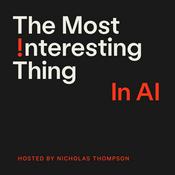 Download for free in the App Store
radio.net
Sleep timer
Save favourites
44 episodes
Why Ray Dalio is Worried About an AI Bubble
14/10/2026 | 49 mins.Since the AI boom began, industry skeptics have warned it would be the next bubble. They point to massive investments, circular financing, and the technology’s reliability issues. And yet, as revenue rises and the models improve, it might appear that a crash is no longer likely. Ray Dalio says that isn’t the case.
As the founder of Bridgewater Associates, the world’s largest hedge fund, Dalio knows a thing or two about markets. He famously warned of the 2008 crisis, enabling his firm to post gains while most funds lost money. In the AI market, Dalio still sees a potential calamity. The technology is amazing, he says, but that doesn’t necessarily mean it’s an amazing investment.
Is he right? And can a catastrophe be averted? In conversation with Nicholas Thompson, CEO of The Atlantic, Dalio describes the five forces that shape history, explains why the AI boom has survived tariffs and the Iran War, and shares the advice he gives young people who are entering the workforce.
Produced independently of The Atlantic’s editorial staff.
(00:00) Introduction
(02:20) How macroeconomic forces, debt cycles, and emerging technology can drive bubbles
(07:15) The rules-based system Ray used to run Bridgewater
(12:54) Assessing the current tech bubble
(16:15) How bubbles pop
(23:00) Why the bubble hasn’t popped yet
(30:58) Why there might be a crash even if AI ushers in unprecedented productivity
(37:49) Solutions to the government’s debt crisis
(42:04) The difference between how China and the US view AI
(45:49) What Ray tells young people entering the AI era
(48:27) What Ray would do if he had an unlimited budget to invest in AI
Learn more about your ad choices. Visit podcastchoices.com/adchoicesBuilding Models That See the World - Eric Xing with Nicholas Thompson
07/10/2026 | 1h 13 mins.If you want AI to drive your car or simulate a cell or control a robot, it had better be able to understand the world it’s operating within. Eric Xing is one of the leading researchers working on this kind of AI, known as ‘world models.’ Unlike LLMs, which are trained largely on text data and predict the next token, world models aim to understand and simulate physical environments using multimodal data. Xing found his way to the field after a long trek through prestigious institutions, studying cancer before transitioning to machine learning. Now, as the president of Mohamed bin Zayed University of Artificial Intelligence in the United Arab Emirates, he’s helping to train a generation of AI builders.
In conversation with Nicholas Thompson, CEO of The Atlantic, Eric discusses how his unusual career trajectory prepared him to work in the AI industry, what people misunderstand about the US-China arms race, and how the war in Iran has impacted his work in the region.
Produced independently of The Atlantic’s editorial staff.
(0:00) Introduction
(02:03) Lessons on survival from a mountaineering expedition gone wrong
(04:48) Eric’s winding path from physics to biology to computer science
(11:56) Balancing academia and business: raising $100M and founding an AI company
(19:41) The limits of large language models
(26:43) Using world models to simulate biology
(36:30) Revolutionizing drug discovery with digital organisms
(43:10) Why Eric refused to sign an AI safety letter
(49:37) Debunking existential risk narratives: the difference between a blueprint and a weapon
(57:40) Why Eric is a “true believer” in open-source AI
(1:05:37) How the Iran War has impacted AI in the UAE
(1:11:18) What Eric would do if he had an unlimited budget to invest in AI
Learn more about your ad choices. Visit podcastchoices.com/adchoicesThe Risks of Artificial Relationships - Sherry Turkle with Nicholas Thompson
30/09/2026 | 57 mins.AI wants to be your friend. And your therapist. And your lover. It’s not an entirely new offer, author and MIT professor Sherry Turkle reminds us, but it’s one that’s grown more dire as AI has improved. In a conversation with Nicholas Thompson, CEO of The Atlantic, Turkle describes the dangers of anthropomorphizing generative AI, gleaned from hundreds of conversations she conducted (with real humans) for her new book, Artificial Intimacy: Who We Become When We Talk To Machines. What do we lose when we make machines our best friends? And what, if anything, do we stand to gain? Turkle details her own experience creating a simulation of her mother, and the wounds that we risk reopening.
Produced independently of The Atlantic’s editorial staff. Supporting sponsor: PwC.
(00:00) Introduction
(03:45) The surprising return of relational machines
(07:35) Why Sherry wrote her new book, Artificial Intimacy
(11:18) The problem with delegating parenting, education, and therapy to AI
(19:07) Why people seek emotional support from chatbots
(24:40) Sherry’s concept of “dual consciousness”
(29:43) Regulating generative AI use for kids
(32:42) Can college students still read and write?
(37:32) Distinguishing between useful AI tools and harmful delegations
(41:32) How chatbots mimicking deceased loved ones can cause new psychological harm
(50:56) What Sherry would do with unlimited AI funds
Learn more about your ad choices. Visit podcastchoices.com/adchoicesThe Case Against the AI Bubble - Azeem Azhar with Nicholas Thompson
23/09/2026 | 1h 5 mins.Among the many eye-popping numbers of the AI industry—from trillions in investments to billions in spending—one stands out: $0 in profit among leading AI companies. According to Bloomberg, “never before has so much money been spent so rapidly on a technology that, for all its potential, remains largely unproven as an avenue for profit-making.” That imbalance, and the industry’s reliance on circular financing, has led to fears of a bubble. But those concerns are overblown, according to Azeem Azhar, author of the Exponential View newsletter, who earlier this year released a report on the AI economy.
In conversation with Nicholas Thompson, CEO of The Atlantic, Azhar expands on his findings. He says AI’s finances are sound: the demand is there, revenue is growing, and the technology will advance enough to deliver on the necessary ROI.
Produced independently of The Atlantic’s editorial staff. Supporting sponsor: PwC.
(00:00) Introduction
(03:40) Mapping the AI economy through forensic accounting
(07:50) How to think about infrastructure spend
(16:30) The "J-curve" of AI adoption
(24:00) How cheaper tokens will change the market
(27:17) China's AI strategy
(40:22) Is there something that could break Azeem’s model?
(48:34) What could happen when the AI firms IPO
(53:34) The effects of the culture in Silicon Valley
(56:34) Which bubble-breaker scenario worries Azeem the most
(59:16) What Azeem would do if he had an unlimited budget to invest in AI
Learn more about your ad choices. Visit podcastchoices.com/adchoicesThe Future of Economic Power - Circle’s Jeremy Allaire with Nicholas Thompson
16/09/2026 | 1h 9 mins.Technological waves often arrive with a promise. The internet was going to democratize information. Blockchain was going to decentralize power. Now, AI's boosters say it will bring unprecedented prosperity.
Few people are better positioned to speak to that possibility than Jeremy Allaire. As the CEO of the fintech company Circle—issuer of the USDC stablecoin—and a longtime internet entrepreneur, Allaire has been at the center of the first two technological waves. With AI, he says we’re going through a change that’s “bigger than the Industrial Revolution.” He sees a future of financially-empowered agents—and believes this technology could be the one that finally fulfills the promise of shared wealth.
In a conversation with Nicholas Thompson, CEO of The Atlantic, Allaire describes how the agentic economy might work, why regulation will be critical to its success, and what’s missing from the conversation around AI’s effect on society.
Produced independently of The Atlantic’s editorial staff. Supporting sponsor: PwC.
(00:00) Introduction
(03:33) Jeremy’s early fascination with open networks
(07:14) Creating the first online archive of Noam Chomsky's work
(10:54) The promise of the early web
(17:00) How the internet centralized power through social media giants
(22:53) Founding Circle with the vision of creating "HTTP for money"
(31:18) Navigating crypto's reputation challenges
(38:18) Why Jeremy wrote The Agentic Economy Treatise
(43:30) How AI agents could change the fundamental structure of companies
(53:34) The risks of extreme capital concentration with AI
(59:40) The choice we face with AI regulation
(1:05:03) What Jeremy would do if he had an unlimited budget to invest in AI
Learn more about your ad choices. Visit podcastchoices.com/adchoices
More Technology podcasts








Trending Technology podcasts











About The Most Interesting Thing in AI
A podcast series examining how AI is reshaping our world. Hosted by Nicholas Thompson, each episode features a conversation with a leading thinker who offers a fresh perspective on the far-reaching ethical, economic, and social implications of this technology.
This podcast is from The Atlantic’s CEO and is produced independently of The Atlantic’s editorial staff. Some episodes have a supporting sponsor. Those episodes are clearly labeled and the sponsor is named.
Podcast websiteListen to The Most Interesting Thing in AI, Dwarkesh Podcast and many other podcasts from around the world with the radio.net app

Get the free radio.net app
- Stations and podcasts to bookmark
- Stream via Wi-Fi or Bluetooth
- Supports Carplay & Android Auto
- Many other app features
Get the free radio.net app
- Stations and podcasts to bookmark
- Stream via Wi-Fi or Bluetooth
- Supports Carplay & Android Auto
- Many other app features

The Most Interesting Thing in AI
Scan code,
download the app,
start listening.
download the app,
start listening.
The Most Interesting Thing in AI: Podcasts in Family
 Australia