

Listen to this podcast in the app for free: Download for free in the App Store
radio.net
Sleep timer
Save favourites
360 episodes
How To Live Forever
09/09/2026 | 5 mins.Most of my listeners are somewhere between 35 and 45, which means quite a few of us are reaching the age when mortality starts feeling a little less theoretical. In this episode, I explore one reason the idea of death can trouble us that has less to do with fear and more to do with something deeply human: the desire not to feel disposable.
Apply for private coaching: https://stoicismpod.com/apply
Join my free community: https://stoicismpod.com/join
I begin with a conversation I recently had with a private coaching client about why believing in something after death can be comforting. My suggestion was that the comfort may not necessarily come from imagining rewards, avoiding punishment, or even continuing our conscious existence. It may come from believing that we remain important to something beyond ourselves, that we continue to have a place.
Stoicism offers an interesting answer to this without requiring a supernatural afterlife. The Stoics understood the Cosmos itself as God: the complete, contained system of Nature of which every one of us is presently a part.
Within that system, nothing simply disappears. The matter and energy that presently constitute us return to the Cosmos and continue participating in it. The individual person, with their name, memories, career, possessions, and personality, may not continue indefinitely, but that from which the individual is constituted remains part of the whole.
In that limited but meaningful sense, I suggest there is something resembling immortality available within the Stoic worldview. Stoicism doesn't promise a celestial city, an eternity spent with deceased relatives, or reincarnation as some other creature. Instead, it offers the idea that we were never separate from the Cosmos in the first place, and that what constitutes us continues to belong to and participate in that same whole.
If what troubles you about death is the thought of becoming irrelevant or disposable, perhaps there's some comfort in that. You aren't something the Cosmos eventually throws away. You are part of it now, and what constitutes you remains part of it after the particular arrangement presently called "you" is gone.
Mentioned in this episode:
Equanimity Talk
Attend the equanimity talk by visiting the link below. I want to make it clear that this was very last minute, that I don't know this organiser particularly well, and that there's no financial incentive involved here. I was simply presented an opportunity to speak on equanimity and thought it might be worthwhile. Cheers.
Equanimity TalkA Reflection on "Inner Peace"
04/09/2026 | 8 mins.Marcus Aurelius famously reminds himself that we don't need to retreat to the countryside or the seashore to find peace. In this episode, recorded from my new office in an old textile mill in Dundee, I reflect on why I think Marcus was theoretically right but practically wrong, at least for those of us who aren't sages.
Apply for private coaching: https://stoicismpod.com/apply
Support this podcast financially: https://stoicismpod.com/members
Join my free community: https://stoicismpod.com/join
Check the LinkedIn post: https://lnkd.in/p/emRAsNbz
Get alerted when the book goes on sale: https://livingstoicism.tannerocampbell.com
Inner peace may ultimately be a state of mind, but we're not perfect practitioners. Our surroundings affect us. Sometimes getting away from the noise, finding somewhere that feels comfortable, familiar, and peaceful, genuinely makes practicing Stoicism easier.
Since moving to Dundee, I've noticed a quieting in myself that I can't really attribute to anything else. Life hasn't become less demanding. I'm currently cramming roughly 40 hours of work into Monday through Wednesday, then spending Thursday and Friday as a full-time dad while protecting my weekends for my family. If anything, I'm doing more than ever.
Yet something about this place feels different. My little office overlooking Dundee, the seagulls and church bells outside the window, our flat beside a park, the city's working-class character, and even the coastal air remind me of places and people from my childhood. After several enormously busy years of marriage, fatherhood, building a business, raising investment, working full-time, and moving repeatedly, I feel unexpectedly at home here.
So this episode isn't really a lesson. It's a reflection on the role our environment can play in our ability to find some peace. Theoretically, Marcus was right: the perfect Stoic shouldn't need a particular place in order to achieve tranquility. But none of us are perfect Stoics, and sometimes finding the right place can make the work of becoming better considerably easier.
I also share a few updates at the end of the episode, including a request for help choosing the subject of a TED talk I'm working on, some early details about my forthcoming book Living Stoicism, and an invitation to a free community Q&A.How to have healthy self-esteem
24/08/2026 | 13 mins.A healthy Stoic practice requires an accurate view of yourself. Think too little of yourself and you misunderstand your capacities; think too much of yourself and you do the same. In this episode, I explore self-esteem through a Stoic lens and explain why accurate self-knowledge matters to our pursuit of eudaimonia and sagehood.
Apply for private coaching: https://stoicismpod.com/apply
Support this podcast financially: https://stoicismpod.com/members
Join my free community: https://stoicismpod.com/join
I begin by separating self-esteem from the popular idea that “ego is the enemy.” Rather than treating a positive view of ourselves as something inherently suspect, I argue that Stoic practice requires us to understand ourselves accurately: our capacities, our roles, our duties, our individual nature, and the ways we are positioned to contribute to the world.
That means avoiding two extremes. A depressive view of ourselves causes us to underestimate what we are capable of and what our duties require. A grandiose view causes us to overestimate our importance and abilities. Neither gives reason an accurate picture of the person whose life it is trying to direct.
I also look at criticism and the effect other people's judgments can have on our self-understanding. Marcus Aurelius reminds himself in Meditations 2.1 that we will encounter difficult, arrogant, ungrateful, and mistaken people because they misunderstand good and evil. Criticism can contain useful information, and we should examine it when it does, but another person's judgment of our value is not automatically authoritative simply because they have expressed it.
Finally, I offer a practical Stoic basis for healthy self-esteem using four areas of reflection: our shared nature as human beings, our individual nature, the circumstances and contexts we have been given, and the roles and paths we have deliberately chosen.
The goal is neither humility for its own sake nor inflated confidence. It is accuracy. Understand what you are, understand what is appropriate for you, and then work seriously to fulfil those roles and duties well.How to defend your standards kindly
19/08/2026 | 16 mins.In today's episode I discuss whether pursuing a dream is a Stoic thing to do, and how to talk about your ambitions without accidentally insulting the people who don't share them. Before digging in please be aware of all the ways this podcast is able to exist without ads or formal sponsorship:
Private Stoic Life Coaching Practice: https://stoicismpod.com/coaching
Stoic Journaling Program: https://stoicjournaling.com
Courses: https://stoicismpod.com/courses
Elective Listener Support: https://stoicismpod.com/members
First, some genuinely wonderful news. 134 Labs Limited, the company I started in December of 2025 to buy back my intellectual property from Front Porch Media, has closed a pre-seed round of 74,000 US dollars. That means I get to do philosophy full-time for the next 12 months. It took 5 years to get here and 7 months of chasing venture capital to close, and I'm honest in this episode about how ugly it got along the way (including a couple of months where my family had to be on Universal Credit to bridge the gap). Nothing about the podcast changes. No third-party ads, no unaligned sponsors, same content. But this next year is make or break: either I find a morally just way to make a living in philosophy or I walk away.
Then we get into the episode proper, which is about the pursuit of dreams. When you tell a friend that a regular life wouldn't be enough for you, they often hear "so my life isn't enough either," and that misunderstanding can wreck relationships. I use my sister as an example of someone wise enough to hear "your life wouldn't make me content" as a statement about alignment rather than a criticism of her choices.
To unpack why, I reintroduce the Stoic Daimon. I walk through how logos permeates everything, how different degrees of tonos produce different manifestations, and how in beings like us that becomes rational cognition (I use an electricity-in-a-building analogy to make this digestible). The daimon can incline us toward certain pursuits, but here's the catch: an inclination doesn't guarantee our interpretation of it is correct, and it doesn't guarantee success. An inclination toward music doesn't mean your role is professional musician, and measuring daimon-alignment by material success is measuring poorly.
I also talk about how a poorly trained rational faculty confuses things all the time (lust for love being the classic example), and how "follow your heart" guru advice can lead people into neglecting real duties. I share that I have two coaching clients right now whose husbands have been chasing startups for years with nothing to show for it, and I own the awkward fact that my own funding chase could look exactly like that from the outside. The difference, I argue, isn't outcomes. Stoics decide based on role ethics: reasoning about duties, roles, justified risks, and what we're asking others to bear.
The episode lands on this: the Stoic answer is neither "follow your heart" nor "settle for whatever falls into your lap." Take your inclinations seriously without treating them as commands, bring them before a properly trained rational faculty, and pursue what is appropriate without making your happiness depend on how the world responds.
And, one more thing: if you haven't already, please join my free Stoicism community on Skool: https://skool.com/tannerocampbellHow to find your own Stoic path
10/08/2026 | 13 mins.Apply for private coaching: https://stoicismpod.com/apply
Support this podcast financially: https://stoicismpod.com/members
Join my free community: https://stoicismpod.com/join
In this episode, I explore why there is not always a single answer to the question, “What would a Stoic do?” Stoicism gives us a shared ethical framework, but it also takes seriously the particular roles, relationships, capacities, dispositions, and circumstances of each individual.
I begin with the common search for “the Stoic position” on a given issue. Sometimes a general answer is appropriate, such as returning a lost wallet. But more complex situations, such as war, require us to consider what our particular roles and circumstances demand of us.
I turn to Epictetus and his discussion of preserving our proper character, or prosōpon, in Discourses 1.2. His examples of Agrippinus and another man facing the same pressure under Nero show how two people can reason well and still arrive at different actions because their characters, roles, and circumstances differ.
From there, I explain how to begin identifying your own path toward sagehood. Start with your roles: parent, employee, neighbour, citizen, friend, carer, and so on. Then consider your individual nature, including your dispositions, strengths, weaknesses, resources, limitations, and circumstances.
I also discuss Hierocles' circles of concern and the Stoic responsibility we all share toward the cosmopolis. Everyone has that responsibility, but nobody will fulfil it in exactly the same way.
The goal, then, is not to ask, “What would a sage do?” as though there were one universal answer waiting to be discovered. The better question is: “What would I do if I were the sage version of myself, given my roles, capacities, dispositions, circumstances, and context?”
Stoicism gives us the same philosophy to guide us, but the path toward sagehood is necessarily particular to each person.
More Education podcasts
 The Ella EraEducation, Self-Improvement, Society & Culture
 The Rich Roll PodcastEducation, Health & Wellness, Self-Improvement, Society & Culture
 Begin Again with Davina McCallEducation, Health & Wellness, Mental Health, Self-Improvement, Society & Culture
 6 Minute EnglishEducation, Language Learning
 Motivation Daily by MotiversityEducation, Health & Wellness, Self-Improvement
 Platypus Economics with Justin WolfersBusiness, Courses, Education, Science, Social Sciences
 IMO with Michelle Obama and Craig RobinsonEducation, Self-Improvement, Society & Culture
 Aussie EnglishCourses, Education, Language Learning
 The Jefferson Fisher PodcastEducation, Relationships, Self-Improvement, Society & Culture
 Your Thoughts Your RealityBusiness, Careers, Education, Health & Wellness, Mental Health, Relationships, Self-Improvement, Society & Culture
Trending Education podcasts
 Topher Field PodcastComedy, Education, News, Politics
 The Dr. Lee Warren PodcastChristianity, Education, Health & Wellness, Life Sciences, Mental Health, Religion & Spirituality, Science, Self-Improvement
 English Learning PodcastEducation, Language Learning
 The Art of AwakeningAlternative Health, Education, Health & Wellness, Religion & Spirituality, Self-Improvement, Spirituality
 The Rollercoaster PodcastBusiness, Education, Self-Improvement
 SBS Easy FrenchEducation, Language Learning, News
 潘吉Jenny告诉你|学英语聊美国|开言英语 · PodcastEducation, Language Learning
 大人的Small TalkBusiness, Careers, Education, Entrepreneurship, Management, Self-Improvement
 EconTalkCourses, Education, Philosophy, Science, Social Sciences, Society & Culture
 IELTS Energy English 7+Education, Language Learning
 Easy French: Learn French through authentic conversations | Conversations authentiques pour apprendre le françaisCourses, Education, Language Learning, Places & Travel, Society & Culture
 Learning English GrammarEducation, Language Learning
 YUYUの日本語Podcast【Japanese Podcast】Education
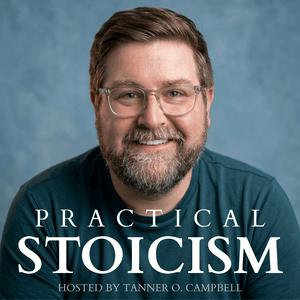
About Practical Stoicism
Stoicism the pursuit of perfect moral character. If this is not what you understand the objective of Stoicism to be, then you do not understand Stoicism properly. If you would like to understand Stoicism properly, you should join Stoic author and public philosopher Tanner O. Campbell, every week, right here, to explore various aspect of Stoicism from an orthodox, but practical perspective. Practical Stoicism is 100% independently owned, entirely ad-free, and produced by a real live human being who knows what he's talking about.
Podcast websiteListen to Practical Stoicism, The Ella Era and many other podcasts from around the world with the radio.net app
Get the free radio.net app
- Stations and podcasts to bookmark
- Stream via Wi-Fi or Bluetooth
- Supports Carplay & Android Auto
- Many other app features
Get the free radio.net app
- Stations and podcasts to bookmark
- Stream via Wi-Fi or Bluetooth
- Supports Carplay & Android Auto
- Many other app features
Practical Stoicism
Scan code,
download the app,
start listening.
download the app,
start listening.
Practical Stoicism: Podcasts in Family
 Australia