
Listen to this podcast in the app for free: Download for free in the App Store
radio.net
Sleep timer
Save favourites
108 episodes
107 | Mining's Untapped Removals Opportunity - with Cara Maesano
27/10/2026 | 26 mins.In this episode of The Carbon Removal Scoop, Eve Tamme and Sebastian Manhart sit down with Cara Maesano, lead author of RMI's new report Mining and Carbon Dioxide Removal: A Responsible Path Forward, to dig into an industry the carbon removal world has barely talked about. Cara's starting point is striking: with the land, materials and engineering know-how that mines already have, almost every form of carbon removal could run on a mine site. But only one approach, she argues, really has to.
Much of the conversation centres on surficial mineralisation, where reactive mine waste absorbs CO2 from the air and locks it away as stable minerals. Cara walks through the new research hub at Thetford Mines in Quebec, set up by Frontier and Carbon Removal Canada on a legacy of asbestos waste the local community wants gone, and explains how churning and activating tailings could push carbonation far deeper than the surface layer. She is clear that these are not cookie-cutter projects, and why.
The hosts also press on the numbers. Cara is candid that the report's headline potential and $80 to $300 price range rest on theoretical and price-based estimates rather than hard cost data. On policy, she explains why permitting is a bigger hurdle than mining's vast footprint suggests: mines are permitted to do specific things with their waste and rarely deviate, which is why building carbon removal in from the very start of a mine's life may be easier than adding it later.
They close on the business case. Thin profit margins per ton of CO2 mean miners are unlikely to buy durable removals, but they may have strong reasons to deliver them on site, from green premiums to tax credits to the environmental liabilities sitting in their tailings piles. Tune in to hear the one thing Cara says is holding the industry back.
LINKS:
Eve Tamme: LinkedIn and Website
Sebastian Manhart: LinkedIn and Website
Cara Maesano: LinkedIn
RMI: Website
Mining and Carbon Dioxide Removal: A Responsible Path Forward (RMI, August 2026):
Frontier: Launching the Quebec Surficial Mineralization Hub
Arca announces agreement with Microsoft for nearly 300,000 tonnes of durable carbon removal
Isometric partners with Anglo American and ZeroEx on Project Earthstone
The Carbon Curve: Canada's Next Industrial Play: The Mine That Stores Carbon
Hosted on Acast. See acast.com/privacy for more information.106 | SHOWDOWN: Europe’s CDR Strategy: BioCCS vs Tech Neutral - with Kaja Voss and Alastair Collier
20/10/2026 | 26 mins.In this episode of The Carbon Removal Scoop, Eve Tamme moderates our fifth SHOWDOWN debate, live on stage at Carbon Unbound Europe in London. The motion takes on one of the hottest fault lines in European carbon removal policy: should Europe’s CDR strategy put BioCCS (biogenic carbon capture and storage) first?
In the BioCCS corner, Kaja Voss, CEO and Founder of Inherit: an economist and believer in markets. Three-quarters of durable offtakes to date are already BioCCS, it sits lowest on the cost curve among high-durability solutions, and the pipelines and terminals it builds will serve other pathways later. Europe should pick that winner “on purpose rather than by accident.”
In the tech neutrality corner, Alastair Collier, Chief R&D Officer at A Healthier Earth: “When you concentrate the technology, you concentrate the politics.” Pointing to Australia’s repeal of its carbon price, he warns that concentrating storage in a handful of member states and paying oil and gas companies to run it creates an easy target for climate sceptics.
From Northern Lights and storage as a public utility to the CRCF (the EU’s Carbon Removals and Carbon Farming certification framework) and a closing call to look to China, the room had plenty to weigh before casting its vote. Listen to the end to find out who won.
LINKS:
Eve Tamme: Eve Tamme: LinkedIn and Website
Kaja Voss: LinkedIn
Inherit: Website
Alastair Collier: LinkedIn
A Healthier Earth: Website
Carbon Unbound Europe
Hosted on Acast. See acast.com/privacy for more information.105 | What Next for the ISO Net Zero Standard - with Delia Meth-Cohn
18/10/2026 | 29 mins.In this episode of The Carbon Removal Scoop, Eve Tamme sits down with Delia Meth-Cohn, Co-founder of Rethinking Removals, to make sense of what happened to ISO 14060, the draft net zero standard for organisations. When Delia joined Sebastian in June, the draft had just opened for consultation. Since then it has drawn around 5,000 comments and failed its first ballot, a rare result at this stage of an ISO process.
Delia explains why this vote was different. Participation was capped at four experts per country because of the level of interest, few national standards bodies abstained, and the draft fell well short of ISO's thresholds of two-thirds approval with no more than a quarter of votes against. She walks through what comes next, a second draft and two more votes, and why publication now looks closer to 2028 than mid-2027.
Eve and Delia dig into why the draft felt rushed, why an ISO standard carries quasi-regulatory weight that SBTi does not, and how the ground is shifting underneath it, with ISO and the GHG Protocol rewriting the foundations of carbon accounting. Delia's challenge for the next round is to treat the comments as themes rather than wording, and to find the balance between flexibility and credibility without watering the standard down.
The conversation closes on removals. Speaking personally, Delia sets out how the next draft might handle anticipated residual emissions and the gap between cheap credits and expensive removals, and has a pointed message for a removals community she suggests needs to rethink its approach.
LINKS:
Eve Tamme: LinkedIn and Website
Delia Meth-Cohn: LinkedIn
Rethinking Removal
Our previous episode, Inside the ISO Net Zero Standard with Delia Meth-Cohn:
ISO/DIS 14060 Net Zero Aligned Organizations
Trellis, ISO members send net-zero draft back for revisions
SBTi Corporate Net-Zero Standard V2.0
ISO and GHG Protocol partnership on unified carbon accounting standards
Hosted on Acast. See acast.com/privacy for more information.104 | From Equity to Debt: How CDR Gets Bankable - with Julia Reichelstein and Tyler Manchester
12/10/2026 | 28 mins.In this episode of The Carbon Removal Scoop, Sebastian Manhart sits down with Julia Reichelstein, co-founder and CEO of Vaulted Deep, and Tyler Manchester, Head of Voluntary Carbon at CFP Energy, to get the inside story of Vaulted's $35 million debt facility from Mediobanca. Julia explains why Vaulted grew on equity for its first two sites and why, with a delivery track record and a pipeline of new sites, it has now reached what she calls the "just add water" stage where debt is the right capital.
Tyler explains why this is CFP Energy's first debt transaction in carbon removal after two decades in carbon markets, and what it took to get comfortable: a developer with a proven record, high-credit offtakers removing market risk, and an insurer covering the residual project risk that institutional lenders expect. He is open about who else can get through the door, including the rough minimum loan size CFP will consider, and why he thinks the market's chicken-and-egg problem is finally starting to crack.
Julia makes the case that bankability starts long before anyone talks to a bank. She describes how the fine print of an offtake contract, the page she once skipped past, became the page lenders scrutinised most, and recounts the working capital fight that pushed registries and buyers towards monthly crediting. Both credit Frontier for brokering the introduction and publishing offtake templates others can reuse.
They close on policy. Every debt deal discussed in the episode closed outside Europe, and Tyler sets out what would change that: projectable revenue, ideally fixed forward prices or a liquid forward market. Sebastian lays down a challenge for the first European deal, and Tyler accepts it.
LINKS:
Sebastian Manhart: LinkedIn and Website
Julia Reichelstein: LinkedIn
Tyler Manchester: LinkedIn
Vaulted Deep: Website
CFP Energy: Website (https://www.cfp.energy/)
Vaulted Deep secures $35 million in debt financing
Frontier offtake agreement template
Hosted on Acast. See acast.com/privacy for more information.103 | Levelling up CDR Advocacy: Carbon Gap's Policy Levers Library - with Alexander Mäkelä
11/10/2026 | 26 mins.In this episode of The Carbon Removal Scoop, Eve Tamme and Sebastian Manhart sit down with Alexander Mäkelä, Chief Policy Officer at Carbon Gap, to dig into the Policy Levers Library: a new living database of 165 policy levers across six policy families, unveiled at Carbon Gap's Carbon Removal Policy Summit in Brussels. Alex's starting point is blunt. The sector keeps reaching for the same few tools, contracts for difference, direct procurement, the EU ETS, and that may be a failure of imagination.
Asked which lever Europe is leaving untouched, Alex lands on finance. Demand certainty dominates the conversation, but without bankability and capital ready to deploy, he argues, projects simply won't materialise. He makes the case for CDR debt that is as boring as renewables debt, and points to Stockholm Exergi's crowded capital stack as a sign of just how much it currently takes to get a BECCS project over the line.
Eve and Sebastian also put the library itself under the microscope: why there is no impact score among its eleven criteria, how the team scored every lever using case studies from Europe, North America and the Global South, and where a policymaker handed the link should actually start. The hosts push for something the tool doesn't do yet, connecting policymakers with those who have already solved the same problem somewhere else.
The conversation closes on advocacy, and why Alex thinks the sector is too reactive and too focused on Brussels when thousands of German municipalities alone have no plan for removals. Tune in to hear why Carbon Gap actively wants people to steal its work.
LINKS:
Eve Tamme: LinkedIn and Website
Sebastian Manhart: LinkedIn and Website
Alexander Mäkelä: LinkedIn
Carbon Gap: Website
Policy Levers Library
Carbon Removal Policy Summit
Our episode recorded at the Carbon Removal Policy Summit
Hosted on Acast. See acast.com/privacy for more information.
More Earth Sciences podcasts





Trending Earth Sciences podcasts

About The Carbon Removal Scoop
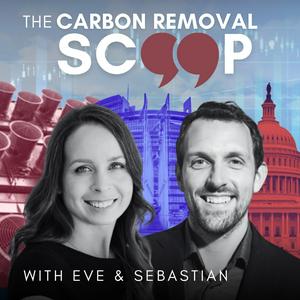
Get the Scoop on the latest carbon removal developments across policy, markets, and tech with Eve Tamme and Sebastian Manhart.Punchy, unfiltered, to the point discussions on all the hottest developments in the sector. Listen in to go several levels deeper and beyond the analysis that you won't find anywhere else. Enjoy. Hosted on Acast. See acast.com/privacy for more information.
Podcast websiteListen to The Carbon Removal Scoop, Crazy Town and many other podcasts from around the world with the radio.net app
Get the free radio.net app
- Stations and podcasts to bookmark
- Stream via Wi-Fi or Bluetooth
- Supports Carplay & Android Auto
- Many other app features
Get the free radio.net app
- Stations and podcasts to bookmark
- Stream via Wi-Fi or Bluetooth
- Supports Carplay & Android Auto
- Many other app features

The Carbon Removal Scoop
Scan code,
download the app,
start listening.
download the app,
start listening.
 Australia