
Listen to this podcast in the app for free: Download for free in the App Store
radio.net
Sleep timer
Save favourites
69 episodes
How AI Helped Prove the Riemann Hypothesis and What Comes Next
26/11/2026 | 1h 56 mins.What does the Riemann Hypothesis actually say, and why does an AI-assisted proof feel like a turning point for mathematics?
Krishna Choudhary and Lester Nare build the story from first principles: prime numbers, Euler's zeta function, complex numbers, analytic continuation and the extraordinary connection between zeta zeros and the "music of the primes."
Then we unpack Levent Alpöge's work with Claude, the race between AI labs, and the harder questions behind the announcement. What is the difference between a formally verified proof and an explanation humans understand? Who gets credit? And what happens to mathematical culture when access to frontier models and compute becomes part of the equation?
VISUAL CREDITS
Some of the mathematical visuals featured in this episode are from 3Blue1Brown. Explore their work: https://www.3blue1brown.com/
CHAPTERS
00:00 The music of primes: a preview
00:31 Hello Internet
02:38 Why this feels like a turning point
06:11 Prime numbers: the atoms of arithmetic
10:35 Euler, the Basel problem and the zeta function
18:16 Gauss and the distribution of primes
23:35 A sieve-based intuition for prime density
32:56 Approximations, errors and the prime-counting staircase
37:59 Riemann brings in complex numbers
44:06 The magic of analytic continuation
48:49 Symmetry, zeros and the critical strip
52:26 What the Riemann Hypothesis actually says
55:21 How zeta zeros connect to prime counting
1:02:28 Waves, overtones and the music of primes
1:09:14 What if a zero were off the critical line?
1:14:11 The history and mythology of Riemann
1:21:28 Levent Alpöge, Claude and the AI math race
1:31:37 The quasi-Riemann milestone
1:33:18 The path to the Riemann announcement
1:36:41 What kind of proof is this?
1:45:06 Machine verification versus human understanding
1:46:41 Compute, credit and access
1:50:30 Mathematics and the end of the hero era
1:54:23 Closing reflections
1:55:53 Outro
RESEARCH & FURTHER READING
Alpöge: Riemann Hypothesis announcement
https://alpo.ge/remark.pdf
Independent verification and exposition updates
https://math.uwaterloo.ca/~mrubinst/alpoge_claude_grh/
Terence Tao: context and commentary
https://terrytao.wordpress.com/2026/11/20/unforced-euler-singularity-unforced-navier-stokes-singularity-and-the-generalized-riemann-hypothesis/
Clay Mathematics Institute: Riemann Hypothesis
https://www.claymath.org/millennium/riemann-hypothesis/
NIST DLMF: Riemann zeta function
https://dlmf.nist.gov/25.2
EDITORIAL NOTES
Recorded November 25, 2026. Independent checks of the Alpöge–Claude Lean formalization are documented in the verification link above. Machine verification, human-readable exposition and Millennium Prize recognition are separate milestones. The closing P vs NP discussion concerns rumors, not a verified result.
On-screen mathematical clarifications:
20:51 There are 25 primes below 100.
28:16 The finite Euler-product argument is heuristic, not a proof of the Prime Number Theorem.
35:21 The graph shows actual prime count divided by the approximation; 1 means agreement.
43:12 / 49:18 The critical line and zero symmetry refer to the input s-plane.
47:38 Zeta(-1) = -1/12 uses analytic continuation; the ordinary series diverges.
50:12 sin(πs/2) has real period 4 and zero spacing 2.
56:15 The displayed equation should be labeled J(x), not π(x); J(x) includes weighted prime powers.
1:37:43 Four colors suffice for a planar map; some maps need fewer.
1:39:05 General quintics have no general solution by radicals; numerical solutions remain possible.
WATCH & LISTEN
Watch and listen: https://ffppod.com
Subscribe: https://www.youtube.com/@FromFirstPrinciplesPod?sub_confirmation=1
Support the show: https://ffppod.com/donate
Contact: https://ffppod.com/contact
Follow @FFPPod on Instagram, TikTok, X and Facebook.
Breaking down science news so it makes sense to curious people everywhere.
#RiemannHypothesis #Mathematics #AIDo Pigeons Navigate with Their Livers? A New Study Sparks Debate
18/11/2026 | 1h 40 mins.Do pigeons navigate with their livers? A surprising study proposes that iron-rich immune cells help homing pigeons sense Earth's magnetic field. But other researchers argue that the mechanism does not hold up. Lester Nare and Krishna Choudhary unpack the experiments, the physics and the scientific debate.
Jump to 36:19 for the pigeon deep dive. We explore macrophages, magnetite, quantum biology, classic magnetic-coil experiments, and why changing an animal's behavior does not automatically prove how its compass works.
First, we examine what the midterms mean for science: how Congress funds research, the difference between authorizing programs and appropriating money, and why committee assignments matter for NASA, the NSF, national labs and university research.
What experiment would convince you that the liver really is part of a pigeon's compass? And what science stories should we cover before the end of the year?
CHAPTERS
00:00 Science funding and a compass in the liver?
00:23 Hello Internet
01:46 What the midterms mean for science
03:05 How midterm elections work
05:01 Why federal research funding matters
07:37 Chris Pappas and research funding
11:02 Melissa Bean and the national labs
15:23 James Talarico and university research
16:34 Scott Wiener and California research
18:13 Andy Barr and Julia Letlow
20:01 What Congress can actually do
27:46 Committees, appropriations and oversight
36:19 Do pigeons navigate with their livers?
43:51 The classic magnetic-coil experiment
52:53 Macrophages, iron and red blood cells
54:30 The radical-pair hypothesis
1:04:23 Could the inner ear detect magnetic fields?
1:07:04 The liver study: testing the hypothesis
1:15:56 Tracking pigeons in sunny and cloudy weather
1:19:17 The rebuttals: evidence vs. mechanism
1:22:39 Thermal noise and the physics problem
1:25:29 Head coils and competing explanations
1:36:29 What comes next?
1:37:23 Wrap-up and your episode suggestions
1:39:44 Outro
RESEARCH & FURTHER READING
Homing pigeon navigation relies on superparamagnetic macrophages under overcast conditions (Science, 2026):
https://doi.org/10.1126/science.ady2486
A macrophage-based magnetoreceptor is not tenable (Winklhofer et al., Science eLetter):
https://zenodo.org/records/21893910
Iron-rich cells in the pigeon beak are macrophages, not magnetosensitive neurons (Nature, 2012):
https://doi.org/10.1038/nature11046
Walcott & Green's magnetic-coil experiment (Science, 1974):
https://pubmed.ncbi.nlm.nih.gov/4815725/
How Senate committee assignments work:
https://www.senate.gov/about/origins-foundations/committee-system/committee-assignments.htm
EDITORIAL NOTES
The liver-based magnetic compass is a contested hypothesis, not an established explanation of pigeon navigation. We distinguish the study's observations from its proposed mechanism and discuss alternative explanations. Political context reflects our November 12, 2026 recording.
On-screen clarifications:
09:20 The roughly $9 billion NASA science figure was a budget request, not an enacted appropriation.
29:59 Committee chairs represent the majority party; ranking members lead the minority on that committee.
32:29 Congress ended Superconducting Super Collider funding in 1993; President Clinton had urged continued funding.
44:04 The historical coil experiment was published in 1974 by Charles Walcott and Robert P. Green.
52:53 Mature mammalian red blood cells lack nuclei; bird red blood cells retain them.
54:30 The 2012 beak study challenged a specific proposed receptor, not every iron-based sensing mechanism.
1:03:39 Bats are not blind.
1:04:23 David Keays is affiliated with LMU Munich and the IMP in Vienna.
WATCH & LISTEN
Watch, listen and explore the research: https://ffppod.com
Subscribe: https://www.youtube.com/@FromFirstPrinciplesPod?sub_confirmation=1
Support the show: https://ffppod.com/donate
Contact: https://ffppod.com/contact
Follow @FFPPod on Instagram, TikTok, X and Facebook.
Breaking down science news so it makes sense to curious people everywhere.
#Pigeons #Magnetoreception #SciencePodcastMapping Humanity From Space: NASA’s Black Marble with Dr. Miguel Román
11/11/2026 | 48 mins.How can a weather satellite see Ramadan, Christmas and a blackout? Dr. Miguel Román joins Krishna Choudhary to explain NASA's Black Marble: nightly maps of the lights on Earth, from a single band on the VIIRS instrument, processed to account for moonlight, airglow, clouds and atmospheric effects.
It began as a calibration job on a brand-new satellite and an "anomaly" that followed the lunar calendar. Román traces how a small NASA team turned it into open data now used for energy access, disaster response and urban growth: Puerto Rico before and after Hurricane Maria, why LEDs can make satellite maps look darker, the 30-meter Black Marble HD, and a John Deere tractor seen from space.
Recorded in Washington, D.C., on September 28, 2026, before the Golden Goose Awards ceremony. Román is Deputy Director for Atmospheres and Data Systems at NASA Goddard Space Flight Center and a member of the Black Marble team, recognized with a 2026 Golden Goose Award. Part of our Golden Goose series.
CHAPTERS
00:00 Cold open: three moments from the interview
00:49 A NASA intern's question and a new weather satellite
02:38 Calibrating the night band: the Moon and the desert
04:09 The anomaly: Ramadan seen from space
05:39 Christmas lights, and home in Puerto Rico
06:48 A new pair of glasses: all of humanity at night
08:32 From calibration to a Black Marble team
11:51 Opening the data to the world
12:58 Keeping the data honest: moonlight and airglow
14:36 One band, and why LEDs look like dimming
15:57 Why the satellite can't see blue: one instrument, many jobs
18:20 Light from every angle, and building heights
22:14 Puerto Rico: the 2016 blackout and Hurricane Maria
27:29 A Golden Goose story: Adjuntas, La Perla and resilience
30:21 From 500 m to 30 m: Black Marble HD
34:55 Ground truth, and a tractor seen from space
36:50 Electrifying Africa: the darkest places on Earth
40:58 What the Golden Goose Award means
44:49 Thank you, and why showing the method matters
47:46 Outro
RESEARCH & FURTHER READING
Holidays in lights: Ramadan and Christmas (2015):
https://doi.org/10.1002/2014EF000285
NASA's Black Marble product suite (2018):
https://doi.org/10.1016/j.rse.2018.03.017
Puerto Rico after Hurricane Maria (2019):
https://doi.org/10.1371/journal.pone.0218883
Uncertainty and viewing angle in night lights (2021):
https://doi.org/10.1016/j.rse.2021.112557
Multiangle night-light composites (2022):
https://doi.org/10.1109/LGRS.2022.3176616
Volatility in human night-time activity, Nature (2026):
https://doi.org/10.1038/s41586-026-10260-w
NASA Black Marble data:
https://www.earthdata.nasa.gov/data/projects/black-marble
Tracking SDG7: The Energy Progress Report 2025:
https://www.worldbank.org/en/topic/energy/publication/tracking-sdg-7-the-energy-progress-report-2025
EDITORIAL NOTES
15:12: White LED streetlights often use blue emitters near 450 nm, outside the VIIRS day-night band's roughly 500-900 nm sensitivity. A change in lighting technology can change what the satellite detects.
22:50: NASA dates the island-wide outage to late on September 21, 2016, following a power-plant fire; nearly 1.5 million customers lost power.
30:21: The 30-meter Black Marble HD maps are downscaled using additional land-surface information, not native 30-meter night-light measurements. Miguel explains this distinction later in the section.
36:50: About 666 million people lacked electricity in 2023, including 565 million in sub-Saharan Africa (Tracking SDG7 2025).
Statements reflect the September 2026 recording.
WATCH & LISTEN
Episode notes and research: https://ffppod.com/episodes/ep67
Golden Goose science rundown (EP59): https://ffppod.com/episodes/ep59
Watch and listen: https://ffppod.com
Subscribe: https://www.youtube.com/@FromFirstPrinciplesPod?sub_confirmation=1
Support the show: https://ffppod.com/donate
Follow @FFPPod on Instagram, TikTok, X and Facebook.
Breaking down science news so it makes sense to curious people everywhere.
#BlackMarble #GoldenGooseAward #SciencePodcastDestroying Tumors With Sound: Histotripsy with Dr. Zhen Xu
05/11/2026 | 1h 4 mins.Can sound destroy a tumor without an incision? Dr. Zhen Xu joins Krishna Choudhary to explain histotripsy: focused ultrasound that creates tiny bubbles to mechanically break apart tissue, without relying on heat.
From a noise complaint in a University of Michigan lab to the Edison system, Xu traces the unexpected discovery, the physics of cavitation, and the decades of research behind noninvasive liver-tumor treatment. We explore surprising immune effects in animal studies, the #HOPE4LIVER clinical trials, and what remains to be tested for other organs.
Recorded in Washington, D.C., on September 28, 2026, before the Golden Goose Awards ceremony. Xu is a histotripsy co-inventor, HistoSonics co-founder, and U-M's Li Ka Shing Professor of Biomedical Engineering. This is the first interview in our Golden Goose series.
CHAPTERS
00:00 The discovery that became histotripsy
00:50 A PhD student and a heart problem
03:42 Heat vs. sound: how histotripsy works
07:06 Gas pockets, and why not the lungs
09:06 The first paper (2004)
09:38 "Don't read any papers": Yellow Pages and pig hearts
12:29 Too loud: rethinking the ultrasound pulse
14:56 "Almost like smoke": the 2002 discovery
18:14 Building the equipment, and the Edison system
22:19 Through the skull, and controlling the bubbles
23:50 The physics: pressure waves, bubbles and cells
28:47 Ten years to understand it
32:42 Surgery keeps getting smaller: from ether to Star Trek
35:58 The surprise: an immune response
38:16 Why liver cancer, and 9 of 11 rats
47:19 #HOPE4LIVER: the clinical trial
49:59 How a treatment works
52:27 Recovery and the 20-mile-run anecdote
56:24 The future: worldwide, kidney, pancreas and brain
1:01:33 The Golden Goose Award and federal funding
1:04:31 Sign-off
1:04:41 Outro
RESEARCH & FURTHER READING
First tissue-erosion paper (2004):
https://doi.org/10.1109/tuffc.2004.1308731
High-speed imaging of bubble clouds (2007):
https://doi.org/10.1109/tuffc.2007.504
Microtripsy and precise cavitation (2014):
https://doi.org/10.1109/tuffc.2014.6722611
Bubble-cloud and cancer-cell interactions (2016):
https://doi.org/10.1016/j.ultrasmedbio.2016.05.018
Histotripsy through the skull (2016):
https://doi.org/10.1109/tuffc.2016.2531504
Abscopal immune responses: animal research (2020):
https://doi.org/10.1136/jitc-2019-000200
Partial treatment of rat liver tumors (2022):
https://doi.org/10.3390/cancers14071612
#HOPE4LIVER pivotal trial (2024):
https://doi.org/10.1148/radiol.233051
#HOPE4LIVER one-year follow-up (2025):
https://doi.org/10.1097/sla.0000000000006720
FDA Edison De Novo review:
https://www.accessdata.fda.gov/cdrh_docs/reviews/DEN220087.pdf
EDITORIAL NOTES
08:40 / 48:12: Edison received FDA De Novo authorization in 2023 for noninvasive liver-tumor destruction. This is not a general cancer-cure approval.
35:58-47:19: The cited immune-response and 9-of-11 results are animal studies, not human cure rates.
49:17: The one-year trial reported 63.4% local control on primary review and 90% on post hoc review. Technical success and durable tumor control are different measures.
53:46: The 20-mile run is an individual anecdote, not recovery advice; Dr. Xu explicitly advises against it.
55:39: The one-year #HOPE4LIVER update was published in 2025.
Clinical and company updates reflect the September 2026 recording. Dr. Xu co-founded HistoSonics.
WATCH & LISTEN
Episode notes and research: https://ffppod.com/episodes/ep66
Golden Goose science rundown (EP59): https://ffppod.com/episodes/ep59
Watch and listen: https://ffppod.com
Subscribe: https://www.youtube.com/@FromFirstPrinciplesPod?sub_confirmation=1
Support the show: https://ffppod.com/donate
Follow @FFPPod on Instagram, TikTok, X and Facebook.
Breaking down science news so it makes sense to curious people everywhere.
#Histotripsy #GoldenGooseAward #SciencePodcastWhat Happens When AI Gets a Lab?
21/10/2026 | 1h 39 mins.What happens when AI moves beyond the chatbot and into the laboratory? From Claude-designed proteins that bind scorpion toxins to robots that assemble optics experiments, we examine what AI can do for science and what still has to be proven in the real world.
Lester Nare and Krishna Choudhary explore the gap between generating a promising design and demonstrating that it works. We also unpack BrainChat, a research platform that lets epilepsy patients interact with their brain-recording data and contribute feedback to seizure detection, and a 15-year study of orangutan mothers facilitating playdates for their young.
Along the way: why binding a toxin is not the same as neutralizing it, how patient feedback can help personalize models, and what cloud laboratories and automated experiments could mean for scientific discovery. Which part of science do you think AI will change most?
CHAPTERS
00:00 Playdates, brain data and robot labs
00:29 Hello Internet and Signal Award celebration
02:40 Orangutan mothers and infant playdates
15:18 What 15 years of orangutan observations reveal
25:16 Testing the playdate hypothesis
39:30 BrainChat and patient-guided learning
44:57 Putting patients in the feedback loop
1:02:00 Personalizing seizure detection
1:05:33 What the BrainChat study does not yet establish
1:07:59 Anthropic scorpion-toxin binders
1:15:49 Why a toxin binder is not an antivenom
1:18:31 Fast AI designs, slower laboratory testing
1:19:40 Connecting AI to the physical lab
1:23:22 Robotic optics and automated laboratories
1:28:04 Cloud laboratories and remote experiments
1:33:00 Closing the loop with Lila Sciences
1:37:48 Wrap-up
RESEARCH & FURTHER READING
Orangutan maternal ranging and infant social play (PNAS):
https://pubmed.ncbi.nlm.nih.gov/42837467/
BrainChat and human-AI collaboration in epilepsy (Nature Medicine):
https://www.nature.com/articles/s41591-026-04680-4
Claude-designed scorpion-toxin binders (Anthropic):
https://www.anthropic.com/research/claude-scorpion-toxin-binder-design
Robotic optics experiments (MIT News):
EDITORIAL NOTES
The orangutan findings are observational evidence of mothers facilitating social play, not direct proof of conscious intent. BrainChat was a small feasibility study, not proof of improved clinical outcomes. The scorpion-toxin work demonstrated binding, not a validated antivenom.
On-screen clarifications:
15:20 The first author is Odd T. Jacobson. Maria A. van Noordwijk is a coauthor.
16:06 About 32,600 observation hours were collected over 15 years. That is roughly 3.7 years of continuous observation.
40:39 In epilepsy, deep brain stimulation reduces seizure frequency. Tremor is the Parkinson's disease example here.
47:07 The study included 13 participants: 11 with scalp EEG and 2 with intracranial EEG.
51:01 and 51:35 GPT-4o-mini ran in Penn's HIPAA-compliant Azure OpenAI cloud environment, not locally.
1:18:03 This was an Anthropic announcement, in collaboration with Citrini Research.
WATCH & LISTEN
Episode notes and research: https://ffppod.com/episodes/ep65
Watch and listen: https://ffppod.com
Apple Podcasts: https://podcasts.apple.com/us/podcast/id1830375095
Subscribe: https://www.youtube.com/@FromFirstPrinciplesPod?sub_confirmation=1
Support the show: https://ffppod.com/donate
Contact: https://ffppod.com/contact
Follow @FFPPod on Instagram, TikTok, X and Facebook.
More Education podcasts
Trending Education podcasts



About From First Principles
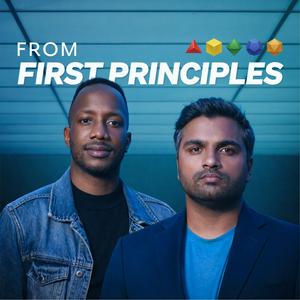
From First Principles is a fast, funny, and rigorous breakdown of the biggest science stories of the week, hosted by Lester Nare and physicist Krishna Choudhary, PhD. We go past headlines into the actual mechanics: what happened, why it matters, and what everyone’s missing.
Expect physics, space, AI, energy, biotech, and the occasional “wait… is that real?” story. If you’re curious, skeptical, and you like learning in public — you’re in the right place.
Podcast websiteListen to From First Principles, The You Project and many other podcasts from around the world with the radio.net app
Get the free radio.net app
- Stations and podcasts to bookmark
- Stream via Wi-Fi or Bluetooth
- Supports Carplay & Android Auto
- Many other app features
 Australia