
Listen to this podcast in the app for free: Download for free in the App Store
radio.net
Sleep timer
Save favourites
80 episodes
Hamilton Mann: Separating the Powers of AI
12/11/2026 | 37 mins.Kevin Werbach speaks with Hamilton Mann, author of the new book Trias Algorithmica: What Code Rules, about the legitimacy of algorithmic power. Mann first distinguishes alignment from what he calls artificial integrity. Alignment means specifying the objectives a system should follow. Integrity means a system can question its own reasoning, both before it acts and after it sees the consequences, and weigh what it should do against what it can do. He then applies Montesquieu's separation of powers to AI, mapping legislative, executive, and judicial functions. Mann notes that corporations already separate powers through their boards, executives, and audit and compliance functions, often without realizing it. He argues that deploying AI changes the "authority stack" as much as the technology stack.
Hamilton Mann is Group Vice President for Global Digital and AI Transformation for Strategy, Marketing and Sales at Thales, working across defense, aerospace, and cyber. He originated the concept of artificial integrity and wrote Artificial Integrity: The Paths to Leading AI Toward a Human-Centered Future (Wiley, 2024) and Trias Algorithmica: What Code Rules (Wiley, 2026). He is Executive Chairman and President of the nonprofit Artificial Integrity Institute, lectures at INSEAD and HEC Paris, and hosts The Hamilton Mann Conversation podcast on digital and AI for good. He was named to the Thinkers50 Radar as one of the 30 most prominent rising business thinkers, and he writes regularly for Forbes.
Transcript
Trias Algorithmica: What Code Rules (Wiley):
Artificial Integrity: The Paths to Leading AI Toward a Human-Centered Future (Wiley):
The Only Code That Matters Is Integrity — Not IntelligenceDave Trier (ModelOp): Turning AI Policies into Workflows
05/11/2026 | 33 mins.Kevin Werbach speaks with Dave Trier, CEO of ModelOp, about what it takes to run AI governance at the scale of a Fortune 500 company. Trier explains how ModelOp turns corporate AI policies, often hundreds of pages, into automated workflows that guide each AI project through the right steps based on its risk tier, whether it faces customers, and where it runs. He explains why traditional governance, risk, and controls (GRC) approaches break down for non-deterministic AI.
Trier points to an important driver of AI governance: rising token spend, which pushes executives to ask whether each AI system is worth what it costs. Agentic AI, he says, is what finally moved enterprises off spreadsheets and SharePoint for these management functions. Governing agents means layered controls, from defining what an agent may do, to limiting its access to tools and data, down to network-level enforcement that blocks unapproved traffic.
Dave Trier is the Chief Executive Officer of ModelOp, which provides AI lifecycle management and governance software for Fortune 500 and Global 2000 enterprises. Before ModelOp, he was VP of Advanced Analytics Services at Teradata and Chief Technology Officer at Powered by Action.
Transcript
Dave Trier, A Visionary in AI Governance, Built for Industrialized AI Delivery
ModelOp, 2026 AI Governance Benchmark ReportLawrence Snapp (TrustScale): Fighting AI Hallucination
29/10/2026 | 32 mins.Kevin Werbach speaks with Lawrence Snapp, CEO of TrustScale, about why hallucinations remain a stubborn problem and what it takes to verify AI outputs against evidence. Snapp, a CPA by training, compares the current moment to Bill Gates's 2002 Trustworthy Computing memo, which helped launch the modern cybersecurity industry. He argues trustworthy AI is on the same curve, only faster. He is skeptical of labs' self-reported hallucination benchmarks, likening them to a race among mules rather than thoroughbreds, and argues that controls shouldn't be built by the companies being checked.
Most questions pose dto AI have no single factual answer, so TrustScale's goal is to give users complete and accurate information, as with the multiple versions of a monthly unemployment figure, rather than declare what's true. That shift, he suggests, means future AI audit reports will look quite different from financial audits built around materiality.
Snapp walks through Argus, TrustScale's verification tool, which checks AI claims against outside evidence and flags them red, yellow, or green. Argus deliberately stops short of rewriting outputs, because Snapp wants users to pause and avoid what he calls cognitive surrender. He frames hallucinations as cybersecurity threat vectors, and warns that small errors early in an agentic chain can cascade into the kind of large failures that dominate discussions of catastrophic risk.
Lawrence Snapp is CEO of TrustScale, an AI training, evaluation, and assurance company that grew out of e2f, a language data firm founded more than two decades ago. He previously served as CEO of Bryj Technologies, a mobile engagement company; President and CEO of Karmia; Chief Digital Officer and SVP of Corporate Development at National CineMedia; Principal Strategist at Microsoft; and President and COO of Clipper Corporation.Joshua Tan (Current AI): The Honda Civic Model of AI
22/10/2026 | 36 mins.Kevin Werbach speaks with Joshua Tan, CTO of Current AI, about the case for public AI: The idea that AI can and should be public infrastructure, like highways, libraries, or the internet. Tan traces his path from theoretical machine learning at Oxford to starting the reseaerch group Metagov. He explains what work on decentralized and collective organizations can offer AI governance. He also discusses autonomous organizations run by AI agents, the safety questions that arise when agents hold bank accounts and manage human employees, and why incentives shift once these experiments reach real scale.
Tan positions public AI as a third way between closed proprietary AI and open-weight models, which are struggling to keep pace with frontier-scale capital costs. Current AI focuses on everything beyond the model, aiming to build a fully open source stack on top of fully open models, a Linux for AI. He describes this as a Honda Civic strategy: not at the frontier, but close enough, cheaper, and reliable. The conversation also covers the role of government funding, a new Swiss cooperative, a community-owned data center effort in Maine, and what it would take for Europe and other middle powers to compete.
Joshua Tan is CTO at Current AI. He also leads product and strategy for the public AI movement and leads Stanford AO, an incubator and lab for autonomous organizations at Stanford OpenLab. He previously co-founded Metagov, a lab for engineering institutions, completed his PhD and postdoc in computer science at Oxford, and held fellowships at Stanford, Princeton, and MIT. He founded and led DAOstar.
Transcript
Joshua Tan research page
Current AI
Not just the model (Artifacts Interview)Brett Levenson (Moonbounce): The Best AI Security System is the One People Will Use
15/10/2026 | 39 mins.Kevin Werbach speaks with Brett Levenson, co-founder and CEO of Moonbounce, about building real-time controls that make AI systems follow the policies companies write for them. Drawing on his years leading integrity work at Meta after the Cambridge Analytica scandal, Levenson explains why content moderation policies there could not be enforced consistently. His team shifted from a decision-first approach to what he calls info-first enforcement, breaking complex policies into simple yes-or-no questions organized in a decision tree. Reviewer consistency jumped dramatically. That atomized approach now underlies Moonbounce, which acts as a semantic firewall that evaluates every input, output, and action an AI takes.
Levenson argues that AI made the application layer non-deterministic, breaking security models that assume predictable software. He describes the challenge of making decisions within a few hundred milliseconds, and a decision memory system that keeps policies adaptive by incorporating customer corrections without hidden state. He also explains Moonbounce's move beyond simple allow-or-block choices to escalating to humans and rewriting outputs. Werbach and Levenson discuss the legal tension around audit trails, payment providers acting as de facto regulators, and why Levenson believes the industry needs measurable, falsifiable standards.
Brett Levenson is co-founder and CEO of Moonbounce. He left Apple in 2019 to lead business integrity at Facebook during the Cambridge Analytica fallout, and later headed Meta's Integrity unit. He co-founded Moonbounce with CTO Ash Bhardwaj, a former Apple engineering leader who built large-scale cloud and AI infrastructure. Moonbounce has raised $12 million in funding co-led by Amplify Partners and StepStone Group.
Transcript
The Facebook insider building content moderation for the AI era
More Business podcasts









Trending Business podcasts


















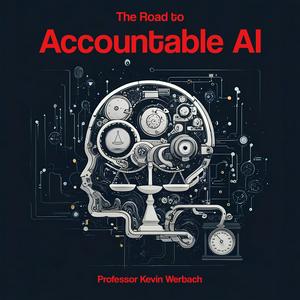
About The Road to Accountable AI
Artificial intelligence is changing business, and the world. How can you navigate through the hype to understand AI's true potential, and the ways it can be implemented effectively, responsibly, and safely? Wharton Professor and Chair of Legal Studies and Business Ethics Kevin Werbach has analyzed emerging technologies for thirty years, and created one of the first business school course on legal and ethical considerations of AI in 2016. He interviews the experts and executives building accountable AI systems in the real world, today.
Podcast websiteListen to The Road to Accountable AI, She's On The Money and many other podcasts from around the world with the radio.net app
Get the free radio.net app
- Stations and podcasts to bookmark
- Stream via Wi-Fi or Bluetooth
- Supports Carplay & Android Auto
- Many other app features

 Australia

