

Listen to this podcast in the app for free: Download for free in the App Store
radio.net
Sleep timer
Save favourites
144 episodes
Episode 144 (Season 5): Neurodivergent Advocacy in Turbulent Times and The Future of Divergent Conversations
06/02/2026 | 44 mins.Living through uncertain times as a neurodivergent person can feel overwhelming, with the world constantly shifting and the weight of global and personal challenges piling up. In moments like these, knowing how to show up, preserve your energy, and find a sense of agency can be both confusing and crucial.
In this episode, Patrick Casale and Dr. Megan Anna Neff, two AuDHD mental health professionals, discuss navigating overwhelm, advocacy, and community involvement during times of societal upheaval. They explore the emotional reality of living through constant crises, the unique stressors for neurodivergent individuals, and how to find paths toward meaningful resistance, connection, and hope—even when capacity feels low. Together, they share candid reflections about balancing activism, self-preservation, content creation, and the ongoing work of staying regulated and connected.
Top 3 reasons to listen to the entire episode:
Gain insight into managing overwhelm and advocacy as a neurodivergent person, including how to channel nervous system arousal into meaningful action, avoid shame-based paralysis, and find sustainable ways of resisting and contributing.
Hear real-life examples and coping strategies for regulating your nervous system amidst media overload, doomscrolling, and the nonstop news cycle, with practical suggestions for curating content and sustaining your energy.
Join a vulnerable, validating conversation about the challenges of showing up authentically as a neurodivergent creator and community member, especially when the world's demands feel impossible—plus, hear updates about the podcast’s evolving approach to sustainability and intentionality.
If you’ve been questioning how to take care of yourself while also caring about the world, or need reminders that community and connection are possible even in hard times, this conversation will offer solidarity, hope, and practical support.
————————————————————————————————
🎙️Listen to more episodes of the Divergent Conversations Podcast
🎙️Spotify
🎙️Apple
🎙️YouTube Music
▶️ YouTube
💬 Join Divergent Conversations Underground
————————————————————————————————
Thanks to Our Sponsors:
✨ Neurodivergent Insights Autistic Burnout Resources
If you’d like to supplement your learning on burnout, you can check out Neurodivergent Insights' resources on burnout. We have articles, an Autistic Burnout course, workbooks, and print books! Visit:Episode 143: FLASHBACK — Chronic Health: All Brains Belong [featuring Dr. Mel Houser]
30/01/2026 | 56 mins.Neuroimmune systems often intertwine with chronic health and neurodivergence, leaving neurodivergent individuals grappling with things like energy management, chronic fatigue, or other long-term health conditions.
In this flashback episode, Patrick Casale and Dr. Megan Anna Neff, two AuDHD mental health professionals, talk with Dr. Mel Houser, an Autistic family physician, about the intricate dynamics of chronic health, energy management, and the often-overlooked connection between neuroimmune systems and neurodivergence.
Top 3 reasons to listen to the entire episode:
Gain a deeper understanding of post-exertional malaise (PEM) and how recognizing one's limits can help in avoiding the debilitating crash that often follows overexertion.
Using real-life experiences, understand the systemic challenges faced by neurodivergent individuals within a traditional healthcare model, highlighting the importance of self-advocacy and community support.
Discover practical strategies and tools from Dr. Houser on identifying environmental triggers and making manageable adjustments to improve health, particularly for autistic and ADHD adults.
As you navigate your own healthcare journey, remember to honor your limits, seek out community, and advocate for the care you deserve.
DISCLAIMER: This episode is not intended as medical advice.
More about Dr. Mel Houser:
Dr. Mel Houser (she/they) is an Autistic family physician with a clinical focus on providing primary care for neurodivergent patients across the lifespan. She is the Founder and Executive Director of All Brains Belong VT, a nonprofit 501(c)(3) organization in Montpelier, Vermont that uses universal design principles to provide neurodiversity-affirming medical care, social connection opportunities for all ages, and neurodiversity-related educational training. At age 37, Dr. Houser was diagnosed as autistic, ADHD, dyspraxic, dyslexic, and dyscalculic. She is also the parent of an autistic 6-year-old, who is her guru of so many keys to the universe.
Website: allbrainsbelong.org
Get Connected: allbrainsbelong.org/get-connected
Clinician Resources: allbrainsbelong.org/clinician-resources
Instagram: @allbrainsbelongvt
Bateman Horne Center Website: batemanhornecenter.org
Check out All Brains Belong’s project: Everything is Connected to Everything: Improving the Healthcare of Autistic & ADHD Adults provides health education resources to support people with this constellation of intertwined conditions, as well as strategies for discussing the project with medical providers. There is also a Clinician Guide with a combination of evidence-based practice and the lived experiences of more than 100 Autistic andEpisode 142: FLASHBACK — AuDHD Burnout City: How Autistic and ADHD Burnout Collide and Compensate
23/01/2026 | 41 mins.ADHD and Autistic burnout can feel like an endless cycle of overwhelm, exhaustion, and frustration—especially for those who live at the intersection of both identities. Many AuDHD individuals struggle to distinguish between ADHD burnout and autistic burnout, but understanding their overlap and unique challenges is crucial to finding compassionate, practical ways to support our mental health.
In this flashback episode, Patrick Casale and Dr. Megan Anna Neff, two AuDHD mental health professionals, discuss the unique qualities of AuDHD burnout. They reflect on their own lived experiences, explore the differences and intersections between ADHD and Autistic burnout, discuss why traditional accommodations often fall short, and share insight on how burnout can lead to shame, depression, and executive function collapse. Through vulnerable storytelling, tangible metaphors, and thoughtful humor, they invite listeners to rethink both self-care and community support in navigating burnout.
Top 3 reasons to listen to the entire episode:
Gain clarity on the nuances between ADHD burnout, Autistic burnout, and their combined impact for AuDHD burnout—plus learn why academic literature often overlooks the lived reality of those with dual neurotypes.
Hear relatable and honest discussions about executive dysfunction, shame spirals, depression risk, and the paradox of needing energy to recover from exhaustion, especially within the context of daily life and work.
Take away practical frameworks and metaphors (including animal critter analogies and the “burnout city”) that offer new language for self-understanding, along with concrete ideas for future-proofing your life against burnout as an AuDHD individual.
If you’re navigating the relentless push-pull of ADHD and Autistic traits, or supporting someone who is, this conversation will help you feel seen and provide tools for building more resilient self-care. Listen now for validation, empathy, and practical insight on surviving—and even softening—the cycle of AuDHD burnout.
Resources
Neurodivergent Insights Autistic Masking Workbook: neurodivergentinsights.com/autistic-masking
Neurodivergent Insights Resource on Autistic Burnout: neurodivergentinsights.com/burnout-resources
The Autistic Burnout Workbook by Dr. Megan Anna Neff: simonandschuster.com/books/The-Autistic-Burnout-Workbook/Megan-Anna-Neff/9781507223062
Check out Neurodivergent Insights’ Library of Boundary Scripts (free resource)
Divergent Conversations Podcast Episodes:
Episode 2: Autistic Burnout (Episode 141: FLASHBACK — OCD: I-CBT and Neurodivergent Approaches to OCD [featuring Brittany Goff]
16/01/2026 | 56 mins.Neurodivergent individuals often find mental health topics like OCD, autism, and ADHD intertwined in ways that can complicate their personal narratives and self-identity.
In this flashback episode, Patrick Casale and Dr. Megan Anna Neff, two AuDHD mental health professionals, discuss with Brittany Goff, an LCSW, the Clinical Director at Zen Psychological Center, and an instructor at the Cognitive Behavioral Institute, about the critical intersections of OCD, autism, and ADHD, their impact on well-being, and the use of I-CBT in the treatment of OCD for neurodivergent individuals.
Top 3 reasons to listen to the entire episode:
Understand how sensory discrepancies can lead to the development of obsessive stories, particularly for autistic individuals, and how inference-based cognitive-behavioral therapy (I-CBT) offers a tailored approach to counteract these doubts.
Discover the unique challenges and strategies for neurodivergent individuals, including those with undiagnosed autism or ADHD, in managing OCD symptoms and building self-trust through a neuro-affirmative lens.
Learn about the intersection of personal experiences, vulnerable self-themes, and logical reasoning with OCD, and how neurodivergent traits such as hyperempathy and rejection sensitivity influence the creation of obsessive narratives.
As you reflect on this episode, consider how your sensory experiences and neurodivergent traits affect your perception of reality and self-trust, as well as how I-CBT can offer tools and strategies to foster a stronger sense of certainty and understanding in your daily life.
DISCLAIMER: I-CBT is currently only evidence-based for OCD.
More about Brittany:
Brittany Goff is a Licensed Clinical Social Worker and the Clinical Director at Zen Psychological Center, a neuroaffirming OCD practice in Maryland. Additionally, she serves as an Instructor at the Cognitive Behavioral Institute, where she provides continuing education in Inference-based Cognitive Behavioral Therapy (I-CBT) for OCD. She authored the first-ever I-CBT workbook and was one of the first adopters of I-CBT in the United States. She is the first clinician to offer I-CBT training specifically tailored for individuals with Autism and ADHD, a neuroaffirming approach to treating OCD.
For those wanting to learn more about Inference-based, Cognitive Behavioral Therapy, visit the following two Facebook groups:
I-CBT & Neurodivergence: For licensed therapists, graduate students, researchers, and occupational therapists to discuss the application of I-CBT. Free Resources will be shared for use with clients.
I-CBT & Neurodivergence Community: A supportive space for all individuals to connect and share experiences. Free resources, games, and worksheets are accessible to those wanting to apply I-CBT with the help of an I-CBT provider.
If you’re interested in deepening your understanding, you can find Brittany Goff’s I-CBT training below, which focuses on resolving the OCD doubt. This fidelity of the model helps you teach your clients how to break free from the obsessive thinking patterns that create convincing narratives of doubt.
Trainings in I-CBT: icbtonlinelearning.com
If you are interested in learning how to adapt I-CBT for neurodivergence join the waitlist here and you will be notified when the training is released:Episode 140: FLASHBACK — Giftedness: Navigating Giftedness in Marginalized Communities [featuring Sheldon Gay]
09/01/2026 | 1h 6 mins.As a gifted, BIPOC individual, it can be uniquely challenging to navigate day-to-day experiences and find meaningful connections, especially prior to the discovery of giftedness.
In this flashback episode, Patrick Casale and Dr. Megan Anna Neff, two AuDHD mental health professionals, along with Sheldon Gay, an entrepreneur, podcast host, and the Vice-Chair of the neurodivergent-affirming non-profit, Umbrella US, discuss his unique perspective on being seen beneath our social masks, the societal impact of intellectual identity as a BIPOC human, and his personal self-discovery journey of giftedness.
Top 3 reasons to listen to the entire episode:
Discover the complexities and societal pressures of intellectual identity and how they shape interactions and self-perception, as well as the struggle to find genuine connections while managing unique cognitive abilities.
Gain a deeper understanding of the unique challenges faced by gifted individuals, especially within marginalized communities. Learn about the burden of expectations, code-switching as a gifted black man, and the journey of self-acceptance.
Learn about Sheldon Gay's perspective on navigating biases in professional spaces, the importance of authenticity, and the impact of self-trust and empathy in both personal and professional settings.
As you explore the depths of your own identity and capabilities, remember the importance of self-trust and creating spaces where you can be your authentic self. Reflect on how societal expectations may have influenced your journey and seek communities that celebrate your unique experiences and perspectives.
More about Sheldon:
Sheldon Gay is an entrepreneur with a background in engineering and creating memorable customer experiences. He's worked in various fields, including healthcare, nonprofits, and education-technology. In addition to growing multiple businesses, he is currently the Vice-Chair of the neurodivergent-affirming non-profit, Umbrella US. As a Black man who discovered later in life that he’s neurodivergent, he sees the world from a different angle than most. Due to his unique perspective, he knows all too well how it feels to be “the only one” in a room. After intense self-discovery work in his early 40s, he found answers to life-long questions and received freedom from burdens he'd carried since he was a child. Now, he uses his experiences to help others embrace their true selves and release their burdens as well. Sheldon helps his audiences become curious about their minds, combat loneliness through community, and experience peace and joy through authenticity.
Website: sheldongayisbugn.com
Social Media: @imustbebugn and @imustbebugn.bsky.social
————————————————————————————————
🎙️Listen to more episodes of the Divergent Conversations Podcast
🎙️Spotify
🎙️Apple
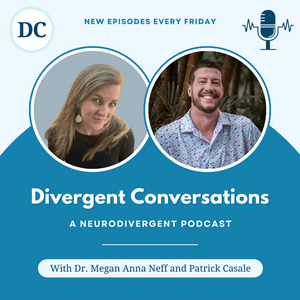
🎙️More Business podcastsTrending Business podcastsAbout Divergent ConversationsDr. Megan Neff and Patrick Casale are two Neurodivergent therapists in a neurotypical world. During this podcast, they’ll talk about their own personal experiences as Autistic-ADHDers. They will reflect on their lived experience as AuDHD mental health professionals, and entrepreneurs, as well as offer clinical guidance, and support. Episodes will be conversational in nature, and they’ll interview other ND Folx to amplify the voices of other neurodivergent advocates and individuals as they share their authentic stories. New episodes will come out weekly, on all major platforms. Megan told Patrick, ”I’ll bring the chaos, You organize it.” This perfectly sums up their working relationship and friendship. Reflections of two neurodivergent clinicians. Raw, Vulnerable, Affirmative As Hell. Follow on instagram.com/divergentconversations Topics include Autism, ADHD, Sleep struggles, Chronic Illness, RSD, Alexithymia, Autistic burnout, Intersectionality, Neuroqueer, Creativity, OCD, Neurodivergence, Affirming Language, Small business ownership, Unpacking Internalized Ableism, and so much more. If you love the podcast, please leave us a 5 star review https://podcasts.apple.com/us/podcast/divergent-conversations/id1662009631 Visit our website for all podcast episodes and sponsorship opportunities divergentpod.com Legal Disclaimer: The content provided in this podcast is for informational purposes only and should not be considered medical advice. Always consult a qualified healthcare provider or medical professional for personalized advice regarding any medical condition or treatment.Podcast websiteListen to Divergent Conversations, money money money and many other podcasts from around the world with the radio.net app
Get the free radio.net app
- Stations and podcasts to bookmark
- Stream via Wi-Fi or Bluetooth
- Supports Carplay & Android Auto
- Many other app features
Get the free radio.net app
- Stations and podcasts to bookmark
- Stream via Wi-Fi or Bluetooth
- Supports Carplay & Android Auto
- Many other app features
Divergent Conversations
Scan code,
download the app,
start listening.CompanyLegalServiceAppsv8.23.5 | © 2007-2026 radio.de GmbHGenerated: 10/15/2026 - 12:26:07 AM








 Australia